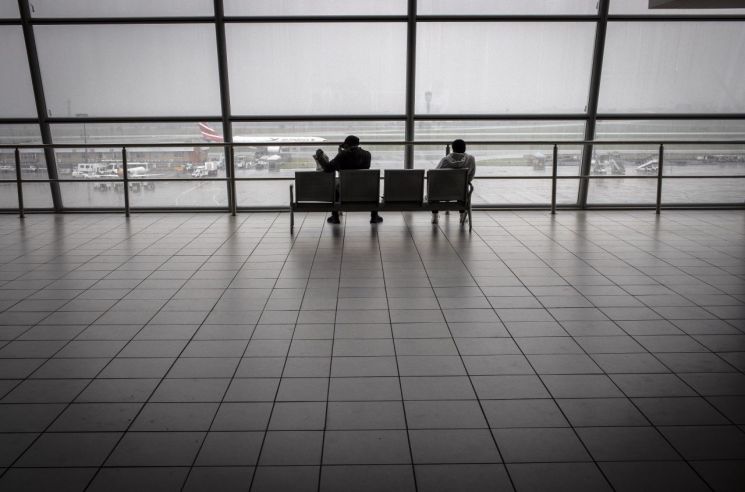
 The scene at Johannesburg Airport after major countries around the world announced a ban on travelers from South Africa due to concerns over the new COVID-19 variant Omicron.
 [Image source=EPA Yonhap News]
[Asia Economy Reporter Hwang Sumi] As countries swiftly impose entry restrictions following the emergence of the new COVID-19 variant 'Omicron,' unprepared travelers find themselves stranded with nowhere to go.
According to foreign media including CNN on the 27th (local time), major governments announced temporary entry bans on travelers from South Africa just hours after the South African government confirmed the new variant.
Starting with the UK and Israel on the 25th, followed by the 27 member countries of the European Union (EU), the United States, and key Asia-Pacific countries, measures such as suspending flights from South Africa and neighboring countries, banning entry except for nationals, and quarantine requirements were announced.
As a result, AFP reported that travelers trying to return to their home countries flocked to Johannesburg International Airport in South Africa.
A British tourist told AFP, "I think I got the last two seats." He said he was watching the sunrise at Table Mountain, a tourist attraction in Cape Town, with his girlfriend when the travel ban was announced.
Another British traveler, holding his passport, complained, "It's ridiculous. New variants will keep emerging," adding, "South Africa discovered it, but it has probably already spread worldwide."
Passengers who had already arrived at airports in Europe and elsewhere were stranded for several hours. Hundreds of passengers on two flights that departed from Cape Town and Johannesburg, South Africa, and landed at Amsterdam Schiphol Airport on the morning of the 26th were held at the airport for hours.
Some of them were sent to hotel quarantine facilities, and Dutch health authorities reported that 61 tested positive for COVID-19. It has not yet been confirmed whether they carry the Omicron variant.
Concerns have also been raised about the travel restrictions imposed by various countries. On the 26th, the International Air Transport Association (IATA) issued a statement from Secretary-General Willie Walsh emphasizing that such measures are not a long-term solution.
IATA stated, "Governments worldwide are responding to the new variant risk with emergency measures, which are causing fear among travelers," adding, "Based on the experience of the past two years, we need to shift to a data-driven approach to find safe alternatives to border closures and quarantines."
Meanwhile, South Korea announced on the 28th that it will ban entry of foreigners arriving from eight Southern African countries to block the domestic inflow of Omicron.
The Central Disease Control Headquarters (CDCH) held an emergency meeting the previous day and designated eight countries including South Africa, Botswana, Zimbabwe, Namibia, Lesotho, Eswatini, Mozambique, and Malawi as enhanced quarantine countries, high-risk countries, and countries excluded from quarantine exemptions starting from 0:00 on the 28th.
The CDCH stated, "We will continuously monitor the Omicron variant, assess the risk and spread, and consider expanding or adjusting the list of enhanced quarantine countries and other target countries."
© The Asia Business Daily(www.asiae.co.kr). All rights reserved.

















