Support for Convenient Communication Use in Public Living Areas Frequently Used by Residents to Bridge the Digital Communication Gap
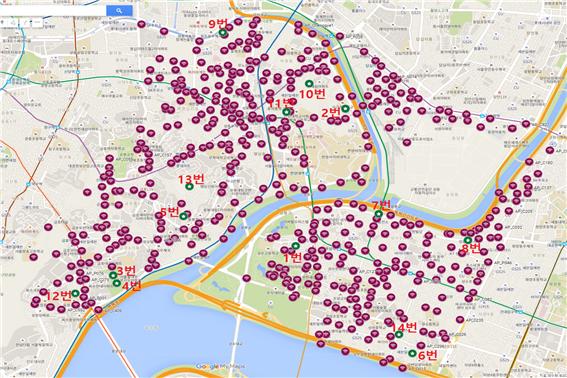 Map of Public Wi-Fi Installations in Seongdong-gu
For detailed locations where public Wi-Fi is available, you can check the map by visiting the Smart Seongdong Map website and clicking on Public Wi-Fi.
※ Starting from December, additional locations include Seoul Forest Cafe Street, the main gate of Sageun Elementary School, two spots in Dalmaji Park, Dokseodang Park, Seongsu Village Square, Sangwon Samgeori, in front of Seongdong Tax Office, in front of Seongdong Disabled Welfare Center, near Majang Station, in front of Majang National Sports Center, school routes around Okjeong Elementary School, Daehyeonsan Park, and near Ttukdo Market, totaling 14 locations.
[Asia Economy Reporter Park Jong-il] Seongdong-gu (District Mayor Jung Won-oh) will expand the installation of public Wi-Fi within the district and provide the service starting in December.
The service target areas include Dalmaji Park, Dokseodang Park, Seoul Forest Cafe Street, and the vicinity of Majang Station. Based on big data analysis of floating populations and other data, the district listed candidate sites where public Wi-Fi is needed and, through on-site inspections, finally selected 14 locations such as parks and traditional markets as public living area data provision zones.
In particular, Dalmaji Neighborhood Park, Daehyeonsan Rose Garden, and Daehyeonsan Children's Forest Experience Center, which residents frequently visit as resting places amid the prolonged COVID-19 pandemic, were selected. Locations for revitalizing the local economy, such as Ttukdo Market and Seoul Forest Cafe Street, were also included.
Last year, the district was selected as a target local government for the Smart Seoul Network (S-Net) construction project, completing the installation of 99.4 km of communication networks and 441 public Wi-Fi units. The district will complete the installation of Wi-Fi signal transmission equipment and communication networks at these locations by the end of this month and has finished operational testing.
A total of 525 public Wi-Fi units will be operated, and the service will be fully provided to facilitate residents' communication usage.
At these locations, users can turn on the Wi-Fi function on smartphones or laptops and select either general access (SEOUL) or secure access (SEOUL_Secure) to use the data. For general access, users click the general access button in the center of the screen to connect, while for secure access, users enter a separate ID and password and configure settings to enable automatic connection anywhere public Wi-Fi is installed in Seongdong-gu.
Previously, the district actively encouraged the provision of free Wi-Fi in publicly announced spaces such as small parks, which are required to be provided when constructing buildings of a certain scale on privately owned land. Since August this year, free public Wi-Fi services have been provided at 42 district-run senior centers.
Starting this month, the district has significantly expanded the ‘Visiting Smart Classroom’ and ‘Smart Volunteer Group’ from earlier in the year to eight members, providing education on digital device usage at community centers and local senior centers, actively working to resolve the digital communication gap so that smart technology is universally applied to everyone.
District Mayor Jung Won-oh said, “Through this project, residents can freely use various internet services provided non-face-to-face without worrying about data charges. We hope this will help with psychological quarantine for residents exhausted by the prolonged COVID-19 pandemic and revitalize the local commercial districts.” He added, “We will continue to strive to enhance communication welfare for residents.”
© The Asia Business Daily(www.asiae.co.kr). All rights reserved.
![Clutching a Stolen Dior Bag, Saying "I Hate Being Poor but Real"... The Grotesque Con of a "Human Knockoff" [Slate]](https://cwcontent.asiae.co.kr/asiaresize/183/2026021902243444107_1771435474.jpg)

















