[Asia Economy Reporter Song Hwajeong] As supply chain disruptions, which have been holding back the global economy, are expected to gradually ease, attention is turning to the variables to watch going forward.
According to Hana Financial Investment on the 27th, supply chain disruptions have been occurring simultaneously across various sectors. There have been disruptions at ports, such as a surge in waiting containers at sea and unloading issues, along with a complex combination of labor shortages and shortages of certain parts.
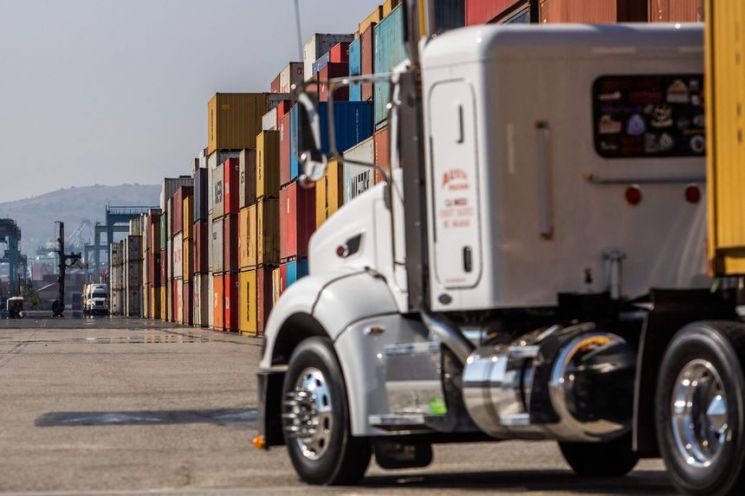
Among these, disruptions at ports are gradually being resolved. The number of ships waiting to dock at the Port of Los Angeles in the U.S. has fallen back to levels seen in early October. Jeon Gyu-yeon, a researcher at Hana Financial Investment, explained, "Since the introduction of container congestion late fees on the 1st of this month, container unloading operations have sped up," adding, "Transportation costs by region are also showing a clear downward trend, indicating that the logistics crisis is past its worst and is improving."
Labor shortages are likely to recover at a slow pace. The ratio of unemployed persons to job openings in the U.S. has sharply dropped from 4.3 times in April 2020 to 0.7 times currently. Researcher Jeon said, "This means that the number of people companies want to hire exceeds the total number of unemployed, indicating how severe the labor shortage is," but added, "However, wages related to transportation are rising, and the number of job openings at U.S. companies has recently hit record highs before declining, so the labor shortage is expected to gradually improve through the first half of next year."
As supply chain disruptions have prolonged, causing shortages of some parts, corporate demand for inventory buildup has increased. Although retail inventories have decreased due to shortages of automotive parts, both U.S. manufacturing and wholesale inventories have risen sharply compared to pre-COVID-19 levels. Researcher Jeon analyzed, "If product manufacturing is not proceeding smoothly due to shortages of some parts, it is time to consider the inventory levels when supply chain disruptions begin to resolve and parts are supplied stably as a counterbalance," adding, "Volatility in future inventory cycles may increase."
With the smooth supply of finished products and increasing inventories, if the phased economic normalization trend continues, household consumption structures are likely to rebalance. Since the COVID-19 crisis, durable goods consumption has increased beyond long-term trends, while service consumption is still recovering below trend lines. It appears that the consumption share concentrated on goods will partially shift toward services. "If the consumption structure normalizes, a reversal of the excessively rising durable goods prices may occur," he said, "Of course, underlying inflationary pressures such as wages and housing costs remain, so inflation risks still lean upward, but heavily concentrated items may stabilize faster than expected, easing price pressures toward mid-next year." Researcher Jeon added, "If prices stabilize, the U.S. Federal Reserve (Fed) is likely to proceed with monetary policy normalization at the pace it has been communicating with the market."
© The Asia Business Daily(www.asiae.co.kr). All rights reserved.
![Clutching a Stolen Dior Bag, Saying "I Hate Being Poor but Real"... The Grotesque Con of a "Human Knockoff" [Slate]](https://cwcontent.asiae.co.kr/asiaresize/183/2026021902243444107_1771435474.jpg)
















