Korea Real Estate Board Sales Supply-Demand Index Announcement
Seoul Shows 'Buy < Sell' Dominance for 2 Consecutive Weeks
Impact of Comprehensive Real Estate Tax Bomb and Strengthened Loan Regulations
Busan, Daegu, Sejong, and Other Regions Also 'Frozen'
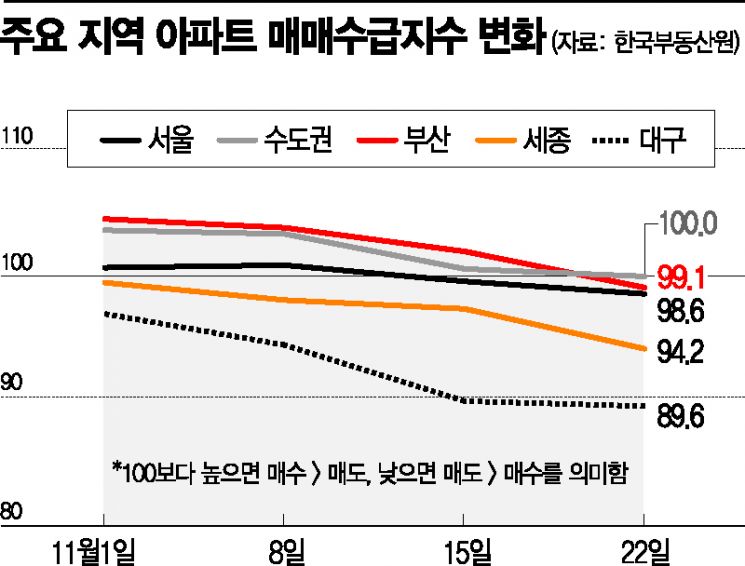
The proportion of people in Seoul who want to ‘sell’ apartments has increased more than those who want to ‘buy’ compared to last week. This trend of weakening demand is becoming more evident not only in Seoul but also in the metropolitan area and some other major cities. Due to the burden of comprehensive real estate taxes, loan regulations, and the widespread perception that housing prices have peaked, market sentiment for buying is expected to remain subdued for the time being.
According to the Korea Real Estate Board on the 26th, the apartment sales supply-demand index in Seoul recorded 98.6 this week, down 1 point from last week’s 99.6. This index is calculated by analyzing data from frontline real estate agencies and online listings, and a value below the baseline of 100 indicates that supply exceeds demand in the housing market.
In Seoul, after the sales supply-demand index fell below 100 for the first time in about seven months last week, the decline deepened again this week, showing a spreading weakening of buying demand. All four regions except the downtown area (Yongsan, Jongno, Jung districts) recorded indices below 100. The southeastern region, including the Gangnam 4 districts, dropped from 99.5 to 98.2, while the northwestern region (Eunpyeong, Seodaemun, Mapo districts) recorded the lowest in Seoul at 97.4.
The situation is similar in the metropolitan area and other regions. Both Incheon and Gyeonggi Province saw weakening demand this week, resulting in the overall metropolitan area index standing at the baseline of 100. Considering that the index had been above 113 during the rapid price surge last summer and remained high throughout this year, this represents a clear downward trend.
Busan’s index fell to 99.1 this week, dropping below 100 for the first time in about seven months since April 19 (99.8). Daegu, where housing prices have turned downward, saw its index plunge to the 80s (89.6) for the first time in about three years since the second week of August 2018 (89.3). Ulsan (98.2) and Sejong (94.2) also saw more sellers than buyers.
Yoon Ji-hae, chief researcher at Real Estate R114, said, "There is resistance to the rapid price increase, but due to loan regulations, even buyers who want to purchase cannot do so. However, since prices are still maintaining an upward trend, it seems premature to talk about a full-scale decline in housing prices."
© The Asia Business Daily(www.asiae.co.kr). All rights reserved.

















