UK Atom Bank and Others Spark Talk on 4-Day Workweek
Growing Adoption in Developed Countries
"Boosting Employee Passion" Focused on Productivity Increase
"Improved Work-Life Balance" vs "Reduced Wages" Divides Worker Opinions
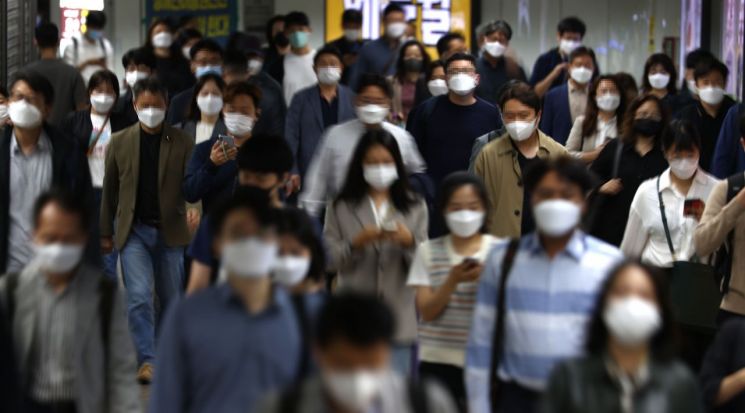 On the morning of the 15th, office workers are walking at Gwanghwamun Station of the Seoul subway. / Photo by Yonhap News
[Asia Economy Reporter Lim Juhyung] "I hear that companies abroad are increasingly adopting a four-day workweek... Is there any news about it in Korea yet?"
As more companies in advanced countries such as Europe and Japan introduce a four-day workweek, domestic office workers are showing growing interest. There is anticipation that an era of working only four days a week may soon arrive. Supporters of the four-day workweek argue that reducing working hours can enhance labor productivity and improve workers' quality of life. However, there are concerns that a hasty implementation of the four-day workweek might instead increase overtime work and reduce wages.
◆Experiments with the 'Four-Day Workweek' Increasing in Europe, Japan, and Others
According to the US 'CNN' broadcast on the 23rd (local time), Atom Bank, an internet-only bank established in the UK, announced at the beginning of this month that it would adopt a four-day workweek. As a result, all 430 employees hired by Atom Bank started working only four days a week from this month.
This reduced the weekly working hours per employee from 37.5 hours to 34 hours. Employees can choose either Monday or Friday as their day off. Despite this, their salaries remain unchanged.
 British internet-only bank 'Atom Bank' promoting the transition to a '4-day workweek' through the company's official Twitter account / Photo by Twitter Capture
Countries embarking on bold experiments with the four-day workweek are increasing, mainly in advanced countries such as Europe and Japan. Earlier this year, the Spanish government selected 200 companies willing to participate and decided to trial the four-day workweek over the next three years.
This policy was promoted after the Spanish government accepted a proposal from the progressive party 'Mas Pais.' The government plans to support any revenue losses incurred from implementing the four-day workweek. To this end, the Spanish government allocated a budget of 50 million euros (approximately 67 billion KRW).
Japan's ruling party, the Liberal Democratic Party (LDP), also officially announced the promotion of a four-day workweek in April. According to the Japanese media 'Asahi Shimbun,' the 'selective four-day workweek' being considered by the LDP would allow employees who wish to work four days a week while reducing their monthly salary by about 10-20%. Through this, the LDP expects to increase workers' leisure time, thereby promoting human interaction and consumption.
◆"Work-Life Balance Fulfilled" vs. "Overtime May Only Increase"
Supporters of the four-day workweek argue that reducing working hours can achieve the 'two birds with one stone' effect of increasing both employee job satisfaction and productivity. Mark Mullen, CEO of Atom Bank, which recently gained attention for switching to a four-day workweek system, issued a statement emphasizing, "The four-day workweek will inspire employees with more opportunities and passion, fulfilling their work/life balance."
He expressed confidence that the experience of a full transition to remote work during the COVID-19 pandemic "shattered many myths about modern work life," and that the four-day workweek would bring much more positive results than the traditional five-day workweek.
In Korea, a small number of companies are also experimenting with the four-day workweek. The most representative company is the education firm 'Eduwill,' which has maintained a 'twice a month four-day workweek' since introducing it in 2019.
 Since 2019, Eduwill, a domestic education company, has been operating with a four-day workweek. Photo by Eduwill Official Website Capture
However, opinions among office workers are divided. Some welcome it, saying it will improve quality of life, while others express concerns about side effects such as wage cuts.
A in their 20s working in the IT industry said, "Having three days off and working four days increases the time available for self-development. Employees' work capabilities will improve. It also benefits the company."
Another office worker, B (29), argued, "There was resistance when the workweek changed from six to five days, but everyone eventually adapted. Transitioning to a four-day workweek should not be a big problem either."
On the other hand, concerns were raised that the four-day workweek might expand 'unofficial work.' C (28), who works at a marketing company, said, "On days off, you might have to send messages or work extra because tasks aren't finished. It's practically unpaid overtime." He added, "There could be a worst-case scenario where wages are cut but working hours don't change."
There were also criticisms that the four-day workweek could cause inconvenience to citizens. D, a worker in their 30s, pointed out, "Hospitals, banks, and government offices will also adopt the four-day workweek. Can people really tolerate all that?"
◆Growing Interest in Politics... Will It Become a Major Agenda?
Meanwhile, the four-day workweek is expected to become a major topic of discussion in politics as well. Some presidential candidates have mentioned the need to introduce the four-day workweek.
The first candidate to raise the issue was Lee Jae-myung, the Democratic Party presidential candidate. In a media interview at the end of last month, Lee said, "The four-day workweek for a humane life and reduced working hours is something that must be done someday," marking the first mention of the four-day workweek.
However, regarding the specific timing of its introduction, he was cautious, saying, "We should strive to introduce it as soon as possible in line with the Fourth Industrial Revolution," but added, "It will be a long-term national task."
 Sim Sang-jung, the Justice Party's presidential candidate, is speaking at the four-day workweek campaign held at Sinchon Star Square in Seoul on the morning of the 23rd. / Photo by Yonhap News
Meanwhile, Sim Sang-jung, the Justice Party presidential candidate, made the four-day workweek her 'number one pledge.' On the 12th, she held a press conference at the Jeon Tae-il Foundation in Jongno-gu, Seoul, emphasizing the need for the four-day workweek by stating, "Excessive working hours and the 'Monday to Sunday' work pattern create a new inequality called time inequality."
She also unveiled a concrete roadmap for policy implementation. A social consensus body involving labor unions, self-employed workers, small and medium enterprises, and large corporations will be formed by 2022. One year later, in 2023, the four-day workweek will be experimentally introduced in some workplaces. Based on the pilot results, a 'new labor law' will be created, aiming to realize a nationwide four-day workweek by 2027.
© The Asia Business Daily(www.asiae.co.kr). All rights reserved.
![Clutching a Stolen Dior Bag, Saying "I Hate Being Poor but Real"... The Grotesque Con of a "Human Knockoff" [Slate]](https://cwcontent.asiae.co.kr/asiaresize/183/2026021902243444107_1771435474.jpg)


















