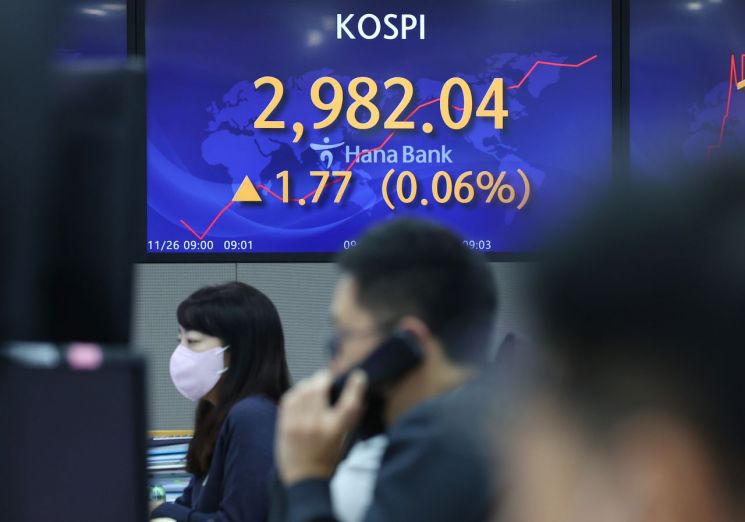
[Asia Economy Reporter Park Jihwan] The KOSPI has fallen to the 2960 level due to four consecutive days of selling by institutional investors.
As of 10:38 a.m. on the 26th, the KOSPI is at 2964.65, down 0.56% (16.55 points) from the previous day. The index opened at 2973.04, down 7.23 points (0.24%). After turning upward shortly after the opening and recovering the 2980 level, the decline widened as time passed.
By investor type, individuals and foreigners bought net amounts of 126.8 billion KRW and 39.1 billion KRW, respectively. On the other hand, institutions sold a net 175.8 billion KRW, continuing their four-day consecutive net selling trend.
Among the top market capitalization stocks, the performance was mixed. Samsung Electronics (-1.22%), SK Hynix (-2.13%), NAVER (-1.13%), Kakao (-0.39%), and LG Chem (-1.22%) declined. Meanwhile, Samsung Biologics (0.94%), Samsung SDI (1.12%), and Celltrion (0.72%) showed gains.
At the same time, the KOSDAQ was trading at 1018.50, up 0.28% (2.84 points) from the previous day. The index opened at 1017.90, up 2.24 points (0.22%).
By investor type, foreigners and institutions were net sellers of 48.4 billion KRW and 3.3 billion KRW, respectively. Individuals were net buyers of 56.3 billion KRW.
Among the top 10 market capitalization stocks, most rose. EcoPro BM (1.55%), Pearl Abyss (5.41%), L&F (2.01%), Kakao Games (4.95%), WeMade (1.66%), and Celltrion Pharm (0.57%) increased. Conversely, SK Materials (-2.86%) and HLB (-2.07%) declined.
The current Korean stock market is evaluated as a scene where risks and opportunities coexist. Kim Younghwan, a researcher at NH Investment & Securities, said, "Currently, the KOSPI is in a state where upward factors such as expectations for easing global supply chain disruptions and anticipated strong sales during the U.S. consumer peak season coexist with downward factors such as concerns over rising U.S. long-term interest rates, year-end selling to avoid capital gains tax by major individual shareholders, and fears of a COVID-19 resurgence."
Jo Byunghyun, a researcher at Yuanta Securities, said, "The domestic stock market is facing a challenging environment to return to a sustained upward trend due to the U.S. Federal Reserve's liquidity normalization moves and lowered expectations for economic indicators and corporate profits. Recently, the global spread of COVID-19 is also appearing as a negative factor for economic activity."
© The Asia Business Daily(www.asiae.co.kr). All rights reserved.
![Clutching a Stolen Dior Bag, Saying "I Hate Being Poor but Real"... The Grotesque Con of a "Human Knockoff" [Slate]](https://cwcontent.asiae.co.kr/asiaresize/183/2026021902243444107_1771435474.jpg)
















