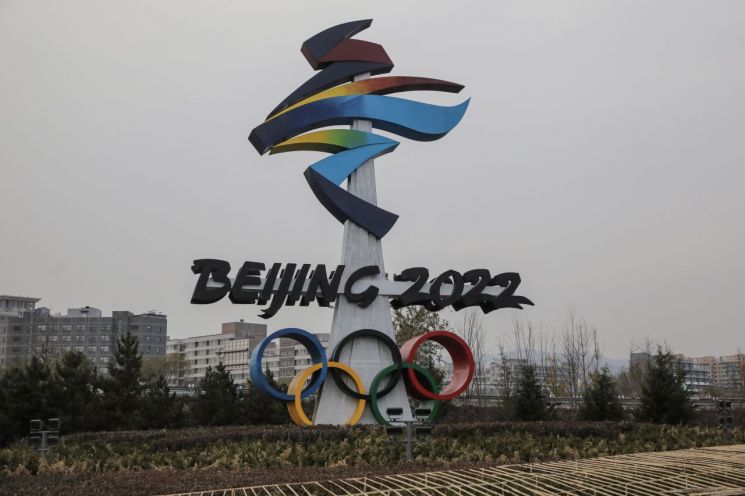
[Asia Economy Reporter Hyunwoo Lee] The Russian Foreign Ministry publicly criticized the U.S. government's move to boycott the Beijing Winter Olympics, urging an end to the politicization of the Olympics. As the boycott movement expands among allies and the European Union (EU) alongside the U.S., concerns are rising that a 'half-Olympics' reminiscent of the Cold War era may reoccur.
On the 25th (local time), Maria Zakharova, spokesperson for the Russian Foreign Ministry, stated at a press briefing, "Russia opposes the politicization of the Olympic Games worldwide," and strongly criticized, "The U.S. attempt to boycott the Beijing Winter Olympics is an abuse of power unrelated to sports." She added, "We believe sports should be beyond politics, and there is no doubt that China will organize the sports events at the highest level in accordance with quarantine measures."
Spokesperson Zakharova also said, "The boycott cases by the U.S., various media, and activists were the same during the 2014 Winter Olympics held in Sochi, Russia," and insisted, "The U.S. must stop politicizing the Beijing Winter Olympics."
Earlier, U.S. President Joe Biden hinted at the possibility of a diplomatic boycott of the Beijing Winter Olympics, raising the prospect of allied countries joining the boycott alongside the U.S. During a meeting with Canadian Prime Minister Justin Trudeau at the White House on the 18th, President Biden responded to reporters' questions about considering a diplomatic boycott of the Beijing Winter Olympics by saying, "It is something we are considering."
According to Forbes magazine, the U.S. is currently persuading four countries? the United Kingdom, Canada, Australia, and New Zealand?to join the diplomatic boycott of the Beijing Olympics. Human rights issues, highlighted by forced labor in China's Xinjiang Uygur Autonomous Region and the recent sexual assault allegations involving Chinese tennis star Peng Shuai, have also increased the likelihood of the European Union (EU) joining the boycott.
© The Asia Business Daily(www.asiae.co.kr). All rights reserved.
![Clutching a Stolen Dior Bag, Saying "I Hate Being Poor but Real"... The Grotesque Con of a "Human Knockoff" [Slate]](https://cwcontent.asiae.co.kr/asiaresize/183/2026021902243444107_1771435474.jpg)
















