Impact on Real Estate Market? Housing Transactions Restricted Due to Increased Financing Difficulties
Counterargument: Market Impact Not Significant Without Sharp Interest Rate Hikes
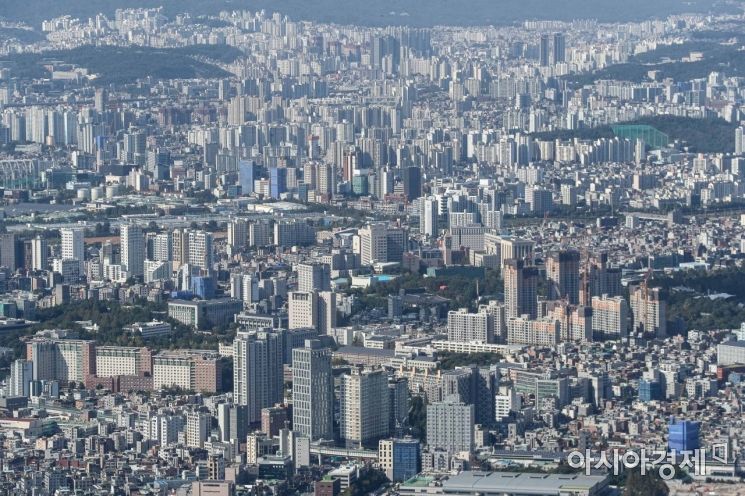
[Asia Economy Reporter Kangwook Cho] As the era of sub-1% interest rates comes to an end, significant aftershocks are expected in the housing market. Since many young buyers relied on loans to purchase homes, the interest burden on them could sharply increase due to the rate hikes. There is also a possibility that the already weakened housing demand will further decline with the Bank of Korea's base rate increases. However, some argue that if the overall low interest rate environment is maintained and steep rate hikes do not occur, the impact on the real estate market will not be substantial.
According to industry sources on the 25th, housing transactions are expected to be somewhat restricted as financing becomes more difficult due to the base rate hikes. As commercial bank loan interest rates rise, the interest burden on those who have borrowed heavily or invested with debt will inevitably increase. For example, if one took out a 300 million KRW loan at an annual interest rate of 3.5%, the annual interest payment would be 10.5 million KRW. However, if the rate rises to just 4.5%, the annual interest increases to 13.5 million KRW. Monthly interest payments jump from 875,000 KRW to 1,125,000 KRW. Especially with the possibility of further hikes, the principal and interest repayment burden could grow, leading to a decrease in real estate investment demand.
On the other hand, contrary to government expectations, some forecasts suggest that the impact of base rate hikes on the real estate market will not be significant. The overall low interest rate trend is still maintained, and except for the foreign exchange crisis and financial crisis periods, there have been no cases of sharp housing price declines during past rate hike periods. In fact, when the Bank of Korea raised the base rate from 1.25% in November 2017 to 1.75% by June 2019 in two steps, the average nationwide apartment sale price rose from 289.07 million KRW to 344.32 million KRW, an increase of 19.11%. Moreover, even if rate hikes act as a pressure factor on demand, supply shortages have a stronger influence on the housing market, so many believe that the upward trend in housing prices will continue next year.
Seojinhyung, President of the Korea Real Estate Society (Professor at Gyeongin Women's University), said, "Since the overall low interest rate environment is still maintained, the impact on the market will not be significant," adding, "The recent slowdown in housing price increases is largely due to fatigue from rapid short-term rises, and given the supply shortage and still abundant liquidity, there is a high possibility that housing prices will continue to be stimulated."
© The Asia Business Daily(www.asiae.co.kr). All rights reserved.

















