Seoul 14.6%↑ Compared to 3 Months Ago
Rapid Increase in No, Do, Gangseo with Mid-Low Priced Properties... Gangnam Area Growth Slower
Listing Increase Concentrated in Outskirts... Concerns Over Greater Price Drop Impact
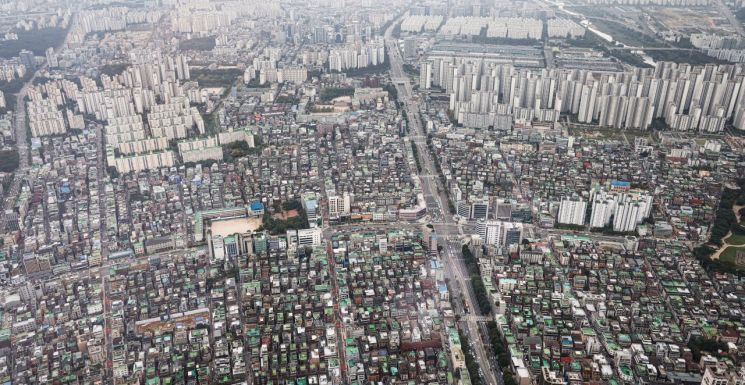
[Asia Economy Reporter Ryu Taemin] As the housing transaction slump shows signs of prolonged duration, apartment listings are rapidly increasing in Seoul's outer areas such as Nowon, Dobong, and Gangbuk districts (No-Do-Gang). Across the metropolitan area, the increase in listings is particularly notable in Incheon, where housing prices rose relatively late. On the other hand, the Gangnam area shows a relatively slower increase in listings, raising concerns that if housing prices begin to fall in earnest, the outer areas with thinner demand will be hit harder.
Listing Increase Rate: Dobong 34% vs Seocho 9%
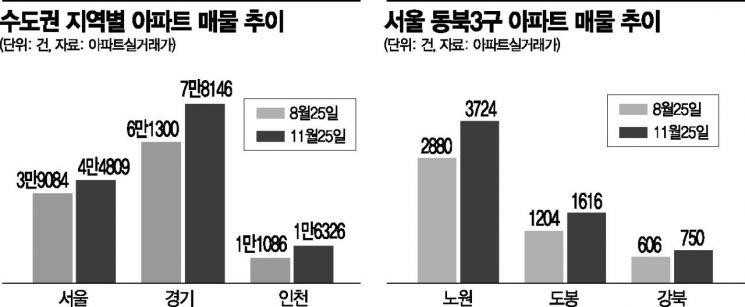
According to real estate big data company Asil on the 25th, the number of apartment listings in Seoul stood at 44,809 as of that day. This is a 14.6% increase compared to 39,084 listings on August 25, three months earlier.
The increase in listings was prominent in the northeastern area of No-Do-Gang. This area, densely populated with mid-to-low priced apartments, had seen concentrated buying demand from younger generations since the beginning of this year. Dobong District saw listings surge from 1,204 to 1,616, a 34.2% increase, the highest rate among Seoul’s 25 autonomous districts. Nowon District ranked third with a 29.3% increase from 2,880 to 3,724 listings, and Gangbuk District also rose 23.7% from 606 to 750 listings, ranking sixth. Additionally, Gangseo (31.9%), Guro (25.3%), and Jungnang (24.4%) were among the top five in listing increase rates, with all six top districts located in outer areas.
In contrast, the increase in listings in the ‘Gangnam 3 districts’ was far below the Seoul average. During this period, Songpa District’s listings rose only 4.2%, from 2,800 to 2,920, making it the second lowest in Seoul after Yeongdeungpo District. Seocho District also recorded a single-digit increase rate of 9.1%, rising from 3,204 to 3,496 listings. Only Gangnam District showed a double-digit increase rate of 10.0%, from 3,617 to 3,981 listings.
The concentration of apartment listing increases in outer areas is also clearly evident across the entire metropolitan area. While Seoul’s listings increased by 14.6%, Gyeonggi Province’s listings rose 27.4%, from 61,300 to 78,146. Incheon, where housing prices rose the latest in the metropolitan area this year, saw listings surge 47.2%, from 11,086 to 16,326. This indicates that downward pressure on housing prices due to transaction contraction is stronger in outer areas.
“Places that rose late fall first”... Growing Anxiety Among Gap Investors
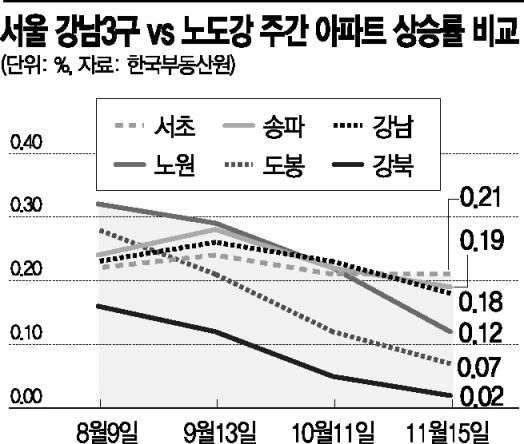
As the withdrawal of buying demand due to regulations such as loans and fatigue from rapid price increases appears first in outer areas, concerns are also raised that the price decline shock will be greater in these areas. In fact, as listings accumulate, the rate of apartment price increases in outer areas is slowing faster than in the Gangnam area. Until the first week of August, Nowon District had the highest weekly apartment price increase rate in Seoul at 0.32%, but it dropped to 0.12% by the second week of this month. Dobong District also slowed from 0.28% to 0.07% during the same period, and Gangbuk District fell to 0.02%, effectively halting its upward trend.
The head of A Real Estate Agency in Junggye-dong, Nowon District, said, “Listings in the area continue to increase, but it is difficult to close even one sales contract per month because there are hardly any buyers.” He added, “Especially in Nowon District, where many reconstruction complexes exist, the dominant view is that the wait-and-see trend will continue until next year’s presidential election.”
Recently, as the burden of comprehensive real estate tax has increased, the concentration of demand for a ‘smart single property’ in the Gangnam area is also said to be deepening the differentiation between Gangnam and outer areas. Song Seunghyun, CEO of City and Economy, explained, “Multi-homeowners, who find it difficult to maintain surplus housing due to tax burdens, are disposing of outer area apartments and moving to the Gangnam area.” He added, “As the tax burden on multi-homeowners is expected to increase further, this phenomenon is likely to spread more.”
© The Asia Business Daily(www.asiae.co.kr). All rights reserved.



















