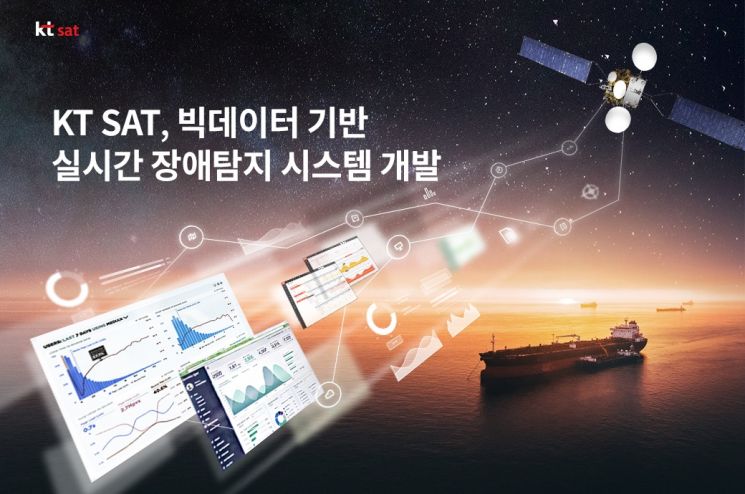
[Asia Economy Reporter Seulgina Cho] KT SAT announced on the 25th that it has independently developed a big data-based real-time interference detection system (ISAS, Interference Detector using Satguard and Splunk) to improve satellite service quality and enhance customer satisfaction.
This system is the result of various research efforts conducted at the Yongin Satellite Center, the hub of satellite control in South Korea, aiming to integrate satellite communication with next-generation technologies. The system tracks sources of interference through big data analysis of satellite signals collected in real time, helping to maintain high-quality communication status.
Previously, operators had to analyze data manually to identify interference sources, causing a time lag before recognizing interference and requiring considerable analysis time. However, after the system's introduction, real-time monitoring of communication status enables automatic detection of customer terminals causing interference, allowing proactive fault response.
Additionally, the system analyzes only meaningful data related to customer communication quality from the vast amount of signal data using big data technology and displays it on a dashboard, enabling operators to systematically manage communication quality. One customer stated, “The introduction of this system has significantly reduced fault handling time,” and added, “Especially when interference occurs, identifying the cause terminal first and handling VoC in real time has increased trust in the service.”
The GNOC center within KT SAT’s Yongin Satellite Center also expects that work efficiency will greatly improve after the system’s introduction, anticipating an annual work reduction of over 500 hours.
KT SAT continues to strive for convergence between satellite communication and 4th industrial technologies. Recently, it has been developing systems that apply big data and machine learning technologies to predict satellite faults in advance.
Song Kyung-min, CEO of KT SAT, stated, “We plan to continuously conduct research on next-generation technologies such as AI and big data in cooperation with the KT Group,” and added, “We will work harder to enhance global customer satisfaction based on more stable and reliable satellite communication services.”
© The Asia Business Daily(www.asiae.co.kr). All rights reserved.
![Clutching a Stolen Dior Bag, Saying "I Hate Being Poor but Real"... The Grotesque Con of a "Human Knockoff" [Slate]](https://cwcontent.asiae.co.kr/asiaresize/183/2026021902243444107_1771435474.jpg)
















