Reduced Disposable Spoons and Cups
Consumers Raise Numerous Complaints
CJ CheilJedang and Food Industry
Invest in Biodegradable Plastics
[Asia Economy Reporter Seungjin Lee] "How can you sell a product without a spoon?" "Sorry. We will include it again."
Food companies are accelerating their efforts to eliminate plastic as part of ESG (Environmental, Social, and Governance) management, but consumer complaints continue, causing confusion such as the reintroduction of disposable items.
Disappearing Plastic, Consumer ‘Complaints’
On the 26th, CJ CheilJedang removed disposable spoons included with their ‘Bibigo Container Porridge’ product to reduce plastic usage, but consumers have been demanding refunds and voicing dissatisfaction. As complaints poured in mainly from convenience stores, CJ CheilJedang is considering reintroducing spoons. A CJ CheilJedang official said, "As part of our eco-friendly management, we removed disposable spoons provided with some ready-to-eat products to reduce disposable items, but consumer complaints were higher than expected. We are considering putting disposable spoons back in convenience stores where most customers buy to eat immediately."
The same applies to plastic cushioning materials included in various gift sets. Due to the plastic waste issue, plastic was replaced with paper and other materials, and no problems occurred during delivery. However, when consumers said, "The packaging looks shabby compared to the price, lowering the gift's value," more companies are reverting to the original packaging.
A food industry insider explained, "Every year, ideas to drastically reduce the volume of gift sets by eliminating plastic trays are proposed, but they are not implemented due to concerns about consumer dissatisfaction, such as the decline in aesthetic function as a gift. Technically, it is already possible to significantly reduce the volume of gift sets."
Since June 6, Starbucks Coffee Korea has been piloting stores without disposable cups in 12 locations in Seoul following the Jeju region, but consumer complaints continue. This is because reusable cups are provided instead of disposable cups previously given to take-out customers. Consumers express inconvenience due to the hassle of returning cups, a 1,000 KRW deposit, and hygiene concerns.
Despite consumer complaints, Starbucks plans to completely stop using disposable cups in stores. Starbucks aims to convert all stores in Seoul to disposable cup-free stores by next year and all stores nationwide by 2025.
Food Industry Investing in Biodegradable Plastics
As consumer complaints increase during the transition to plastic-free policies, the food industry is focusing all efforts on securing biodegradable plastic manufacturing technology. The strategy is to achieve both eco-friendly policies and consumer satisfaction.
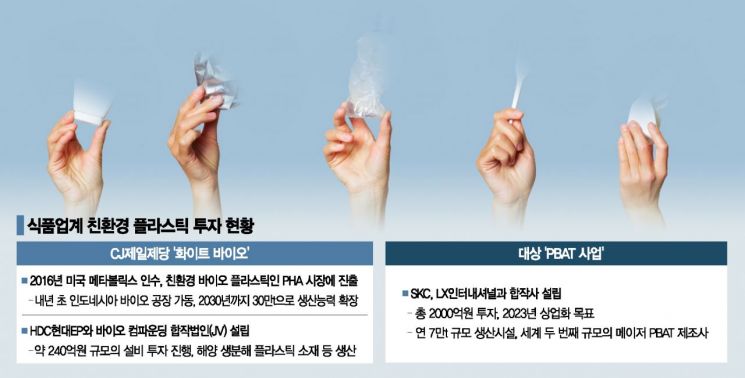
On the 12th, CJ CheilJedang established a bio-compounding joint venture with HDC Hyundai EP, the top polymer compounding company in Korea. The two companies plan to invest about 24 billion KRW in facilities at HDC Hyundai EP’s factory in Jincheon, Chungbuk, aiming to start full production in the third quarter of next year.
The joint venture plans to develop products and technologies applicable to daily life fields such as food packaging and automotive interiors by replacing existing petrochemical raw materials with bio-based materials or mixing biodegradable materials. Daesang is also establishing a joint venture with SKC and LX International for eco-friendly biodegradable new materials.
The joint venture plans to build a production facility with an annual capacity of 70,000 tons in Korea, targeting commercialization in 2023. Once commercialized, the joint venture will become the world’s second-largest major PBAT manufacturer. The three companies will collaborate to expand the base of biodegradable plastics to address plastic issues.
Meanwhile, Greenpeace conducted a survey from August 23 to 29 on 841 households in Korea, recording plastic waste discharged at home by manufacturer, product group, material, and quantity. The results showed that food packaging accounted for 78.1% of total plastic waste discharged. If the food industry’s biodegradable plastic manufacturing technology is activated, it is expected to significantly reduce household plastic waste.
© The Asia Business Daily(www.asiae.co.kr). All rights reserved.

![User Who Sold Erroneously Deposited Bitcoins to Repay Debt and Fund Entertainment... What Did the Supreme Court Decide in 2021? [Legal Issue Check]](https://cwcontent.asiae.co.kr/asiaresize/183/2026020910431234020_1770601391.png)














