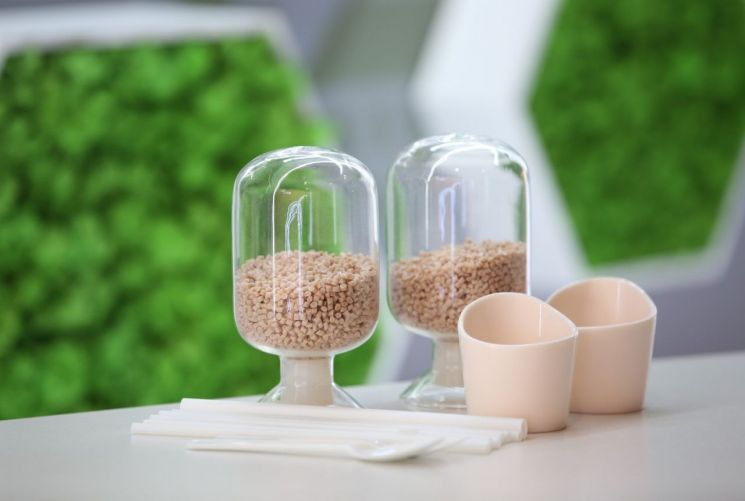
[Asia Economy Reporter Seungjin Lee] Daesang is joining forces with SKC and LX International to fully launch the PBAT business, an eco-friendly new material high-strength biodegradable plastic, and strengthen ESG (Environmental, Social, and Governance) management. Last year, Daesang introduced high-strength PBAT technology from the Korea Research Institute of Chemical Technology and has been preparing for commercialization, including the development of mass production technology.
On the 23rd, Daesang held a board meeting and decided to invest 40 billion KRW in the joint venture established with SKC and LX International. SKC also held a board meeting on the same day and decided to invest 104 billion KRW, including a technology valuation of 79 billion KRW, while LX International held an investment review committee on the 22nd and decided to contribute 36 billion KRW. The joint venture plans to build a production facility in Korea with an annual capacity of 70,000 tons, aiming for commercialization in 2023. Once commercialization begins, the joint venture will become the world's second-largest major PBAT manufacturer.
The three companies are working together to expand the base of biodegradable plastics to address plastic issues. Daesang plans to enhance eco-friendliness by supplying the main raw material for PBAT (BDO) derived from biomass, utilizing its fermentation capabilities and experience. SKC will provide high-strength PBAT mass production technology, operational know-how, and R&D capabilities, while LX International will support product distribution based on its overseas marketing capabilities and global network accumulated over more than 60 years.
The biodegradable materials market is rapidly growing due to strengthened regulations on single-use plastics centered in Europe and the spread of plastic waste issues. According to an analysis by a market research firm, the global PBAT market, which was about 250,000 tons last year, is expected to grow to approximately 500,000 tons by 2025. In particular, the market is rapidly expanding as China and the United States have recently begun to phase out single-use plastics. SKC estimates that the potential demand will exceed 2 million tons.
High-strength PBAT, which improves the drawbacks of conventional PBAT, has great growth potential. Existing PBAT is petroleum-based, competitively priced, and decomposes 100% underground in a short period, but it tears easily, limiting its applications. High-strength PBAT uses nanocellulose extracted from wood as a reinforcing material, giving it strength comparable to general plastics. Therefore, it is highly anticipated by customers as an alternative material for hard-to-decompose single-use plastics such as straws, plastic bags, and agricultural mulching films. Discussions and tests for commercial application are already underway with more than 20 customers.
Currently, SKC, a partner company, is conducting a pilot project for agricultural biodegradable mulching films together with NongHyup Economic Holdings, Hamyang NongHyup, and Ilsin Chemical. SKC supplies the high-strength PBAT material, and Ilsin Chemical manufactures the biodegradable mulching films, which are supplied to the onion cultivation area in Hamyang County. Mulching films that cover the soil for crop cultivation pose a problem as they must be collected and disposed of after use. Using biodegradable mulching films helps solve environmental issues as well as labor problems.
A Daesang official said, "This investment is a collaboration of three companies sharing their strengths and raising the value of coexistence and co-prosperity for a better future." The official added, "Daesang will contribute to carbon neutrality by producing and supplying biomass-derived BDO and will further strengthen eco-friendly ESG management, including greenhouse gas emission management, eco-friendly package development, and reduction of wastewater and waste, which are currently underway."
© The Asia Business Daily(www.asiae.co.kr). All rights reserved.
![Clutching a Stolen Dior Bag, Saying "I Hate Being Poor but Real"... The Grotesque Con of a "Human Knockoff" [Slate]](https://cwcontent.asiae.co.kr/asiaresize/183/2026021902243444107_1771435474.jpg)
















