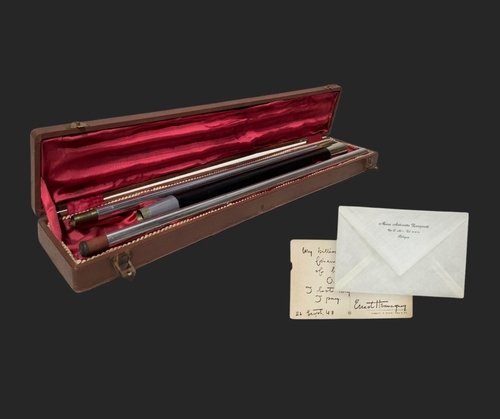
[Asia Economy Reporter Kwon Jae-hee] A billiard cue that literary master Ernest Hemingway (1899?1961) lost in a drinking bet and handed over to someone else is going up for auction 60 years after his death.
According to the British daily The Telegraph on the 23rd (local time), this billiard cue, which was one of Hemingway's cherished possessions, is scheduled to be auctioned next month in Catania, Sicily, Italy.
The starting price for the auction is 35,000 euros (approximately 47 million KRW), and it is organized by a company called 'Arte La Rosa.'
The 'history' of this billiard cue dates back to 1948, just after World War II.
At that time, Hemingway was staying near Lake Maggiore in northern Italy, and one day while drinking at a hotel bar, he happened to meet a local pharmacist named Arnaldo Zamparetti.
Zamparetti, a World War II veteran who had fought in battles such as El Alamein, became friends with Hemingway after they spent the night sharing war stories. Hemingway, a former army sergeant, had devoted much of his life to the subject of war.
Then, while talking about a beauty contest scheduled for the next day, an impromptu bet began. Zamparetti's sister was participating in the beauty contest 'Miss Italia,' and Hemingway predicted that his sister would win the contest.
However, Zamparetti himself believed that a contestant who was a former model, backed by a patron named Jiyun, would win instead of his sister.
They agreed that the loser of the bet would pay for the drinks, and Hemingway put up his folding billiard cue engraved with his name as a bonus stake.
At the Miss Italia contest held the next day, the former model contestant ultimately won, and Hemingway, having lost the bet, handed over the billiard cue.
He also gave a note that read, "To my young friend Arnaldo, and in honor of his beautiful sister Ornella."
Zamparetti treasured Hemingway's billiard cue as a treasure until the day he died, according to his son.
His son said, "The two became friends over accumulating drinks, war stories, and billiard games," adding, "My father was a war veteran, so he must have had many stories to tell."
Hemingway, a journalist-turned-novelist, participated as a Red Cross ambulance driver during World War I and was wounded. He used this experience as the background for his novel A Farewell to Arms (1929). He won the Nobel Prize in Literature for The Old Man and the Sea (1952). In his later years, he suffered injuries from a plane crash and ended his life by suicide in 1961.
© The Asia Business Daily(www.asiae.co.kr). All rights reserved.