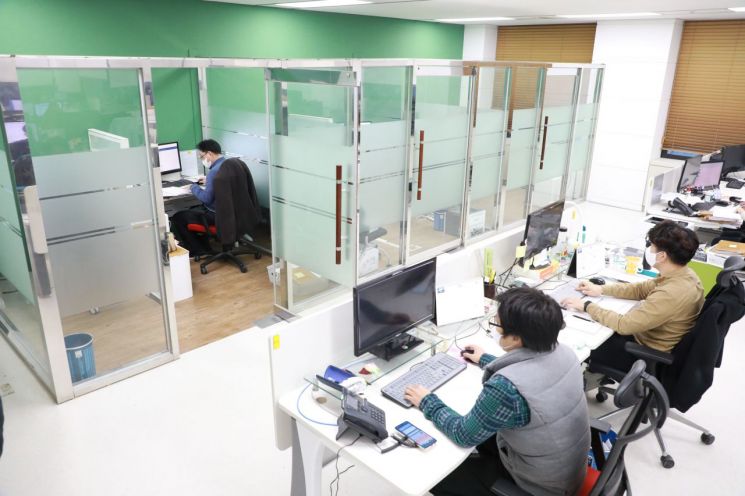
 Interior view of the 'Smart Office' introduced and operated by the Public Procurement Service. The Smart Office is the first to be introduced and operated by the Public Procurement Service among central government agencies. Provided by the Public Procurement Service
[Asia Economy (Daejeon) Reporter Jeong Il-woong] The Public Procurement Service (PPS) is operating a ‘Smart Office.’ The core of the Smart Office is to allow employees to autonomously choose their workspaces. Among central government agencies, PPS is the first to operate a Smart Office.
On the 23rd, PPS announced that it would open a Smart Office as part of the ‘2021 Workspace Innovation Pilot Project’ in collaboration with the Government Complex Management Headquarters.
The Smart Office was established to enhance work efficiency by creating a horizontal office environment featuring flexible seating, paperless operations, and open communication spaces.
The space was set up on one floor of the Government Daejeon Complex (one bureau and four divisions). The Smart Office first introduces a ‘flexible seating system,’ transforming the traditional hierarchical office culture, where seats are assigned by rank, into a horizontal and autonomous organizational culture.
The introduction of the flexible seating system aims to break down barriers between departments and maximize work efficiency by providing various workspace options tailored to individual work characteristics and situations.
Seat reservations can be made through the Ministry of the Interior and Safety’s cloud system (G Drive) and cloud printing services.
In particular, PPS explained that by placing open desks by the windows and installing focused workrooms suitable for online video evaluations, they have enhanced both employees’ autonomy in seat selection and work efficiency.
Additionally, an ‘Open Community’ space was created in the center of the workspace to facilitate free communication and relaxation among employees. Convenience facilities for employees were expanded by providing a caf?-like meeting area and separate phone booths that also serve as single-person rest spaces.
Another notable aspect of the Smart Office is the reduction of relatively large office spaces for bureau and division chiefs, allowing for additional meeting rooms such as video conference rooms and soundproof meeting rooms.
Kim Jeong-woo, Administrator of PPS, said, “Building a Smart Office is not just about improving the office environment but a cultural innovation through changes in space and autonomy of choice.” He added, “PPS will continue to apply space utilization methods that meet the demands of information and communication technology and the MZ generation to the Smart Office.”
© The Asia Business Daily(www.asiae.co.kr). All rights reserved.
![Clutching a Stolen Dior Bag, Saying "I Hate Being Poor but Real"... The Grotesque Con of a "Human Knockoff" [Slate]](https://cwcontent.asiae.co.kr/asiaresize/183/2026021902243444107_1771435474.jpg)
















