"Resolving Customer Inequality Due to Vehicle Delivery Delays... Consumer Spending Expected to Increase"
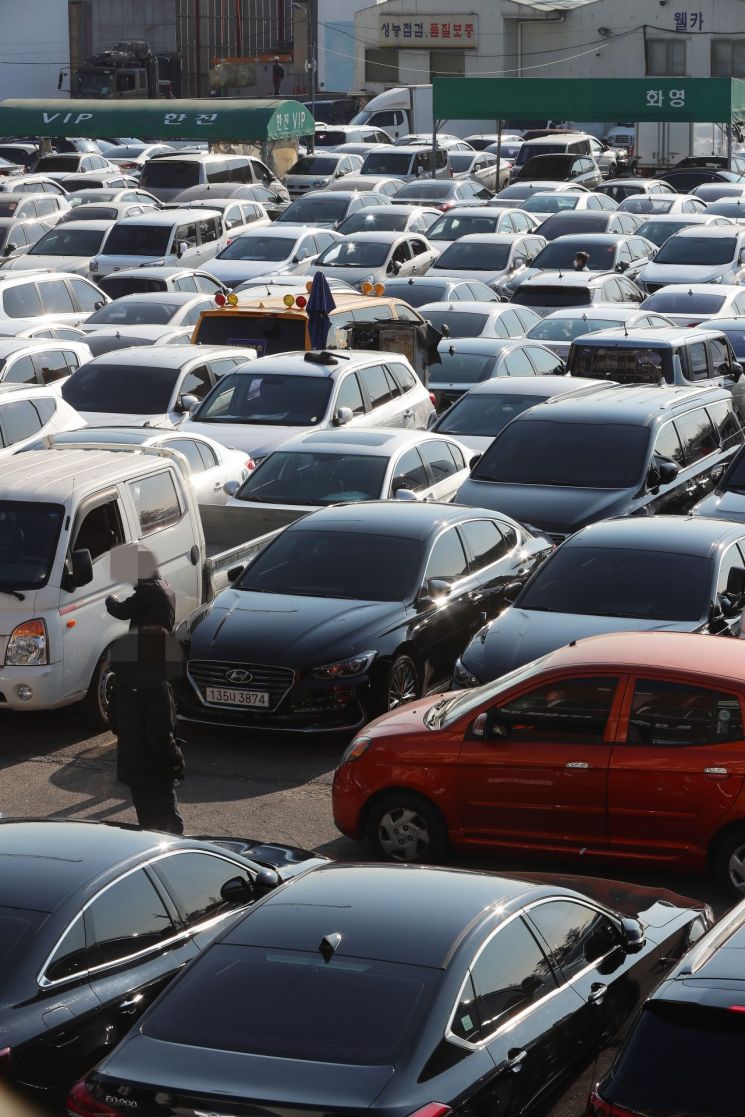
[Asia Economy Reporter Ki-min Lee] The government’s decision on the 23rd to extend the individual consumption tax (ICT) reduction on passenger cars for six months has brought a sigh of relief to the completed car industry. This move is intended to ease concerns about customer inequality caused by vehicle delivery delays and the decline in domestic sales volume.
Hong Nam-ki, Deputy Prime Minister and Minister of Strategy and Finance, held an emergency economic central countermeasure meeting that morning and announced that the ICT reduction on passenger cars would be extended for six months until June next year.
The government is currently reducing the ICT on passenger cars from 5% to 3.5%, a 30% cut, to promote vehicle purchases. Previously, from July 2018 to the end of 2019, the government had reduced the ICT on passenger cars from 5% to 3.5% for one and a half years. Since March last year, when COVID-19 spread, the reduction rate was increased to 70%, applying a 1.5% ICT, but from the second half of the year, the reduction rate was reverted to 30%, maintaining the reduction measure.
The industry is relieved, saying that the government’s recent measure has put out the urgent fire. Kim Ju-hong, Head of Policy Planning at the Korea Automobile Manufacturers Association, said regarding the government’s announcement, “Completed car manufacturers finalize production plans six months to one year in advance, and if consumers’ vehicles contracted within this year were not delivered, they might have canceled,” adding, “It is fortunate that the ICT reduction has been extended.” He added, “Although the semiconductor supply shortage is expected to continue next year, the ICT reduction will also help stimulate domestic demand.”
A representative from a domestic completed car company also said, “Due to COVID-19 and the semiconductor supply shortage, vehicle delivery delays have continued,” and added, “There was concern that customers who contracted early this year might not benefit from the ICT reduction, but with the extension announced, we have breathed a sigh of relief.”
Another official said, “If the ICT reduction ended, there was a possibility that domestic sales would decline due to suddenly higher vehicle prices, so this is fortunate.”
There were also calls to gradually abolish the ICT on passenger cars. The ICT on products such as air conditioners and refrigerators, once considered luxury goods, was abolished in 2015, and maintaining the ICT on passenger cars is seen as inconsistent with this trend.
Professor Kim Pil-su of the Department of Automotive Studies at Daelim University said, “Passenger cars are no longer considered luxury items but everyday necessities,” and pointed out, “Applying a concept that is decades old is problematic, and it is appropriate to extend the ICT reduction and then reform it.”
Head Kim Ju-hong also emphasized, “It will be difficult for the government to suddenly abolish the ICT due to tax revenue issues,” and said, “The ICT should be gradually eased by abolishing it for vehicles below a certain price.”
© The Asia Business Daily(www.asiae.co.kr). All rights reserved.

![Clutching a Stolen Dior Bag, Saying "I Hate Being Poor but Real"... The Grotesque Con of a "Human Knockoff" [Slate]](https://cwcontent.asiae.co.kr/asiaresize/183/2026021902243444107_1771435474.jpg)














