Self-reflection of On-site Police Officers
"Live Ammunition Use Still Restricted" Criticism
Need for Improved Treatment and Specialized Training
Meeting with Commissioner, Ruling Party Lawmaker Says "Police Failure"
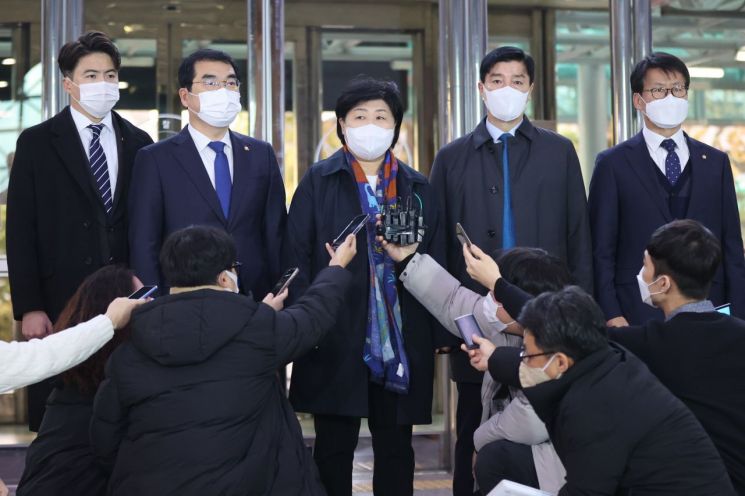 Seo Young-kyo, Chair of the National Assembly's Public Administration and Security Committee (third from the left), along with members of the committee from the Democratic Party of Korea, visited the National Police Agency in Seodaemun-gu, Seoul, on the morning of the 23rd. They are answering questions from the press ahead of a meeting with Kim Chang-ryong, Commissioner of the National Police Agency.
 [Image source=Yonhap News]
As public outrage grows over the police's 'inadequate response,' voices calling for reflection and reform are emerging within the police force.
On the 23rd, according to the police, current and former officers expressed on the police intranet, the anonymous workplace community 'Blind,' and social networking services (SNS) that "we must reflect where reflection is due," while also agreeing that "systems must support resolving the difficulties police officers face in the field and ensure that public authority operates strictly."
Local police officers dispatched to the front lines report that there are still restrictions on using equipment, especially live ammunition, in emergency situations. The 'Standards on Police Use of Physical Force' implemented by the police in 2019 allow the use of firearms when the perpetrator makes a 'lethal attack' with weapons such as knives. However, a lieutenant from a metropolitan district police station said, "The perception that 'guns are for throwing, not shooting' has improved compared to before," but pointed out, "Although regulations allow the use of live ammunition without verbal warning in urgent situations, the judgment of officers on the scene is crucial, yet it can become problematic during subsequent reporting processes." He added, "Some officers hesitate to use equipment because if the perpetrator is injured, it can lead to lawsuits."
There are also opinions that conditions should be created so that field officers can work with a sense of mission. A representative example is the 'Presumption of Line-of-Duty Death or Injury System.' Currently, unless a connection to duty is confirmed, it is difficult for injuries or deaths to be recognized as line-of-duty or duty-related, and even if recognized, it takes a long time. The fact that police officers working for public safety do not receive public security personnel salaries also lowers morale among field officers. The National Police Workplace Council Alliance has announced a related public hearing at the National Assembly on the 25th. Min Gwan-gi, head of the National Police Workplace Council Alliance, emphasized, "Improving treatment and systems to enable police officers to work with a sense of mission will allow for more proactive field activities."
Experts stress the need to reform the training and education system for new police officers to strengthen the response capabilities of field officers. Given the reality that 'civil service exam candidates' are selected through exams, more in-depth and specialized education is necessary. Kwak Dae-kyung, a professor in the Department of Police Administration at Dongguk University, said, "Some apply to the police because it is considered stable, but they may not be sufficiently prepared in terms of service to the public or the spirit of sacrifice," adding, "Education that emphasizes the mindset and attitude required to become a police officer is needed."
Meanwhile, ruling party lawmakers belonging to the National Assembly's Public Administration and Security Committee met with Police Commissioner Kim Chang-ryong on the same day and urged thorough countermeasures. Seo Young-kyo, chair of the committee, told reporters after the meeting, "We received focused reports and discussed two incidents: the Incheon inter-floor noise stabbing and the murder of a woman under protection in Jung-gu, Seoul," adding, "These are unacceptable incidents that must be thoroughly addressed with countermeasures." She continued, "Considering the COVID-19 situation, we also discussed the lack of proper practical training and exercises to protect the public and the need to secure budget for protective equipment."
Oh Young-hwan, a former firefighter and lawmaker, said, "The inter-floor noise incident was a complete escape accident," urging "a corresponding decisive action from the police organization." Lim Ho-seon, a lawmaker with a police background, pointed out, "The inadequate response to the inter-floor noise incident revealed many problems. Necessary education and training were not conducted at all," and criticized, "There is not even a 112 call statistics system or code related to inter-floor noise, which is a failure of the police."
© The Asia Business Daily(www.asiae.co.kr). All rights reserved.

















