Scope of Employment Restriction Includes Establishing Private Academies and Private Tutoring
Violations Punishable by Up to 1 Year Imprisonment or Fines Up to 10 Million Won
Exceptions Maintained for Cases Approved by Teacher Personnel Committee
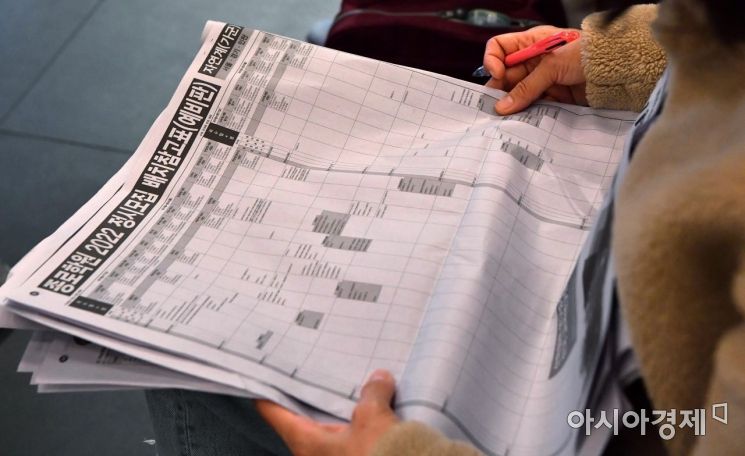 On the 19th, at Konkuk University Alumni Hall in Gwangjin-gu, Seoul, parents are examining the placement chart based on the mock CSAT scoring results at the 2022 College Entrance Regular Admission Strategy Briefing hosted by Jongno Academy. Photo by Hyunmin Kim kimhyun81@
If an admissions officer establishes a private academy or tutoring center, or engages in private tutoring within three years of retirement, they will face imprisonment for up to one year or a fine of up to 10 million won.
On the 23rd, the Ministry of Education reviewed and approved partial amendments to the "Higher Education Act" and the "Act on the Establishment, Operation, and Private Tutoring of Private Academies" at the Cabinet meeting.
Under the current Higher Education Act, to prevent the distortion of fairness in university admissions when admissions officers enter the private education market, they have been restricted from establishing or working at private academies for three years after retirement. However, the existing law lacks penalty provisions for violations, and since providing admissions counseling at private academies or operating tutoring centers and private tutoring were excluded from the restrictions, its effectiveness was low. Accordingly, the Ministry of Education supplemented the existing system by adding grounds for sanctions and expanding the scope of employment restrictions in cases of violation.
The Ministry of Education amended the Higher Education Act to include the establishment of tutoring centers and private tutoring, in addition to private academies, within the scope of employment restrictions for admissions officers for three years after retirement. Violations of these employment restrictions will result in imprisonment for up to one year or a fine of up to 10 million won.
To prevent illegal employment activities by admissions officers in advance, disqualification criteria for registration of establishment and operation of private academies, tutoring centers, and private tutoring have also been specified. This includes violations such as "establishing or working at a private academy, tutoring center, private tutoring, or admissions counseling specialized company within three years of retirement." For private academies that employ admissions officers as instructors or executives within three years of retirement, administrative measures such as suspension of tutoring for up to one year or cancellation of academy registration will be newly introduced.
As before, employment restrictions do not apply if approval is obtained from the Personnel Committee under the Education Officials Act or the Teacher Personnel Committee under the Private School Act. A Ministry of Education official explained, "Since this is a task with strong public duty, the restriction is limited to three years after retirement, and exceptions are allowed if approval is obtained from the Teacher Personnel Committee, which aligns with the principle of proportionality. If an admissions officer conceals their identity and gains employment, the head of the private academy will be able to exercise subrogation rights against that admissions officer."
Deputy Prime Minister and Minister of Education Yoo Eun-hye stated, "Admissions officers are experts responsible for student selection at universities, so securing professional ethics is essential to ensure fairness in university admissions. As social responsibility is emphasized, we will continue efforts to guarantee treatment and improve working conditions so that they can take pride in their work in the field."
© The Asia Business Daily(www.asiae.co.kr). All rights reserved.

![Clutching a Stolen Dior Bag, Saying "I Hate Being Poor but Real"... The Grotesque Con of a "Human Knockoff" [Slate]](https://cwcontent.asiae.co.kr/asiaresize/183/2026021902243444107_1771435474.jpg)














