Transaction Volume of 1,234 Lots in September... 35.7% Decrease from January
Government Announces Semi-Industrial Area Development, Raising Residents' Expectations
As Prices Rise, Homeowners Withdraw Listings... Buyers Face Increased Burden
[Asia Economy Reporter Ryu Taemin] The volume of land transactions in semi-industrial areas, considered prime development sites in Seoul, is sharply declining. This is interpreted as owners withdrawing their listings following two government policy announcements on development plans for semi-industrial areas since last year, coupled with a steep rise in land prices causing buyers to feel the price burden and reduce their purchasing activity.
According to the Korea Real Estate Board's nationwide housing price survey statistics on the 23rd, the volume of land transactions in Seoul's semi-industrial areas in September was 1,234 parcels. This is 687 parcels (35.7%) fewer than the 1,921 parcels traded in January.
The decrease in land transaction volume in these semi-industrial areas is due to growing expectations for development. Since last year, the government has announced development plans for semi-industrial areas, creating a growing atmosphere of redevelopment anticipation within Seoul's semi-industrial zones. The government declared in the May and June measures last year that it would promote a cyclical maintenance project for semi-industrial areas. Earlier this year, as part of the February and April measures, it announced development policies for semi-industrial areas through public housing complex development projects and small-scale redevelopment. The intention is to reorganize idle land in semi-industrial areas, which account for 3.3% of Seoul's total area, into hub industrial facilities combining industry and residential environments.
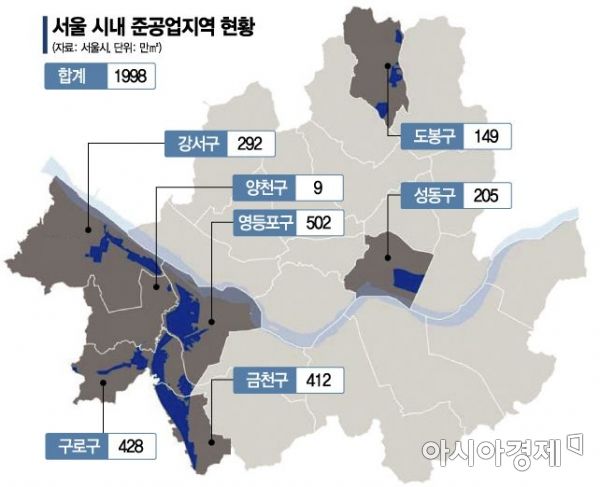
In fact, last month, a district unit plan was finalized to develop 578,619㎡ in Seongsu-dong 2-ga, Seongdong-gu, as a specialized hub for information and communication technology (ICT) and research and development (R&D). This area, designated as a semi-industrial zone, will see high-rise buildings constructed with a maximum floor area ratio of 560% applied.
The sharp rise in land prices in Seoul's semi-industrial areas compared to other zoning districts is also considered a contributing factor. In September, land prices in Seoul's semi-industrial areas rose by 0.497%. This is an increase of 0.125% compared to 0.384% in September of the previous year. Notably, since December last year, the land price increase rate in semi-industrial areas has surpassed that of residential areas.
Yeokyunghee, Senior Researcher at Real Estate 114, explained, "Semi-industrial areas are among the few remaining developable lands in Seoul, so their scarcity is significant. Recently, as expectations for redevelopment have grown, landowners appear to be withdrawing their listings." She added, "Also, as land prices have risen sharply recently, buyers hoping to purchase are feeling the price burden, which is interpreted as another factor reducing purchasing activity."
© The Asia Business Daily(www.asiae.co.kr). All rights reserved.


















