Operational Standards Must Consider School Level, Grade, or Student Development Stage
Responsibilities for Supporting Participation of Students with Disabilities, Recipients, and Single-Parent Families Specified
At Least 30% of Students Must Participate in the Remote Education Management Committee
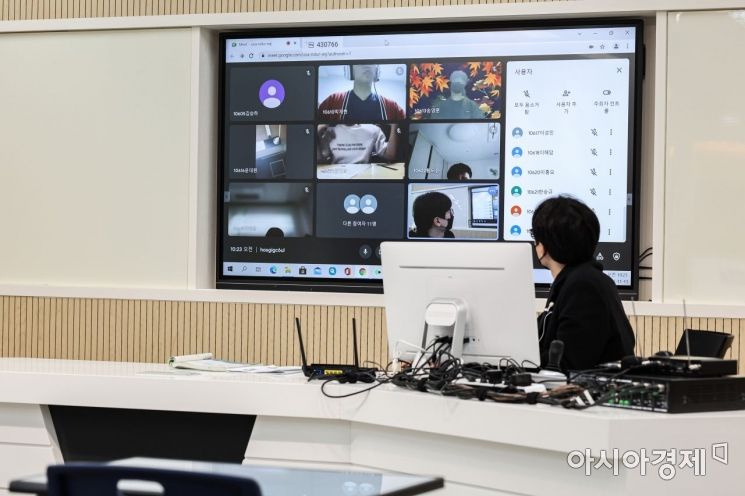 One week before the 2022 College Scholastic Ability Test, remote classes began as a COVID-19 prevention measure at all high schools nationwide. On the 11th, a teacher at Jamsil High School in Seoul is conducting a remote class with students. Photo by Hyunmin Kim kimhyun81@
[Asia Economy Reporter Han Jinju] The Ministry of Education will announce the legislative notice of the 'Enforcement Decree of the Basic Act on the Activation of Digital-Based Remote Education' from the 25th, which supports the participation of vulnerable groups in remote education and requires that operational standards consider school levels and grades.
With the enforcement of the 'Basic Act on the Activation of Digital-Based Remote Education' starting in March next year, this enforcement decree has been prepared to stipulate detailed matters delegated by the law and necessary provisions for the implementation of the law.
The main content clearly defines the scope of vulnerable students whom the state and local governments must support for participation in remote education, including students with disabilities, recipients of basic national livelihood security, single-parent family protection recipients, students in rural schools, and multicultural students, thereby clarifying the responsibility for education.
When the Minister of Education and superintendents set operational standards for remote education, they must include matters related to the organization and operation of remote education, recognition criteria, and student evaluation items, and provide a basis for customized remote education that reflects individual student characteristics by distinguishing according to school level, grade, or developmental stage of the student.
When the Minister of Education, superintendents, and heads of universities build and operate remote education infrastructure, they must consider stability, security, user convenience, suitability to students' developmental stages, and securing content copyrights.
The remote education management committee of universities and others shall be composed of faculty, students, and related experts, with student members comprising at least one-third of the total committee members, and shall deliberate on necessary matters for remote education planning and quality management (cyber universities and Korea National Open University shall serve in an advisory capacity).
The decree also includes provisions on remote education statistical surveys, data processing, and the designation and operation of specialized institutions, including targets, standards, and procedures.
Institutions, organizations, or individuals with opinions on the enforcement decree may submit their statements via the National Participation Legislation Center website, mail, fax, or email by January 4, 2022.
© The Asia Business Daily(www.asiae.co.kr). All rights reserved.