Suncheon-si Raises Need for Detailed Management of Child and Adult Disabilities
Suncheon-si Council's 'Developmental Disability Support Ordinance' Without Budget Increase Is an Illusion
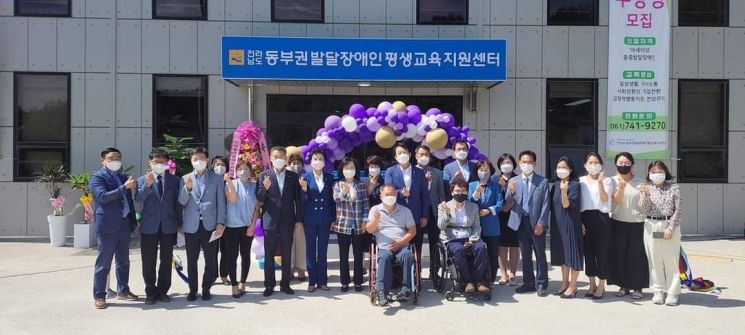 In June, the Jeonnam Eastern Region Lifelong Education Support Center for People with Developmental Disabilities was opened in Yahung-dong, Suncheon City, and a commemorative photo was taken with the attendees.
[Suncheon=Asia Economy Honam Reporting Headquarters, Reporter Lee Hyung-kwon] Population decline is a national issue, and to address this, efforts are being made to encourage youth marriage and childbirth. Local governments, where the theory of local extinction due to population decline has emerged, are busy preparing countermeasures to attract population inflow.
These regions are becoming key topics for next year's local government elections.
Although efforts have been made to solve problems such as youth employment and youth housing, for various reasons, these efforts have not led to marriage and childbirth.
Many of the MZ generation (born between the 1980s and 2000s) think that even if they marry, they do not want to have children.
Unless various issues including childbirth and childcare are resolved, it seems difficult to change the minds of the MZ generation.
First, developmental disabilities are pointed out as a problem related to childbirth.
This is the reason why the argument that the state should take responsibility for developmental disabilities is raised in the context of childbirth.
Developmental disabilities refer collectively to autism spectrum disorder and intellectual disabilities, describing a state where physical and mental development appropriate for age has not been achieved.
As the marriage age is delayed, the number of advanced maternal age pregnancies is increasing, and the burden of giving birth to children with developmental disabilities is also growing.
However, support from the state and local governments for developmental disabilities is grossly insufficient.
Suncheon City in Jeollanam-do has 1,451 people with developmental disabilities (1,279 with intellectual disabilities, 172 with autism), all classified as severe disabilities.
Since all are classified as disabled regardless of whether they are children, adolescents, or adults, there have been calls to subdivide this classification and provide tailored support.
Citizen A said, “There is talk that in the organizational restructuring at the end of the year, the department for elderly disabled people will be divided into departments for the elderly and for disabled people,” adding, “If necessary, establishing a developmental disabilities team or a youth disabilities team could be an option.”
Meanwhile, disability allowances are paid to legally low-income and near-poverty groups under 18 years old, but in practice, there is no support for parents.
Especially, if the parents are public officials or employees with general or higher-level jobs, they do not receive disability allowances, and all care for the disabled falls entirely on the parents.
This has been criticized as unfair compared to elderly welfare.
There is an argument that policies are needed to directly provide disability allowances to parents caring for disabled children, as opposed to the current system where couples who have obtained qualifications such as care workers receive care allowances when caring for their spouses, but parents caring for disabled children receive nothing, which is inequitable.
Compared to the increasingly expanding welfare for the elderly, child disability welfare is relatively neglected.
A Suncheon City official said, “We think it is necessary to pay child care fees and child-rearing allowances directly to families,” adding, “Currently, these go to institutions including daycare centers.”
Even in modern society with advanced science and medicine, developmental disabilities are congenital diseases that cannot be detected through fetal testing, and it is argued that the state must take responsibility to increase the birth rate.
The ‘Developmental Disabilities Support Ordinance,’ which was proposed by Suncheon City Council member Park Gye-su, passed the Suncheon City Council in the last session, but the crucial budget remains the same for the next five years.
Citizen B said, “There is talk that the next year’s budget includes 100 million won per city council member allocated for specific projects,” adding, “While budgets for welfare and others are being cut, what is the meaning of allocating 100 million won for election funds?”
The burden caused by childbirth must be eliminated.
Since giving birth to children with congenital disabilities threatens the peace and daily life of individuals and families, society, the state, and local governments need to be prepared to take responsibility.
© The Asia Business Daily(www.asiae.co.kr). All rights reserved.
![Clutching a Stolen Dior Bag, Saying "I Hate Being Poor but Real"... The Grotesque Con of a "Human Knockoff" [Slate]](https://cwcontent.asiae.co.kr/asiaresize/183/2026021902243444107_1771435474.jpg)
















