[Asia Economy Reporter Jeong Hyunjin] As supply chain disruptions have intensified since COVID-19, it is analyzed that next year will see the full-scale implementation of country-specific self-reliant supply chain strengthening policies and the U.S.-led alliance-centered supply chain restructuring, known as 'Kkanbu-shoring (Friendshoring)'.
On the 23rd, the Korea International Trade Association’s International Trade and Commerce Research Institute identified five key trade issues to watch next year in its report, '2022 Trade Outlook Explained through the Drama "Squid Game"': ▲the full-scale division for supply chain stabilization ▲the prolonged 'managed strategic competition' between the U.S. and China ▲the unilateral extraterritorial application of domestic measures ▲trade disputes in the era of interdependence seen through Australia-China trade conflicts ▲and the intensification of trade conflicts surrounding the European Union (EU)’s Carbon Border Adjustment Mechanism (CBAM).
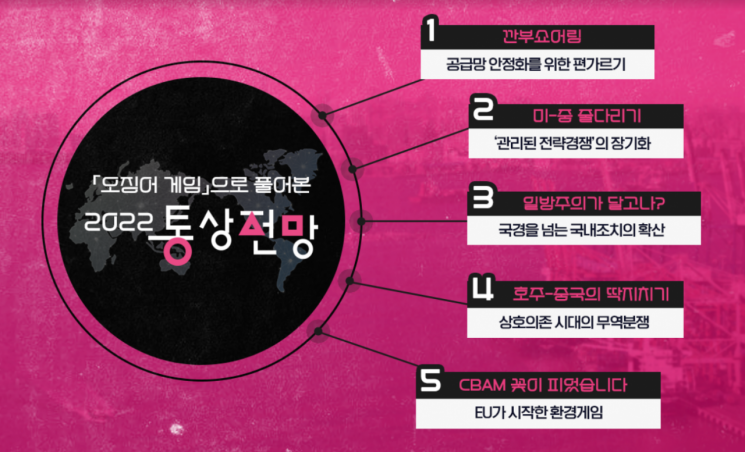
The KITA International Trade and Commerce Research Institute stated, "As COVID-19 outbreaks, ongoing U.S.-China hegemony competition, and simultaneous climate anomalies have caused persistent supply chain disruptions, the perception of global supply chains among countries and companies is changing," adding, "Major countries are strengthening self-reliant supply chains, while the U.S. will promote 'Kkanbu-shoring' to restructure supply chains centered on its allies."
After U.S. President Joe Biden mentioned a new Indo-Pacific economic cooperation framework last month, recently U.S. Secretary of Commerce Gina Raimondo announced that official procedures for this cooperation framework will begin early next year. The core agenda of the new economic cooperation system promoted by the U.S. is expected to focus on establishing standards and related norms for digital new technologies related to technological hegemony and building stable supply chains.
The institute further analyzed, "The U.S. and China will politically utilize but not abuse the trade conflict phase ahead of the U.S. midterm elections and China’s National Congress in the fall next year, engaging in 'managed competition,'" and added, "The U.S.-China competition will be prolonged as a more complex strategic competition involving technology rivalry, restructuring of core material supply chains, mobilization of allies, and expansion of international influence."
As competition between the U.S. and China continues and the multilateral trade system weakens, the unilateral application of a country’s laws and measures to other countries is becoming a global trend. Representative examples include the U.S. Trade Act Section 301, export control regulations, and the EU’s Carbon Border Adjustment Mechanism (CBAM). The unilateral enforcement of domestic laws in new trade areas such as environment and digital sectors is expected to deepen policy conflicts and trade frictions between countries.
The institute also noted, "Since the EU’s CBAM legislative proposal was disclosed, many countries have begun serious discussions on various policies linking environment and trade, such as carbon border adjustment taxes, carbon taxes, climate clubs, carbon emissions trading systems, and global carbon agreements," forecasting, "Debates on pursuing carbon neutrality in ways that do not hinder trade will become even more heated."
Furthermore, analyzing this year’s intensified trade conflicts between Australia and China, the institute predicted, "As the division between the U.S. and China deepens, the frequency and scope of economic sanctions against China may increase," and added, "Just as Australia, which took the lead on the U.S. side, faced Chinese retaliation, if the anti-China coalition expands, trade disputes surrounding China could also increase."
Park Cheon-il, head of the KITA International Trade and Commerce Research Institute, said, "As U.S.-China hegemony competition continues, and policies for national supply chain stabilization and climate change response proliferate, the likelihood of increased trade conflicts and disputes is growing," and added, "KITA will actively support our companies to respond to the complex trade environment where various issues such as international politics, supply chains, environment, and human rights are intertwined."
© The Asia Business Daily(www.asiae.co.kr). All rights reserved.
![Clutching a Stolen Dior Bag, Saying "I Hate Being Poor but Real"... The Grotesque Con of a "Human Knockoff" [Slate]](https://cwcontent.asiae.co.kr/asiaresize/183/2026021902243444107_1771435474.jpg)
















