Seoul Overcrowded and Oversized Schools Allowed 3/4 Attendance
Gyeonggi and Incheon Oversized Schools Permitted Staggered Attendance
Vaccination Pass Replaced with Improved Guidelines for Vaccinated Students' Attendance
Attendance Allowed if Conditions Met Even if Cohabitant Confirmed Positive
Recommended to Prepare Separate Exam Rooms for Isolated Students in University Entrance Exams
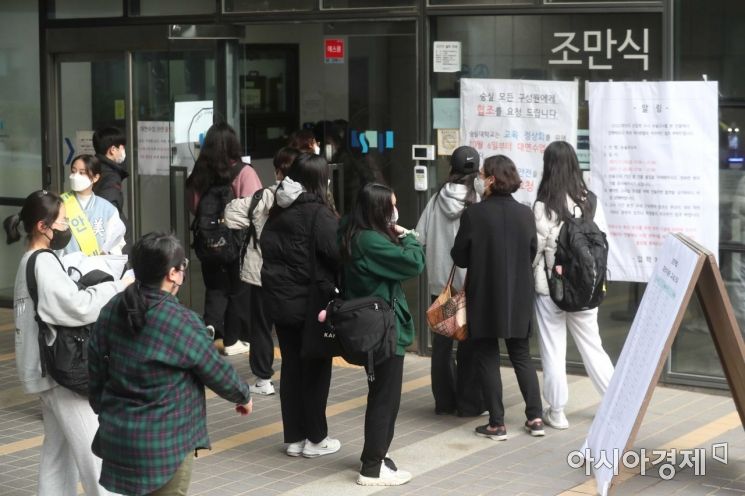 On the 19th, the day after the 2022 College Scholastic Ability Test, the humanities essay exam was held at Soongsil University in Dongjak-gu, Seoul. Examinees are heading to the exam venue. Photo by Mun Ho-nam munonam@
[Asia Economy Reporter Han Jinju] From the 22nd, all kindergartens and elementary, middle, and high school students nationwide will attend school in person. Although the youth 'vaccine pass' has not been introduced yet, students who have been vaccinated can attend school even if their cohabitants are in self-quarantine or have tested positive, provided they meet certain conditions.
On the 18th, the Ministry of Education announced that full in-person attendance will be implemented from the 22nd in line with the phased recovery of daily life. After a three-week preparation period for daily life recovery, full attendance will be enforced even in the metropolitan area, where only two-thirds attendance was allowed until now.
The Ministry of Education stated on the 18th, "It is expected that 97% of all schools in the metropolitan area will implement full in-person attendance," adding, "Home study days will be maintained as before and will be reduced starting from the new school year next year."
Flexible Full Attendance Operation for Overcrowded Schools in the Metropolitan Area
In principle, full attendance is applied in the metropolitan area, but guidelines have been prepared to allow overcrowded and oversized schools to flexibly attend up to two-thirds of students. Oversized schools generally refer to schools with more than 1,000 students, and overcrowded classes are defined as those with 28 or more students per class. The Seoul Metropolitan Office of Education has guided that in oversized and overcrowded schools, more than three-quarters of grades 3 to 6 in elementary schools and more than two-thirds in middle and high schools can attend after gathering opinions from school members.
An official from the Ministry of Education explained, "If it is difficult to gather overall opinions, it is possible to collect opinions through the school operation committee, parent association, or student council," adding, "In case of a sudden emergency situation escalating over the weekend or Monday, it is also possible to impose attendance restrictions or school policies first and then seek consent."
Gyeonggi Province and Incheon have guidelines allowing staggered attendance in oversized and overcrowded schools. In Incheon elementary schools, a combination of in-person and remote classes is possible during the day. Middle and high schools will strengthen monitoring of academic operations for oversized and overcrowded schools. The Gyeonggi Provincial Office of Education has advised schools with oversized student bodies to allow staggered attendance after 9 a.m., depending on school conditions such as quarantine and additional meal times. Additionally, online alternative learning is supported for students whose attendance is suspended due to COVID-19, and middle and high schools are encouraged to provide real-time online and offline classes for both attending and non-attending students.
An official from the Ministry of Education explained, "In Incheon, schools in the district are based on in-person classes, and through staggered attendance, it is possible to combine in-person and remote classes within the school," adding, "The provincial education offices have set policies to discourage all-day remote classes."
Attendance Allowed Even if Cohabitant of Vaccinated Student is in Quarantine
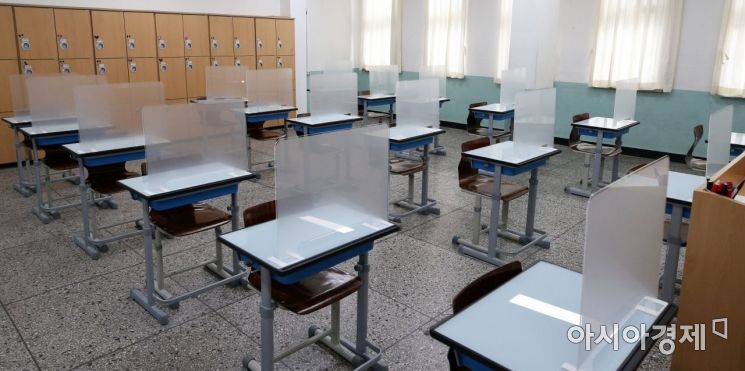 On the 27th, six days before the 2021 College Scholastic Ability Test, partitions were installed in the examination room set up at Jamsil High School in Songpa-gu, Seoul. Photo by Hyunmin Kim kimhyun81@
Although a 'quarantine pass' for youth has not been introduced yet, criteria have been established to allow attendance if a vaccinated student's cohabitant is confirmed positive or in self-quarantine.
The Ministry of Education revised school quarantine guidelines reflecting measures for fully vaccinated individuals, ventilation, and meal-time quarantine rules. If a student's cohabitant is in self-quarantine, attendance is allowed for students who have completed vaccination. Unvaccinated students can attend if they have a negative PCR test result within 48 hours before attending. If a cohabitant is confirmed positive, attendance is allowed if the PCR test is negative, vaccination was completed at the time of close contact, or there are no clinical symptoms. When a confirmed student is released from isolation, they can attend school without a PCR test upon release.
An official from the Ministry of Education explained, "This is not an additional application of a vaccine pass and it is difficult to call it an official vaccine pass," adding, "It reflects the content related to students who have completed vaccination according to the quarantine authorities' management guidelines for fully vaccinated individuals."
The school quarantine guidelines also recommend operating designated seating in school cafeterias. If partitions are installed, students can sit in all seats, but if partitions are not installed, seating must be spaced apart.
The Ministry of Education will provide additional support for school quarantine personnel and budgets in preparation for full attendance in the metropolitan area. A 'School Life Quarantine Guidance and Inspection Team' consisting of 1,361 members will be formed and operated, and joint inspection teams with local governments and education offices will operate until the end of the year.
Strengthened Quarantine for 'Mass Movement of Examinees' During Early Admission Essays and Interviews
As examinee movement intensifies from the 19th for university-specific admissions, the Korea Disease Control and Prevention Agency, local governments, and universities will cooperate to focus on quarantine management.
Universities must prepare disinfection and quarantine supplies according to their own quarantine management plans and set up general test centers, separate test centers (for symptomatic individuals), and isolated test centers according to examinee types. Isolated examinees can take university-specific evaluations such as essays and interviews at separate test centers within the university. The Ministry of Education strongly recommends universities actively utilize non-face-to-face interviews for confirmed examinees.
However, there are cases where confirmed individuals have limited opportunities to take exams, and since the Ministry of Education does not enforce this, examinees must be especially careful about quarantine.
An official from the Ministry of Education said, "We recommend providing exam opportunities to confirmed individuals, but since the operation method of university-specific evaluations is decided by each university, there is no way to seek remedy even if objections are raised," adding, "We will discuss with universities ways to ensure fairness while providing opportunities to take practical exams and essays."
© The Asia Business Daily(www.asiae.co.kr). All rights reserved.
![From Bar Hostess to Organ Seller to High Society... The Grotesque Con of a "Human Counterfeit" [Slate]](https://cwcontent.asiae.co.kr/asiaresize/183/2026021902243444107_1771435474.jpg)

















