[Seoul District News] Forum on Multiculturalism and Environment with Domestic and International Scholars and Experts Presenting and Discussing; Videos to be Released on YouTube Channel 'Yeonggune' from the 29th... Geumcheon-gu Recruiting 100 Winter Break University Student Part-time Workers... Gangdong-gu Installing Landscape Lighting under Gangilgyo Pedestrian Bridge... Guro-gu Hosting '2021 Guro-gu Job Fair'
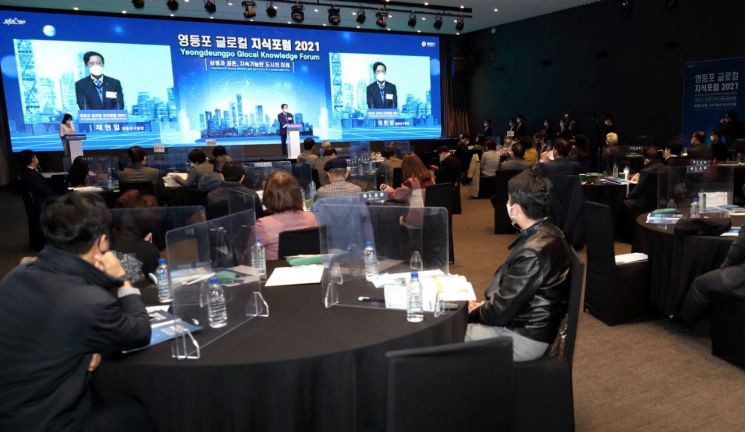
[Asia Economy Reporter Park Jong-il] Yeongdeungpo-gu (District Mayor Chae Hyun-il) held the ‘Yeongdeungpo Glocal Knowledge Forum 2021’ at the Glad Yeouido Hotel over two days on the 16th and 17th.
Hosted by Yeongdeungpo-gu, sponsored by the Seoul Metropolitan Government, and in cooperation with the Migration Policy Institute and the Government Competitiveness Research Center at Seoul National University Graduate School of Public Administration, this knowledge forum was organized to examine the future values that local governments should pursue in the rapidly changing global environment after the COVID-19 pandemic and to explore sustainable development directions.
The forum, themed ‘Coexistence and Symbiosis, the Future of Sustainable Cities,’ featured passionate presentations and panel discussions by domestic and international scholars and experts from various fields on ‘multiculturalism’ and ‘environment,’ which are current issues for the district and common challenges for global cities.
On the first day, the 16th, the forum began with an opening address by Yeongdeungpo-gu Mayor Chae Hyun-il, followed by congratulatory remarks from Go Gi-pan, Chair of the Yeongdeungpo District Council, and Steve Hamilton, Korea Representative of the United Nations International Organization for Migration (IOM). The day included a keynote speech, presentations, and discussions on the ‘Paradigm Shift in Multicultural Urban Policy.’
In his keynote speech, Kang Dong-kwan, President of the Migration Policy Institute, emphasized the importance of immigration policy and social integration starting from intercultural understanding, raising issues related to the growth and development of multicultural cities through the dynamism, innovation, and creativity brought by cultural diversity.
The first session, titled ‘From Multicultural Cities to Intercultural Cities,’ included ▲Jang Han-eop, Professor at Ewha Womans University Graduate School and Director of the Multicultural Research Institute, presenting ‘Understanding Intercultural Cities,’ ▲Ivana d’Alessandro, Head of the Intercultural Cities Team at the Council of Europe, presenting a video on ‘Intercultural City Programs,’ and ▲Bob W. White, Professor at the University of Montreal, Canada, presenting a video on ‘Intercultural City Cases.’ Following these, Professor Kim Seok-ho of Seoul National University chaired a discussion with Chang Hyun-hwa, Head of the Seoul Metropolitan Government’s Foreign Resident Policy Team, and Professor Jang Han-eop on the presentations.
The second session focused on ‘Urban Competitiveness Created by Diversity,’ featuring ▲Han Geon-su, Professor of Cultural Anthropology at Kangwon National University, presenting ‘Cultural Diversity and Sustainable Urban Development,’ ▲Melissa Siegel, Professor of Migration Studies at Maastricht Graduate School of Governance, Netherlands, presenting overseas city cases, and ▲Kim Ji-seon, Senior Research Fellow at the Korea Institute of Criminology and Justice Policy, presenting ‘Safety Status and Measures in Foreign Resident Concentrated Areas.’ Kim Tae-hwan, President of the Korean Immigration Policy Association, chaired an in-depth discussion with the presenters.
The final roundtable provided a platform to hear voices from multicultural local communities. Participants included ▲Kim Yong-seon, Chairman of KC Co-prosperity Planning Group, ▲Kim Hee-jung, Chairperson of the Multicultural Happy Road Center, ▲Go An-su, Representative of Daerim-dong People, ▲Ahn Soon, Principal of Seoul Yeongrim Elementary School, and ▲Park Esther, Teacher at the Da Plus On Center. They shared diverse opinions on harmony between native and foreign residents, educational field stories, and development plans for Daerim-dong.
On the following day, the 17th, the forum continued with presentations, discussions, and a special lecture on the theme ‘Beyond Eco-friendliness: Talking about Essential (必) Environmental Cities.’
The first session, ‘Environmental Cities: Preparing for Future Generations,’ featured ▲Lee Dong-geun, Professor of Landscape Architecture and Regional Systems Engineering at Seoul National University, presenting ‘Solving Urban Problems through Green Infrastructure,’ ▲Kim Jin-hong, Representative of Seoul Stream Network, presenting ‘Directions for Sustainable Urban Stream Restoration,’ and ▲Jeon Seung-jun, CEO of InfoShare, presenting ‘Smart Solutions for Carbon Neutrality.’ Professor Kim Se-yong of Korea University’s Department of Architecture chaired a deep discussion on environmental city creation with the three presenters, along with Jeong Eun-hae, Head of the Climate and Atmospheric Research Division at the National Institute of Environmental Research, and Lee Hong-soo, Smart City Specialist at the Asian Development Bank.
Before the second session, a special lecture was given by Lee Dong-hak, author of the book ‘Garbage Book,’ titled ‘Why is Half of the Earth Covered in Garbage?’ The lecture raised awareness about the seriousness of waste problems and the climate crisis.
The subsequent session included ▲Kim Hyung-joo, Senior Deputy Director at the Green Technology Center, presenting ‘Waste Issues and Green Technology,’ and ▲Yoo Kwang-soon, Head of the Cleaning Department at Yeongdeungpo-gu Office, presenting policy cases on ‘Realizing a Sustainable Resource Circulation City.’ Professor Jeong Tae-yong of Yonsei University Graduate School of International Studies chaired a discussion with Kim Mi-hwa, Chairperson of the Resource Circulation Society Solidarity, Park Ju-young, Associate Professor at Korea University Graduate School of Energy and Environment, and Yoo Yong-ho, Officer of the Resource Circulation Policy Division at the Ministry of Environment, exploring public-private cooperation for a local circular economy.
Over two days, the forum with 28 knowledge leaders became a passionate platform for knowledge exchange, reviewing Yeongdeungpo-gu’s current status and future development directions in the fields of ‘multiculturalism’ and ‘environment.’
Considering the COVID-19 situation, the forum minimized on-site attendance and was conducted in a hybrid format combining online and offline participation. Starting November 29, recorded videos capturing the vivid atmosphere will be released on Yeongdeungpo-gu’s official YouTube channel ‘Yeonggu-ne.’
Yeongdeungpo-gu Mayor Chae Hyun-il said, “I sincerely thank everyone who contributed to the successful hosting of the first knowledge forum. Based on the knowledge and opinions shared with many people, we will do our best to help Yeongdeungpo, one of Seoul’s three major downtowns, rise as a sustainable global future city.”
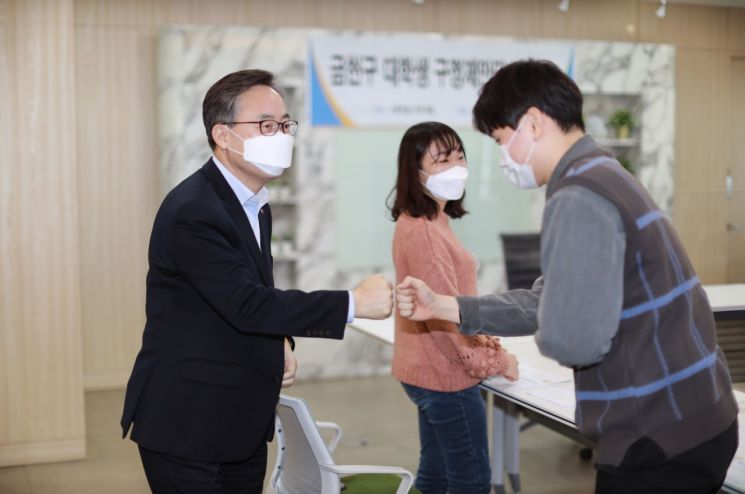
Geumcheon-gu (District Mayor Yoo Sung-hoon) announced that it will recruit participants for the ‘2022 Winter Vacation University Student Part-time Jobs’ from November 22 to December 1, coinciding with the winter break.
This recruitment targets a total of 100 students: 70 through ‘General Selection’ and 30 through ‘Priority Selection.’ Selected university students will be assigned to the district office, community service centers, and affiliated institutions during the work period, assisting with administrative tasks as well as various district government duties.
Notably, this time, workplaces include educational institutions supported by Geumcheon-gu such as the ‘Global Talent Academy’ and ‘Local Children’s Centers,’ providing university students with meaningful opportunities to become mentors to younger members of the community. Additionally, ambitious youths can explore career experiences at places like the ‘Geumcheon Video Media Startup Center’ and the ‘Humanoid Startup Support Center’ to envision their futures.
Applicants must be currently registered residents of Geumcheon-gu as of the application start date (November 22) and be enrolled or on leave at a college or higher institution. However, those who have worked within the past two years, prospective university students, expected graduates, graduate students, students of broadcasting and communication universities, cyber universities, academic credit bank system students, and foreign university students are excluded.
The ‘Priority Selection’ category includes individuals designated as recipients of basic livelihood security or near-poverty class or their children, multicultural families, households with three or more children, persons with disabilities (registered under the Disability Welfare Act), North Korean defectors, national veterans, and those with over 100 hours of volunteer work after university admission.
The work period is from January 3 to 28, 2022. Working hours are five hours per day, five days a week, scheduled according to the department’s timetable between 9:00 a.m. and 6:30 p.m. The daily wage, including lunch allowance, is 53,830 KRW, amounting to approximately 1.28 million KRW if all workdays are completed.
University students wishing to participate can apply through the ‘Integrated Reservation’ service on the Geumcheon-gu Office website.
Geumcheon-gu will select the final candidates through a public computerized lottery on December 6 and announce the results on the district website and via individual notifications.
Geumcheon-gu Mayor Yoo Sung-hoon said, “The annual university student part-time job program offers young people about to enter society a valuable chance to experience career paths and learn more about their local community. We hope many will show interest and participate in this winter vacation university student part-time job recruitment.”
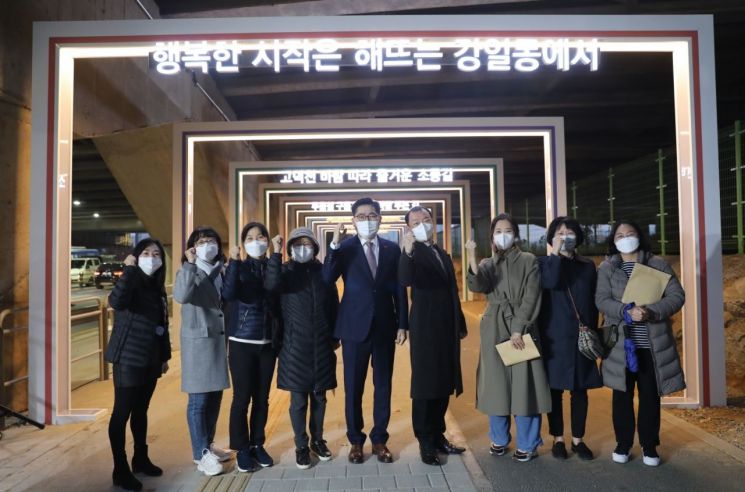
Gangdong-gu (District Mayor Lee Jung-hoon) has newly renovated the pedestrian walkway under Gangil Bridge by installing landscape lighting to improve a safe walking environment.
The pedestrian walkway under Gangil Bridge connects Gangil-dong and Godeok-dong and links to Godeok Stream, making it a frequently used route for Gangil-dong residents. However, due to the dark and gloomy environment under the bridge pillars where the Outer Ring Expressway and Subway Line 5 pass, there have been ongoing complaints about pedestrian safety.
In response, the district completed a distinctive landscape improvement project using landscape lighting under Gangil Bridge in October to create a safe and pleasant street environment as a living space for residents.
The installed landscape lighting consists of a total of 11 poles that serve both as security lights and landscape lights. At the top, hopeful messages reflecting the wishes of Gangil-dong residents, such as ‘A Happy Start in Sunrise Gangil-dong,’ are displayed through lighting.
Gangdong-gu Mayor Lee Jung-hoon said, “Underpasses and underground pedestrian crossings tend to be dark and gloomy, making them prone to crime and causing residents to feel uneasy while walking. We plan to continuously identify and select such areas and promote unique landscape improvement projects exclusive to Gangdong-gu.”
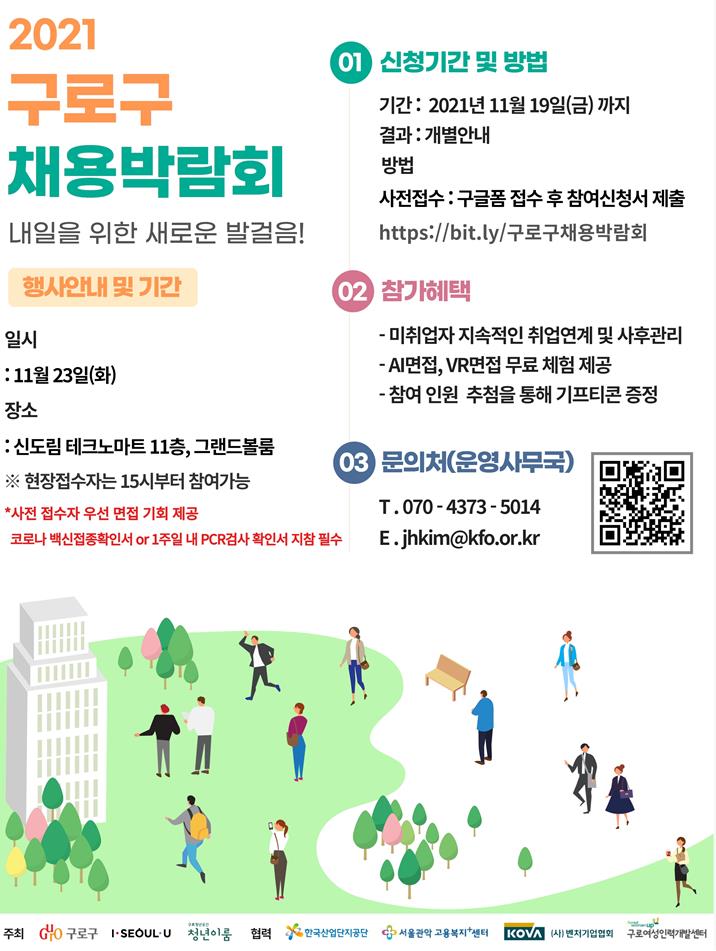
Guro-gu (District Mayor Lee Sung) will hold the ‘2021 Guro-gu Job Fair.’
On the 19th, Guro-gu announced, “The job fair is being held to provide employment opportunities to job seekers and help small and medium-sized enterprises overcome recruitment difficulties.”
The job fair will take place on the 23rd at the Sindorim Technomart Grand Ballroom. Five related organizations?Youth Dream, Guro Women’s Human Resources Development Center, Korea Industrial Complex Corporation Seoul Regional Headquarters, Seoul Gwanak Employment Welfare Plus Center, and the Korea Venture Business Association?will participate along with 32 pre-registered companies.
Considering the COVID-19 situation, Guro-gu will separate entry for pre-registered and on-site applicants at the fair. Pre-registered applicants will have priority interviews at matched company booths on the day of the event. After completing interviews with pre-registered applicants, on-site applicants will be interviewed. Participants can also receive employment counseling and experience AI and VR interviews at the related organizations’ promotional booths.
Guro-gu plans to provide follow-up support such as recruitment assistance and job placement for companies that fail to hire on-site and for participants who remain unemployed.
To prevent COVID-19, Guro-gu will stagger interview times and limit the number of attendees to 100. Masks will be required, and temperature checks and disinfection will be conducted upon entry.
A Guro-gu official said, “We expect this job fair to contribute to employment expansion and regional economic revitalization. We will continue to do our best to provide good jobs to job seekers and excellent talent to companies.”
© The Asia Business Daily(www.asiae.co.kr). All rights reserved.



















