Korean Venture Innovation Society Academic Conference on the 17th
Keynote Speech by Former Prime Minister Jeong Un-chan on ESG Theme
Proposing Innovation in Venture Companies and Pandemic Response Measures
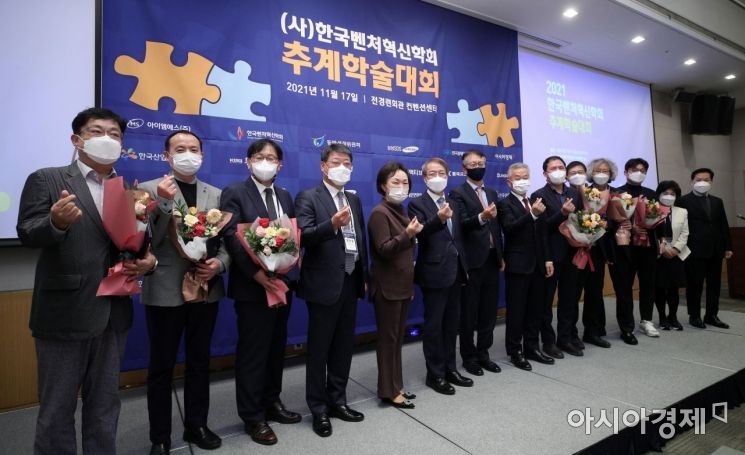 On the 17th, guests and awardees are taking a commemorative photo at the awards ceremony of the Korean Venture Innovation Society Autumn Academic Conference held at the Federation of Korean Industries building in Yeouido, Seoul, under the theme "ESG Management of Small and Medium Venture Innovative Companies." From the fourth person on the left: Jeon In-o, President of the Korean Venture Innovation Society; Han Mu-gyeong, member of the People Power Party; Jeong Un-chan, Chairman of the Win-Win Growth Research Institute; and Lee Ui-cheol, CEO of Asia Economy. Photo by Kim Hyun-min kimhyun81@
As ESG (Environmental, Social, and Governance) management emerges as a survival requirement for companies, opinions have been raised emphasizing the importance of partnerships between large and small-to-medium enterprises (SMEs) and the voluntary improvement of business owners' awareness.
The Korea Venture Innovation Society (President Jeon In-o) held its autumn academic conference on the 17th at the Federation of Korean Industries Hall in Yeouido, Seoul, under the theme "ESG Management of Small and Medium Venture Innovation Companies." Industry, academia, and research stakeholders gathered to share a consensus on the growing importance of ESG, a non-financial indicator, for corporate sustainability and analyzed the direction and cases of ESG management.
Lee Ui-cheol, CEO of Asia Economy, said in his congratulatory remarks, "Management activities that satisfy all stakeholders are necessary for long-term and sustainable profit generation by companies," adding, "Non-financial information such as ESG, that is, eco-friendly production, social responsibility implementation, and transparent management systems, have become essential elements." Yoon Dong-min, head of the Chungcheong Regional Headquarters of the Korea Industrial Complex Corporation, also emphasized, "It is time for manufacturing companies and venture/startup companies to collaborate and pool wisdom to create a 'sustainably growing Korea.'"
Jung Woon-chan, chairman of the Win-Win Growth Research Institute and former Prime Minister, delivered the keynote speech, presenting the direction of ESG management and innovation. Chairman Jung explained the background, saying, "In response to the COVID-19 crisis, investors demanded sustainable management from each company, and ESG, which emphasizes transparent management systems, was reappraised." He continued, "In January this year, the Financial Services Commission mandated ESG disclosure from 2025 for listed companies with assets over 2 trillion won, and from 2030 for other listed companies," adding, "ESG management has already become a reality right before our eyes."
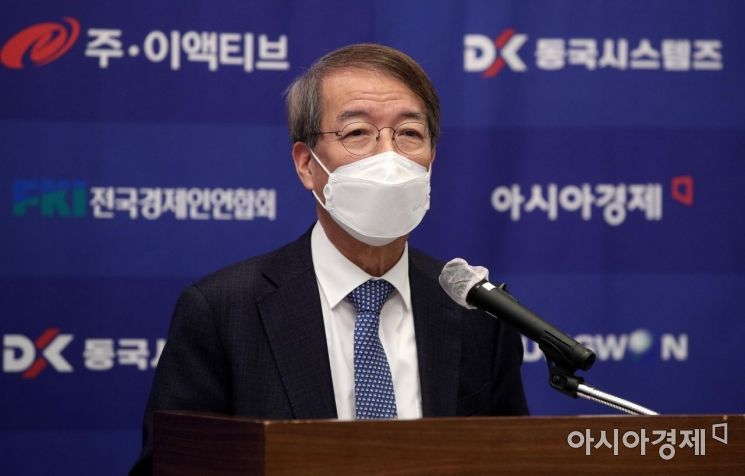 Jung Un-chan, Chairman of the Dongban Growth Research Institute (former Prime Minister), is delivering the keynote speech at the Korean Venture Innovation Society Autumn Academic Conference held on the 17th at the Federation of Korean Industries Building in Yeouido, Seoul, on the theme of "ESG Management of Small and Medium Venture Innovative Companies." Photo by Kim Hyun-min kimhyun81@
However, he pointed out that the dominant-subordinate relationship and unfair practices between large and small-to-medium enterprises still exist, urging large companies to voluntarily step forward to build a sustainable and healthy economic ecosystem. Emphasizing corporate innovation, he argued, "A systemic environment must be established for venture companies to grow into global large corporations." He also stressed the need to expand investment in various source and core technologies and to cultivate creative thinking through talent education.
Professor Moon Doo-cheol of Yonsei University, who gave the main lecture and is the next president of the Small and Medium Business Society, advocated the necessity of multilateral ESG partnerships. This approach involves forming consultative bodies among large and small-to-medium partner companies, local governments, and NGOs to jointly implement ESG. In particular, Professor Moon stated that large companies and economic organizations should actively spread best practices and provide educational opportunities for SMEs that lack the capacity for ESG management. Even if large companies or top-tier companies within the supply chain declare ESG strengthening, the effectiveness inevitably diminishes if partner companies do not realize ESG management. In this regard, the government plans to offer tax credit benefits of up to 2% of costs when large companies provide ESG education to employees of partner companies.
NTB, a POSCO group company and a steel MRO (Maintenance, Repair, and Operations) specialized firm, introduced its ESG management program called "Good Friend" in May. Through this program, a portion of the profits generated from transactions with client companies is used to address local community issues. ESG activities such as △carbon reduction in industrial complexes △SME safety △environmental improvement △support for vulnerable groups are jointly promoted with client companies. Shin Seung-ho, head of NTB's Management Planning Division, stated, "We will continuously pursue public interest activities to create a sound industrial ecosystem and solve social problems."
Meanwhile, the Korea Venture Innovation Society was established in February 2018 with approval as a corporation by the Ministry of SMEs and Startups, aiming for corporate growth through innovation and social value creation. Over the past three years, it has conducted various activities as an institution responding to government venture innovation policies and presenting innovation directions for SMEs.
© The Asia Business Daily(www.asiae.co.kr). All rights reserved.


















