LNG Extraction, Liquefaction, and Storage All-in-One at Sea
Samsung Heavy Builds 3 of the World's 4 FLNG Vessels
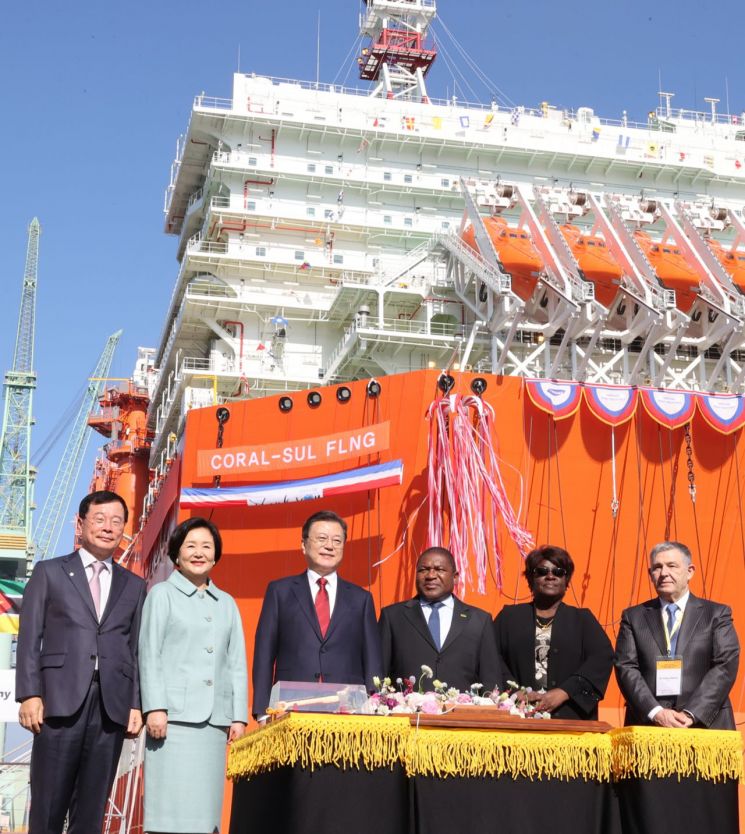 President Moon Jae-in and his wife, President Filipe Nyusi of Mozambique and his wife, Jung Jin-taek, CEO of Samsung Heavy Industries (far left), and Stefano Maio, Director of Natural Resources Development at the shipowner ENI (far right), cut the naming rope at the naming ceremony for the Korea-Mozambique Floating LNG Liquefaction Plant (FLNG) vessel held on the 15th at Samsung Heavy Industries Geoje Shipyard in Geoje, Gyeongnam, and took a commemorative photo with the Coral Sulho vessel in the background. The Coral Sul (Coral-Sul) vessel measures 432m in length, 66m in width, and 39m in height, making it the second largest in the world.
 [Asia Economy Reporter Choi Dae-yeol] The naming ceremony for the ultra-large floating natural gas production, liquefaction, and storage plant (FLNG) built by Samsung Heavy Industries was held on the 15th. A naming ceremony is an event where a completed vessel is given a name and handed over to the client. This facility, named "Coral Sul," will depart for Mozambique tomorrow.
This offshore plant is expected to be recorded as the first ultra-deepwater FLNG deployed in the African region. FLNG, as the name suggests, is a facility that handles everything from extracting natural gas at sea to liquefaction and storage, often called an LNG plant on the sea. Compared to onshore plants, it requires less investment and is considered environmentally friendly. With the carbon neutrality policy, LNG demand is expected to increase in the future, so this facility is also receiving renewed attention.
Samsung Heavy Industries formed a consortium with France's Technip and Japan's JGC and won the order for this facility from the Italian energy company ENI in 2017. Samsung Heavy Industries was responsible for the entire process from hull design to commissioning, as well as the design and fabrication of the topside production facilities. The amount Samsung handled alone reached 2.5 billion dollars. The total weight is 210,000 tons, with a length of 432 meters and a width of 66 meters, large enough to place four soccer fields in a row. In line with the eco-friendly trend, a gas turbine generator with low carbon emission technology to reduce gas discharge was installed, and a waste heat recovery system was also applied.
A Samsung Heavy Industries official said, "Even amid the COVID-19 pandemic, we were able to confirm excellent EPC (Engineering, Procurement, and Construction) construction capabilities by maintaining perfect quality and meeting contract deadlines," adding, "We plan to develop various products such as general-purpose FLNGs to secure market dominance in the future."
Samsung Heavy Industries has built three out of the four FLNGs ordered worldwide so far. It is considered a competitive company globally, having won the basic design order for FLNG from the US company Delfin in October last year. Following the delivery of Shell's Prelude, the world's first FLNG project, in 2017, Samsung Heavy Industries handed over Petronas' Dua last year and now Coral Sul to the clients in succession. Coral Sul will go to the Coral gas field located 250 km northeast offshore from Pemba City, Mozambique, and is expected to produce and refine 3.4 million tons of LNG annually.
© The Asia Business Daily(www.asiae.co.kr). All rights reserved.