Mobilization of Issuance Power, No Restrictions on Review
Concerns Over Economic Side Effects if Habitual
Experts "If Currency Value Drops, It Causes Inflation and Currency Instability"
[Asia Economy Reporter Jang Sehee] The attention on the Bank of Korea's (BOK) issuance power arises from political circles calling for an expanded role of the BOK ahead of the presidential election. The argument is that the central bank should play a supplementary role in fiscal policy by mobilizing its issuance power. However, this raises significant concerns not only about economic issues such as currency value instability but also about potential violations of the central bank's independence.
◆ "Violation of Central Bank Independence and Inflation Side Effects" = On the 15th, experts agreed that since there are no restrictions such as deliberations on the mobilization of issuance power, if it becomes habitual, economic side effects will occur in many areas. Professor Sung Tae-yoon of Yonsei University's Department of Economics pointed out, "If the political circles mobilize the BOK's issuance power, it could undermine the central bank's independence and trigger inflation and financial market instability." South Korea's consumer price inflation rate has maintained a 2% range for six consecutive months since April but rose to the 3% range in October. The problem is that during the post-COVID recovery process, demand-side inflationary pressures are expected to increase further following supply-side pressures.
If the currency value declines, the prices of real assets rise, which can cause inflation. Professor Kim Jin-il of Korea University's Department of Economics said, "The biggest problem with mobilizing issuance power is that the currency value falls, causing overall price increases." He added, "If exchange rate volatility intensifies in the international financial market, it becomes difficult to assess the value of the Korean won." Excessive price fluctuations can cause economic agents to struggle with product valuation, potentially delaying investments. Moreover, if the currency value becomes unstable, foreign investment funds may not flow in.
Professor Lee In-ho of Seoul National University's Department of Economics stated, "If issuance power is mobilized whenever the administration wants to use it, problems can arise in the process itself," adding, "Monetizing debt will further worsen the government's fiscal condition." According to the National Assembly Budget Office, national debt is expected to exceed 2,000 trillion won by 2029.
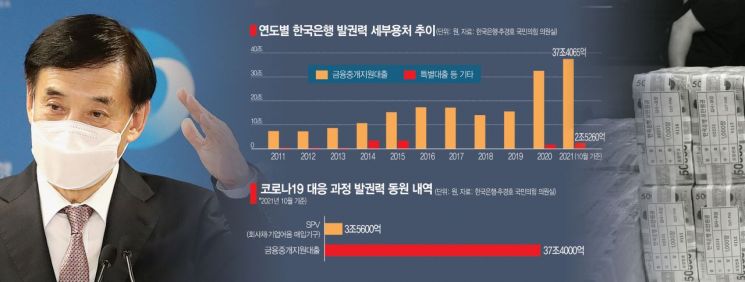
◆ Over 90% of Loans Are Financial Intermediation Loans = According to data received by Rep. Chu Kyung-ho of the People Power Party from the BOK, 94% of the BOK's won-denominated loans this year (39.9325 trillion won) were financial intermediation support loans. Financial intermediation support loans are a system where the BOK supplies funds to banks at a low interest rate of 0.25% per annum to support loans for small business owners and SMEs. The amount of financial intermediation loans was 14.0859 trillion won in 2018, increasing to 15.5684 trillion won in 2019 and 32.5123 trillion won last year. A BOK official explained, "The scale has increased significantly due to the COVID-19 crisis," adding, "Financial intermediation support loans account for most of it," and "The BOK Act does not limit the upper bound of loan amounts." Since mobilizing issuance power affects the entire economy, it requires not only the decision of the BOK's Monetary Policy Committee but also the formation of public consensus.
With the ruling party calling for an expanded role of the central bank ahead of next year's presidential election, concerns within the BOK are growing. A BOK official said, "If the currency value falls, people will want to hold only real assets," adding, "If currency value is not formed according to normal supply and demand, money will eventually stop circulating in the market." Another BOK official said, "It might be included as an election pledge, but it will not actually be mobilized," adding, "If issuance power is mobilized, the BOK governor will oppose it at the risk of his position."
The BOK opposed the then Blue House and government's demand for a 'Korean-style quantitative easing' in 2016. At that time, Deputy Governor Yoon Myeon-sik said, "If capital expansion is needed for policy banks to support corporate restructuring, that is fundamentally a fiscal role," adding, "I think mobilizing issuance power requires national consensus or social agreement to be possible."
© The Asia Business Daily(www.asiae.co.kr). All rights reserved.

















