[Asia Economy Reporters Kang Nahum and Boo Aeri] As domestic game companies rush to develop Non-Fungible Token (NFT) games, concerns about side effects such as promoting gambling addiction are also growing.
According to the industry on the 15th, NFTs refer to digital assets assigned unique identification values using blockchain technology. They are a kind of "certificate" that prevents duplication and forgery and can prove ownership. Based on blockchain technology, NFTs are not only impossible to replicate but also allow all transaction histories to be tracked, earning them the nickname "safe assets."
Because of these NFT characteristics, NFT products have recently been launched in various fields such as art, real estate, and entertainment. A representative example of NFT product transactions in the art field is the digital painter Mike Winkelmann's NFT work "Everydays: The First 5000 Days," which was auctioned for $69,346,250 (approximately 81.7939 billion KRW).
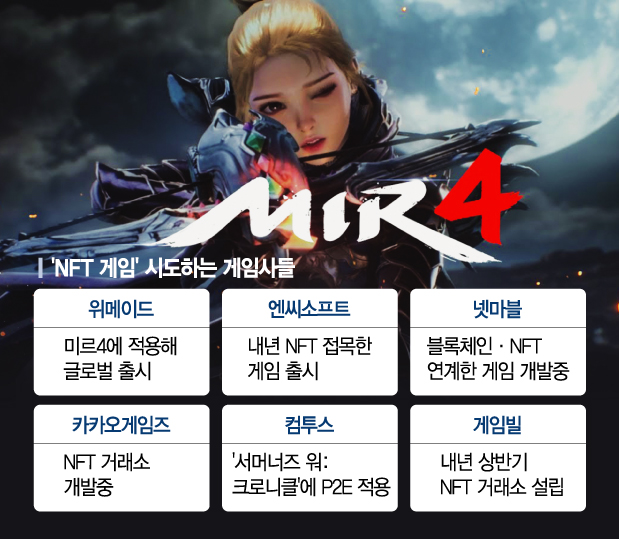
Games are a field that can actively utilize these NFT characteristics. Wemade, which issued its own coin "Wemix" and early on established an economic system that crosses between in-game and real-world, is currently preparing to release in-game items and characters as NFTs. NCSoft has also formed its own task force (TF) and is preparing NFT-applied games. There is a high possibility that NFT technology will be applied to NCSoft's flagship intellectual property (IP), Lineage.
Concerns about side effects are also emerging. First, since NFT products are traded outside the game rather than within it, game companies find it difficult to control transactions. There are no regulations regarding refunds or payment refusals, which could lead to phishing scams. The fact that game users' interest is focused more on acquiring items and mining virtual currency as financial opportunities rather than on the unique gameplay itself is also a negative factor for the growth of the game industry.
The most worrisome aspect is the promotion of gambling addiction. For example, the NCSoft Lineage item "Execution Sword" is already traded for tens of millions of KRW. NCSoft officially prohibits item trading to prevent gambling addiction and other reasons. If NCSoft releases the "Execution Sword NFT," it would legitimize the cash trading of items currently traded in the underground market. The commission revenue that NCSoft would receive is an added bonus.
The Game Rating and Administration Committee (GRAC) is also most concerned about these issues. GRAC views the fact that "NFTs obtained as a result of random game progress can be freely traded and converted into cash" as grounds for refusal of rating under the Game Industry Promotion Act. This is also why domestic game companies are unable to service NFT-applied games in Korea and are turning their eyes to global markets with looser regulations.
Voices from the game industry argue that the regulations are unfair. They point out that while intermediary sites like ItemBay, where high-priced items are traded, are not regulated, blockchain games are held to strict standards. An industry insider said, "On the contrary, NFTs can ensure transaction safety because there is no middleman," adding, "The government should establish clear standards and legislation to open the way for business domestically as well."
© The Asia Business Daily(www.asiae.co.kr). All rights reserved.

















