Apartment Price Increase Rate 0% in Second Week of November... Stopped After a Year and a Half
Apartment Sales Supply-Demand Index Lowest Among 17 Metropolitan Cities and Provinces
2,093 Unsold Units as of September, Sharp Increase of 1,940 Units in Half a Year
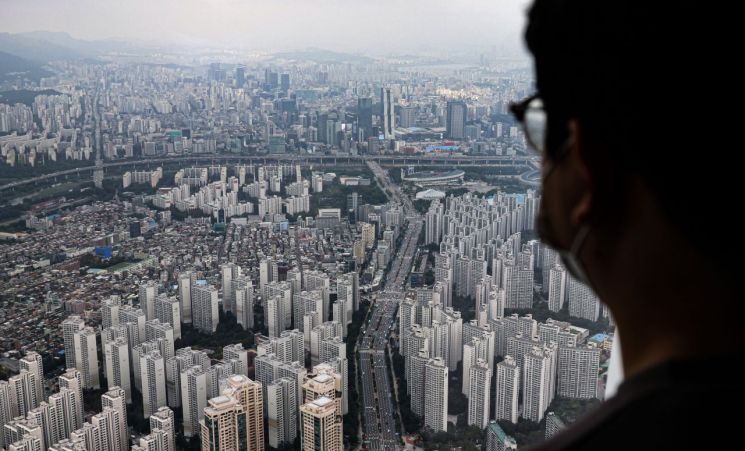
[Asia Economy Reporter Ryu Tae-min] Amidst the ongoing contraction in transactions and slowing price increases in the housing market, apartment prices in the Daegu region have reportedly stopped rising. This is the second case among major provincial cities, following Sejong City. Recently, concerns have been raised that the market may be entering a full-fledged downturn due to a surge in unsold units caused by oversupply in Daegu.
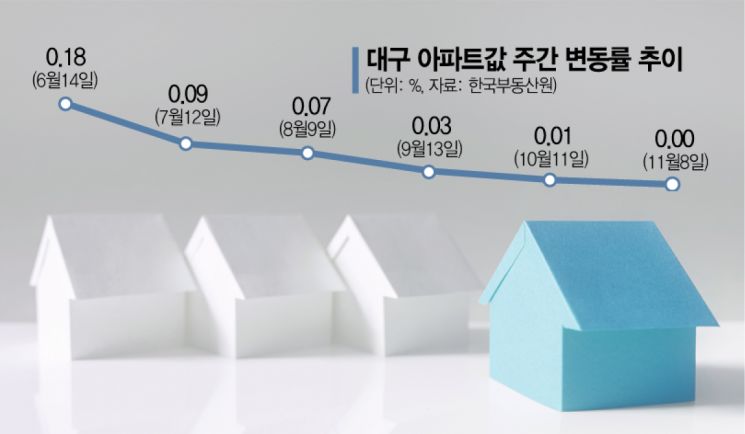
According to the Korea Real Estate Board on the 15th, the weekly apartment price increase rate in Daegu for the second week of November (based on the 2nd to 8th) was 0%. This is the first time in one and a half years since May 11 of last year that Daegu's weekly apartment price increase rate has halted. After peaking at 0.44% in February, the weekly increase rate gradually declined. Since July, it fell below 0.10%, and last month it recorded 0.01% for five consecutive weeks.
By district, some areas have already shifted to negative trends. Among the eight autonomous districts in Daegu city, half?four districts?recorded negative change rates. Nam-gu fell by 0.03%, Dong-gu decreased by 0.02%, and Seo-gu and Dalseo-gu each showed a -0.01% change rate. Jung-gu and Buk-gu had a 0% change rate. Only Suseong-gu and Dalseong-gun saw increases of 0.02% and 0.03%, respectively.
Daegu's apartment sales supply-demand index was also the lowest among the 17 metropolitan cities and provinces at 94.5. The sales supply-demand index quantifies the balance between demand and supply on a scale from 0 to 200. A value above 100 indicates more buyers, while below 100 indicates more sellers. Daegu's index has remained below 100 for five consecutive months since June, indicating a continued oversupply. Transaction volume has also decreased. The average monthly apartment sales transactions in Daegu dropped by 66%, from 4,283 units last year to 1,428 units this year.
More worrisome is the increase in unsold units. Unsold housing units in Daegu reached 2,093 in September. The number of unsold units, which was only 153 in March this year, surged by 1,940 units in six months. This contrasts with the nationwide unsold housing units, which are at historic lows. According to the Korea Housing Industry Research Institute, Daegu's housing market outlook index for last month was 64.0, the lowest level nationwide.
The rise in unsold units is interpreted as a result of oversupply. According to Asil (Apartment Real Transaction Price), a real estate big data company, the number of apartment move-ins in Daegu this year is 16,284 units. This exceeds the estimated appropriate demand of 11,953 units by 4,331 units. Furthermore, 32,503 units are scheduled for move-in in 2023, suggesting that the oversupply situation will continue.
An industry insider stated, "Due to the balloon effect of regulations in the Seoul metropolitan area, house prices in Daegu rose sharply, but recently, as speculative demand has withdrawn, prices are showing a weak trend," adding, "If the accumulated supply is not resolved, the downward trend could be prolonged."
© The Asia Business Daily(www.asiae.co.kr). All rights reserved.
![Clutching a Stolen Dior Bag, Saying "I Hate Being Poor but Real"... The Grotesque Con of a "Human Knockoff" [Slate]](https://cwcontent.asiae.co.kr/asiaresize/183/2026021902243444107_1771435474.jpg)

















