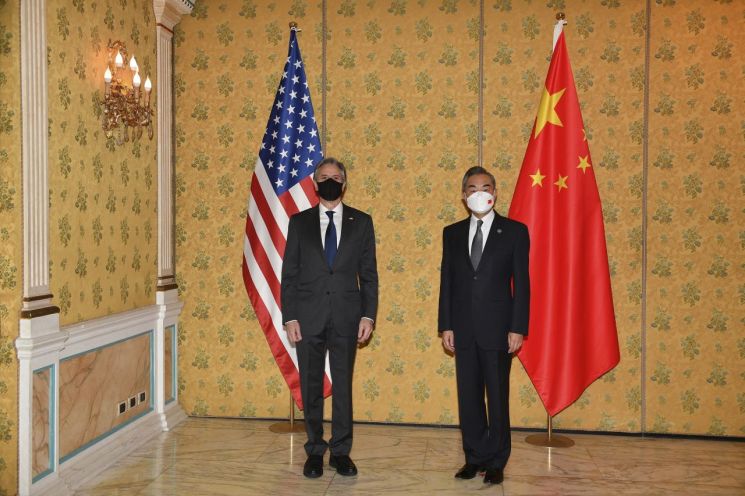
[Asia Economy Reporter Lim Chun-han] U.S. Secretary of State Tony Blinken and Chinese State Councilor and Foreign Minister Wang Yi clashed over the highly contentious Taiwan issue.
In a phone call on the 12th, three days before the bilateral summit on the 15th U.S. time (16th China time), the two ministers reaffirmed their significant differences in views on the Taiwan issue and showed a strong determination not to back down.
During the call, Secretary Blinken emphasized the United States' long-standing interest in peace and stability across the Taiwan Strait, according to a State Department spokesperson's press release on the 13th. He also expressed concern over China's continued military, diplomatic, and economic pressure targeting Taiwan. The State Department added that Blinken urged China to engage in meaningful dialogue to peacefully resolve cross-strait issues in a manner consistent with the wishes and best interests of the Taiwanese people.
On the other hand, according to the Chinese Foreign Ministry website, Foreign Minister Wang warned that "Taiwan independence is the greatest threat to peace and stability in the Taiwan Strait," stating, "History and reality prove that all encouragement and support for Taiwan independence forces will destroy peace in the Taiwan Strait and ultimately bring about self-inflicted consequences." He further urged, "If the U.S. side truly wants peace in the Taiwan Strait, it must clearly and firmly oppose any Taiwan independence activities." Wang emphasized, "The U.S. must faithfully uphold the sincere commitments outlined in the three joint communiqu?s between China and the U.S. (including the joint statement at the time of diplomatic normalization)," and "implement the One-China policy in action and refrain from sending wrong signals to Taiwan independence forces."
However, both ministers also expressed hope for the first virtual summit between U.S. President Joe Biden and Chinese President Xi Jinping. Secretary Blinken described the summit as an opportunity for the two leaders to cooperate in areas of shared interest and discuss how to responsibly manage competition between the two countries. He also stressed the importance of taking measures to ensure that global energy supply and price volatility do not jeopardize the world economic recovery.
Foreign Minister Wang said, "This highly anticipated meeting is a major event not only for China-U.S. relations but also for international relations," adding, "The peoples of both countries and the international community hope that the two sides will reach conclusions beneficial to both countries and the international community." He urged, "The summit should be successfully conducted to drive China-U.S. relations back onto a track of healthy and stable development."
According to the Chinese Foreign Ministry, the two sides exchanged views on energy security, climate change, and the Iran nuclear issue during the call and agreed to continue dialogue to address various global challenges. However, the Chinese Foreign Ministry did not mention the Korean Peninsula issues, including North Korea's nuclear program, in the list of topics discussed by the two ministers.
© The Asia Business Daily(www.asiae.co.kr). All rights reserved.

















