Koreans Increasingly Unfamiliar with Sino-Korean Words
36.3% of Citizens Say "I Don't Understand Newspaper or TV Language"
Some Lawmakers Call for Stronger Chinese Character Education
Others Argue, "Ease of Hangeul Use Matters More"
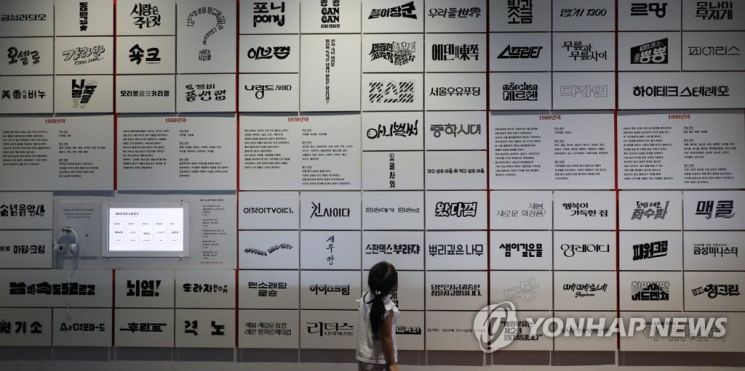 A child is looking at various Korean fonts at the National Hangeul Museum in Yongsan-gu on October 8 last year, a day before Hangeul Day. / Photo by Yonhap News
[Asia Economy, reporter Lim Joohyung] "Wishing for martial luck? Doesn't that mean hoping for bad luck?"
As the number of people unfamiliar with Sino-Korean words increases, incidents of misinterpreting the meaning of words have been occurring one after another. For example, some interpret "wishing for martial luck" as "hoping for bad luck," or understand "n consecutive wins" as "n times defeated." Experts point out that this phenomenon is due to the reduced emphasis on Chinese characters in compulsory education and the declining public interest in them.
◆From 'Muun' to 'Yangduguyuk'... Koreans Struggling with Sino-Korean Words
The so-called "Muun controversy" began on November 1, when Lee Junseok, leader of the People Power Party, made a comment. At that time, Lee said to Ahn Cheolsoo, the presidential candidate from the People’s Party, "I wish you martial luck." However, a reporter from a broadcasting company misinterpreted this as "he wished him bad luck," sparking controversy. On that day, search queries asking for the meaning of "muun" suddenly surged on portal sites such as Naver and Google.
The word "muun" (武運) used in "wishing for martial luck" originally means "the fortune of a warrior." However, it is presumed that some people misunderstood it as "having no luck" (無運).
This is not the only incident caused by misinterpreting Sino-Korean words. During the Tokyo Olympics in July, some internet users were confused by an article stating that the women's archery team had achieved "nine consecutive wins," asking, "Why do you call it a losing streak when they won?" This confusion arose because they were unaware that "yeonpae" can mean both "consecutive defeats" (連敗) and "consecutive victories" (連覇).
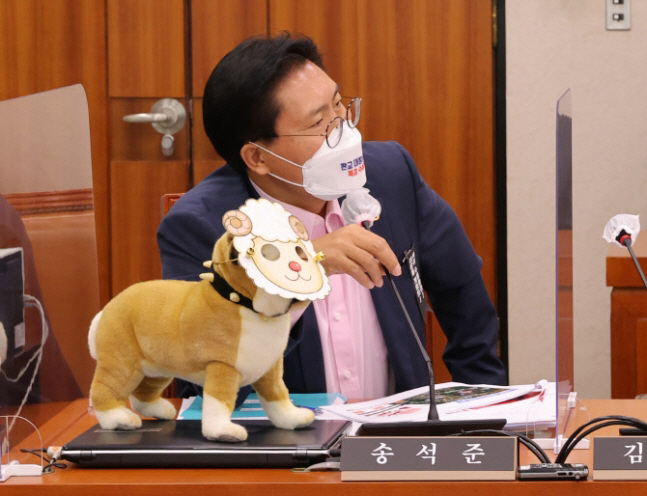 The so-called 'Yangduguyuk' doll that appeared at last month's Gyeonggi Provincial Government audit / Photo by Yonhap News
There are also cases where people struggle because they do not know four-character idioms. On October 20, during the National Assembly’s Transportation Committee audit of the Gyeonggi Provincial Government, Song Seokjun, a lawmaker from the People Power Party, suddenly brought out a dog doll while questioning Lee Jaemyung, the presidential candidate from the Democratic Party. The doll had a sheep illustration attached to its head, and Song explained, "I brought this from near Daejang-dong." He used the doll to reference the four-character idiom "Yangduguyuk" (羊頭狗肉, literally "displaying a sheep's head and selling dog meat"), which means something that looks good on the outside but is worthless inside, to criticize the alleged preferential treatment in the Daejang-dong development project in Seongnam, Gyeonggi Province. However, in the article's comments section, questions such as "Why bring a doll all of a sudden?" and "What does that mean?" kept appearing.
◆36.3% of Citizens: 'I Don't Understand Words Used in Newspapers'
As more people are unfamiliar with Sino-Korean words, cases of misunderstanding word meanings are increasing. While English is becoming more common, Sino-Korean words are becoming increasingly unfamiliar.
In reality, opportunities to learn Chinese characters in compulsory education are gradually decreasing. Currently, elementary, middle, and high school textbooks use only Hangeul, adopting a "Hangeul-only" policy. In addition, since the 7th National Curriculum in 2000, Chinese character classes have been removed from the list of required subjects, resulting in fewer hours of instruction.
Interest in Chinese characters themselves is also declining. The "Sangmuhan-geum" practical Chinese character proficiency test, administered by YBM, has seen a continuous drop in test takers, and with the recent abolition of its status as a nationally certified qualification, regular test administration has been discontinued.
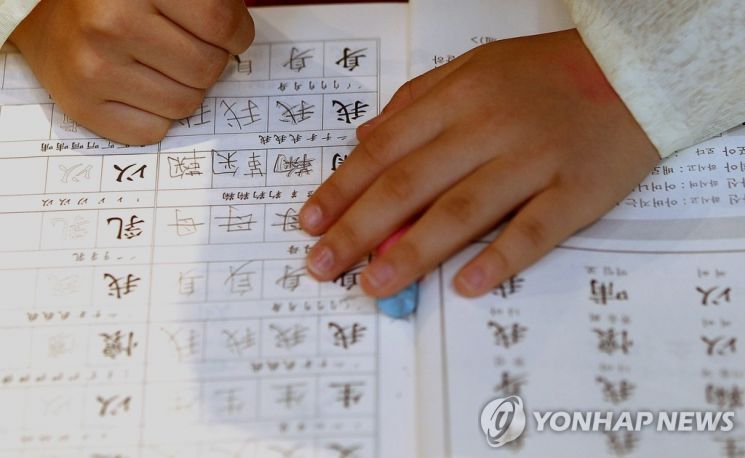 About 80% of the nouns registered in the Standard Korean Language Dictionary compiled by the National Institute of the Korean Language are Sino-Korean words.
 Photo by Yonhap News
The problem is that a significant portion of the Korean language still consists of Sino-Korean words. Currently, about 80% of the nouns registered in the Standard Korean Language Dictionary are Sino-Korean. This is why there are concerns that a lack of knowledge of Chinese characters could hinder communication.
According to a survey conducted last year by the National Institute of the Korean Language, 36.3% of respondents said they had difficulty because they did not understand the meaning of words used in newspapers or on TV. In a similar survey in 2015, only 5.6% responded this way, meaning the figure has increased more than sixfold in about five years.
In particular, among those who struggled to interpret sentences, 46.3% cited "difficult and advanced Sino-Korean words" as the reason.
◆"We Need Chinese Character Education" vs "Convenience Is More Important"-Ongoing Debate
Given the situation, there are growing calls to strengthen basic Chinese character education to improve national literacy. However, some argue that "equal access to written language" for all citizens must be guaranteed, and have voiced opposition, suggesting the debate will continue.
Kim Yeji, a lawmaker from the People Power Party, proposed an amendment to the Elementary and Secondary Education Act on November 2. The main point of the bill is to include Chinese characters alongside Hangeul in elementary school textbooks.
Regarding this, Kim explained, "Because there is no legal basis for the use of Chinese characters in the current law, there is a lack of accurate understanding of the Korean language, which leads to a decline in writing and thinking skills. The aim is to promote correct understanding of Korean and to expand vocabulary."
On the other hand, the Hangeul Society issued a statement opposing the bill on November 14, saying, "Even Representative Kim's bill was written entirely in Hangeul. Did it cause any difficulty in understanding or expressing ideas? Did it lower writing or thinking skills? Did it deepen generational differences in awareness?"
The statement continued, "We use Hangeul not because we are forced to, but because it is convenient and feels very natural to us. Any bill (such as the one requiring Chinese characters) that would make equal access to written language impossible for the public must be withdrawn."
© The Asia Business Daily(www.asiae.co.kr). All rights reserved.



















