NCSoft and Netmarble Stocks Soar
Foreigners and Institutions Lead Net Buying
Individuals Invest Mainly in Large-Cap Stocks Regardless
Even with poor performance, the stock prices of gaming companies fluctuate just by touching on non-fungible tokens (NFTs). While foreign investors and institutions lead the surge in NFT-related stocks, retail investors who missed out expressed dissatisfaction, citing excessive market volatility.
According to the Financial Supervisory Service's electronic disclosure system on the 12th, NCSoft recorded consolidated sales of 500.6 billion KRW and operating profit of 96.3 billion KRW in the third quarter of this year. These figures represent decreases of 14.5% and 55.8%, respectively, compared to the same period last year. Both sales and operating profit fell short of market consensus by 10.7% and 24.3%, respectively. Nevertheless, the stock price hit the daily limit up and closed at 786,000 KRW. This is the first time since August 26 that NCSoft's stock price has risen to the 700,000 KRW range.
The news that NCSoft is considering NFT-related business positively influenced the stock despite the weak earnings. When announcing its third-quarter results the previous day, NCSoft revealed during a conference call its entry into the NFT business. The company has already formed an internal task force (TF) to research blockchain and NFTs and plans to launch related services starting next year.
Netmarble also posted somewhat lackluster results but rose 3.05% the previous day, closing at 135,000 KRW. During the trading session, it briefly reached the 140,000 KRW level for the first time since August 3. The establishment of Metaverse Entertainment by its subsidiary Netmarble F&C to pursue metaverse and NFT-related businesses was seen as a positive factor.
Pearl Abyss also reached an all-time high of 124,800 KRW during the previous day's trading session. Since the beginning of this month through the previous day, its closing price has risen 17.2%, overwhelmingly outperforming the KOSDAQ's 0.03% increase over the same period. Despite a 74.8% drop in operating profit to 10.2 billion KRW in the third quarter compared to the same period last year, the stock surged due to expectations of expansion into China and announcements of exploring NFT and metaverse-related businesses. Other major to small-sized gaming companies such as Krafton, Gamevil, and Neowiz also saw their stock prices fluctuate on news of entering NFT-related businesses.
Foreign Investors and Institutions React Instantly to NFTs... Large-Cap Stocks Mainly Bought by Retail Investors Show Poor Performance
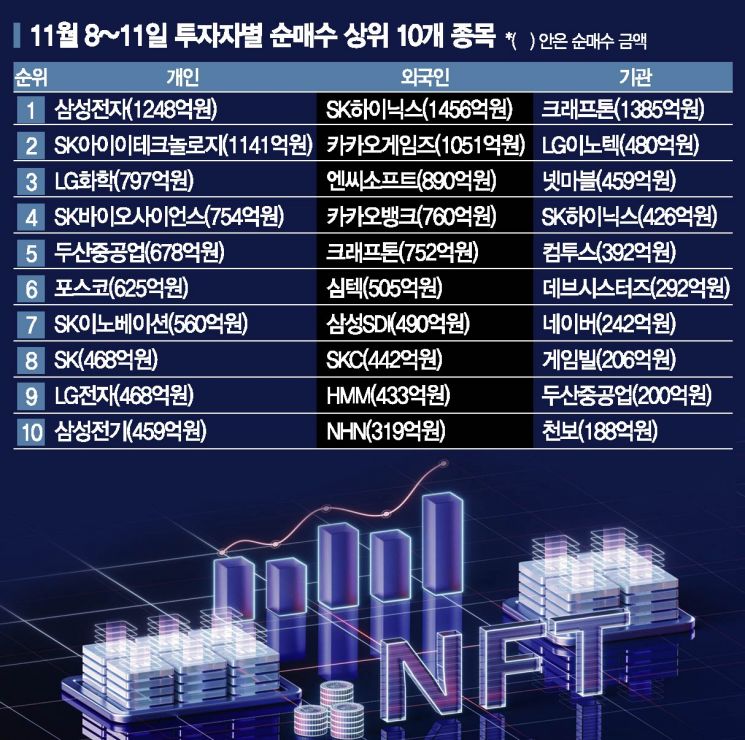
The main players reacting strongly to NFT entry news are foreign investors and institutions. Between the 8th and 11th of this month, when NFTs attracted attention, gaming stocks were heavily included among the top 10 net purchases. Foreign investors net bought Kakao Games for 105.1 billion KRW, NCSoft for 89 billion KRW, and Krafton for 75.2 billion KRW during this period. Institutions also net bought Krafton for 138.5 billion KRW, Netmarble for 45.9 billion KRW, Com2uS for 39.2 billion KRW, Devsisters for 29.2 billion KRW, and Gamevil for about 20.6 billion KRW.
On the other hand, retail investors showed investment behavior unrelated to the NFT surge. During the same period, none of the top 10 net purchases by individuals included NFT-related stocks. The most purchased stock was Samsung Electronics, with net buying of about 124.8 billion KRW, followed by SK IE Technology (114.1 billion KRW), LG Chem (79.7 billion KRW), SK Bioscience (75.4 billion KRW), and Doosan Heavy Industries & Construction (67.8 billion KRW).
However, the returns on these stocks were poor. During this period, Samsung Electronics fell 0.43%, LG Chem 3.69%, SK Bioscience 13.23%, and Doosan Heavy Industries & Construction 2.64%. Only SK IE Technology rose 10.65%, but this is far below the gains seen in NFT-related stocks. Although retail investors bought large-cap stocks at low prices as per conventional wisdom, they lagged behind foreign investors and institutions in terms of returns.
As a result, retail investors expressed dissatisfaction, claiming that foreign investors and institutions excessively shake the domestic stock market. Unlike the U.S. stock market, where performance is better, they argue that foreign investors and institutions artificially create theme stocks to pursue returns amid sluggish domestic markets. Jeong Eui-jeong, head of the Korea Stock Investors Association, a group protecting individual investors' rights, said, "There are frequent cases where foreign investors and institutions use their superior position to manipulate prices," adding, "If they offload shares to retail investors at the peak, those retail investors who jump on the NFT surge late could suffer significant losses."
© The Asia Business Daily(www.asiae.co.kr). All rights reserved.
![User Who Sold Erroneously Deposited Bitcoins to Repay Debt and Fund Entertainment... What Did the Supreme Court Decide in 2021? [Legal Issue Check]](https://cwcontent.asiae.co.kr/asiaresize/183/2026020910431234020_1770601391.png)















