Government Implements Emergency Supply Adjustment Measures for Urea Solution
Only 30ℓ for Cargo Trucks and 10ℓ for Passenger Cars Can Be Purchased
Sales Locations Limited to Gas Stations Until Year-End
Industrial Urea and Diesel Exhaust Fluid (DEF) Exempt from Tariffs
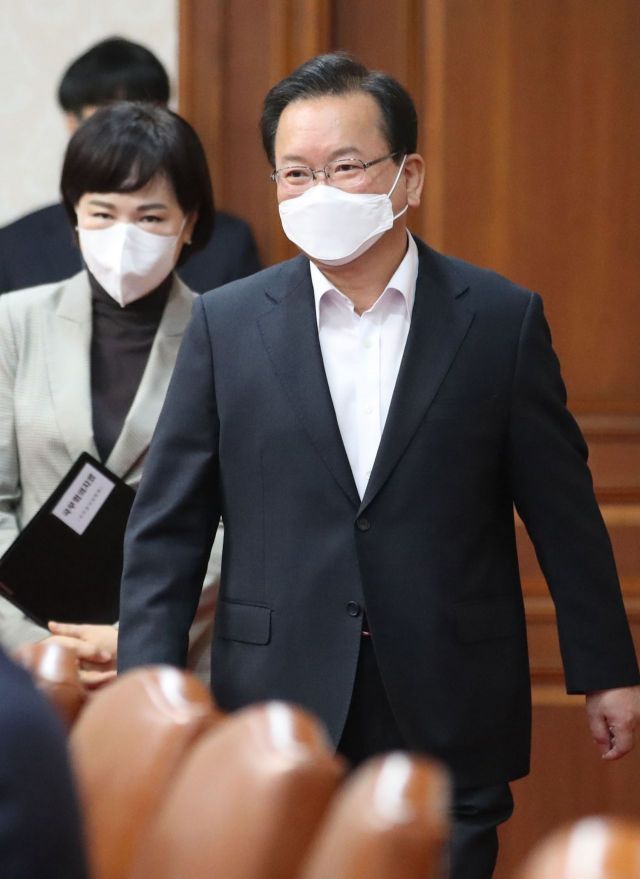 Prime Minister Kim Boo-kyum is attending an emergency Cabinet meeting held at the Government Seoul Office in Jongno-gu, Seoul on the 11th. On this day, the government deliberated and approved urgent supply measures for urea solution at the emergency Cabinet meeting. Photo by Kim Hyun-min kimhyun81@
[Sejong=Asia Economy Reporters Joo Sang-don and Son Sun-hee] The government has decided to limit the sales locations of urea and diesel exhaust fluid (DEF) to gas stations until the end of the year and restrict the purchase of DEF for diesel vehicles to a maximum of 30ℓ. Tariffs on industrial urea and DEF imported into the country will also be exempted until the first half of next year.
On the 11th, the government held an extraordinary Cabinet meeting chaired by Prime Minister Kim Boo-kyum, where it proposed and approved the enactment of the “Emergency Supply and Demand Adjustment Measures” for urea and DEF, as well as the revision of the “Tariff Quota Regulations (Presidential Decree).” In his opening remarks, Prime Minister Kim said, "The industry and procurement authorities are working together to diversify import sources, so we expect no major problems in the supply of vehicle DEF going forward," but added, "It will take time for supply and demand to normalize."
The emergency supply and demand adjustment measures are powerful actions based on the Price Stabilization Act, allowing the government to issue production, supply, and shipment orders to producers and sellers, and to regulate sales. This measure was introduced because resolving the shortage of urea and DEF caused by disruptions from China is not expected to be easy in the short term, similar to the “mask crisis” early last year.
The core of this stabilization measure is to limit sales locations and quantities until December 31. Accordingly, diesel cargo trucks, construction machinery, agricultural machinery, etc., can purchase up to 30ℓ per vehicle, and passenger cars up to 10ℓ, only at gas stations. This is to prevent hoarding of vehicle DEF through large supermarkets and other outlets. With 30ℓ of DEF, a cargo truck weighing around 10 tons can travel 300 to 400 km. This means a single purchase can cover a trip from Seoul to Busan.
The government did not limit the number of purchases under this supply adjustment measure. Since the amount of DEF needed varies depending on driving distance, limiting the number of purchases could become another excessive regulation. An official from the Ministry of Environment said, "Masks were equally needed by everyone, but DEF is different," adding, "However, since purchase records are logged in the comprehensive vehicle emissions management system, if a particular vehicle excessively hoards DEF, purchase frequency may be restricted on a daily or weekly basis." Professor Kim Pil-soo of Daelim University expressed concern, saying, "Just as people lined up for hours to buy public masks, purchasing DEF may also become difficult."
In addition, producers, importers, and sellers of DEF must report daily inventory and sales volumes to the government, and reselling purchased vehicle DEF to third parties or exporting it abroad is prohibited. Companies producing, importing, or selling DEF must report information on daily production, import, shipment, inventory, and sales by noon the following day. Importers are also required to report their expected import volumes for the next two months.
The government will also exempt tariffs on industrial urea and DEF imported into the country until the first half of next year. Countries with existing Free Trade Agreements (FTAs) such as China and Australia already enjoy tariff exemptions, but other countries are subject to a 6.5% tariff rate. Taking this situation as an opportunity to diversify import sources beyond China, the government is negotiating with about 10 countries for emergency imports and has decided to exempt tariffs accordingly. According to the revised “Tariff Quota Regulations (Presidential Decree)” passed at the Cabinet meeting, the tariff exemption on DEF applies to quantities declared for import by June 30 next year. The Ministry of Strategy and Finance stated, "We will consider extending the exemption depending on future market supply and price trends."
© The Asia Business Daily(www.asiae.co.kr). All rights reserved.
![User Who Sold Erroneously Deposited Bitcoins to Repay Debt and Fund Entertainment... What Did the Supreme Court Decide in 2021? [Legal Issue Check]](https://cwcontent.asiae.co.kr/asiaresize/183/2026020910431234020_1770601391.png)
















