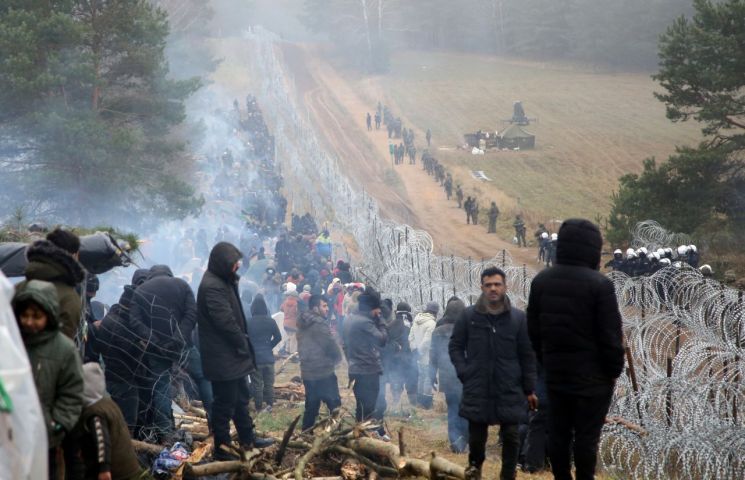
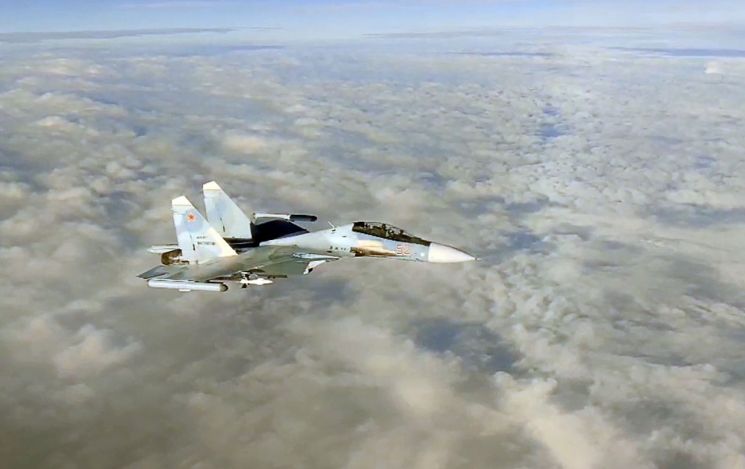
[Asia Economy Reporter Kim Suhwan] The European Union (EU) has announced additional sanctions amid allegations that Belarus, an Eastern European country, is 'pushing out' refugees coming from the Middle East into Poland and other parts of Europe. In response, Russia, an ally of Belarus, has deployed nuclear bombers to Belarus as a countermeasure.
The refugee crisis triggered in Belarus is causing a direct confrontation between the EU and Russia.
EU: "Our borders are under attack"... Announces large-scale sanctions
On the 10th (local time), according to major foreign media, Charles Michel, the President of the European Council, stated, "Our EU borders are under a 'hybrid' attack," and fiercely criticized Belarus for weaponizing refugees.
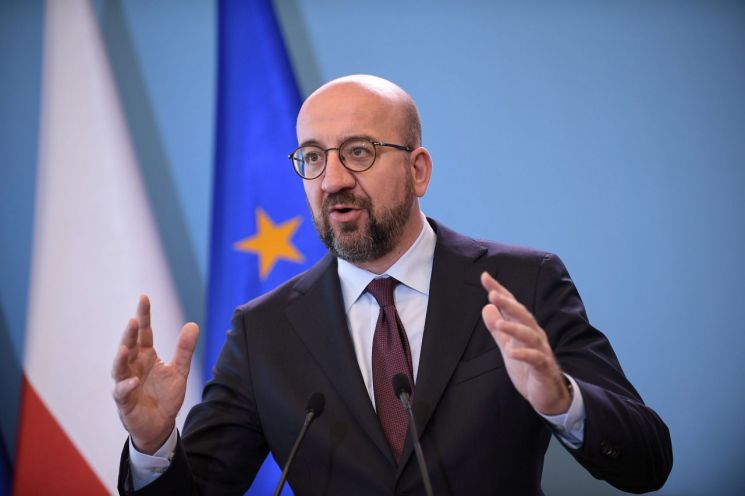
A hybrid attack refers to a warfare technique that inflicts damage on an opponent through irregular means such as cyber warfare, public opinion manipulation, guerrilla warfare, and communication network disruption.
Regarding the current situation, Michelle Bachelet, the United Nations High Commissioner for Human Rights, also emphasized that the involved countries must take immediate action in accordance with international human rights law and refugee law.
In a statement, she said, "I am deeply shocked by the fact that numerous migrants and refugees have been left stranded in extremely cold weather and desperate conditions," and urged, "I call on the relevant countries to respond immediately to resolve this unbearable situation."
Over the past few months, the number of refugees attempting to enter EU countries such as Poland, Lithuania, and Latvia through Belarus has continued to increase.
Poland claims that the Belarusian government is trying to push these people toward Poland and has deployed troops to block their entry.
The EU also asserts that Belarus is either allowing or deliberately encouraging refugees to head to Europe as retaliation against EU sanctions targeting Belarus.
On the other hand, Alexander Lukashenko, President of Belarus, who has faced Western criticism over alleged election fraud last year, previously pressured the EU by stating that Belarus lacks the funds and capacity to curb the influx of refugees due to Western sanctions and that the EU should accept the refugees.
As the refugee crisis shows no signs of resolution, the EU has announced plans for a tougher response.
On this day, ambassadors from the 27 EU member states reached a comprehensive agreement on additional sanctions, aiming for implementation as early as next week.
According to foreign media, these countries plan to impose sanctions on more than 30 individuals and entities, including the Belarusian foreign minister and state-owned airlines.
Ursula von der Leyen, President of the European Commission, emphasized, "(The sanctions) will be implemented swiftly starting next week," and added, "Sanctions against Belarusian airlines suspected of human trafficking, such as transporting refugees to EU borders, are also under consideration."
Russia deploys nuclear bombers: "Europe must not put itself in a dangerous situation"
In response to the EU's announcement of tough measures, Russia, an ally of Belarus, is also taking action.
On this day, the Russian Foreign Minister warned European countries, saying, "They must ensure they do not put themselves in a dangerous situation."
Additionally, it is reported that Russia has deployed bombers capable of carrying nuclear weapons near the Belarusian border. These bombers are also said to be equipped with supersonic missiles capable of bypassing the North Atlantic Treaty Organization (NATO) air defense systems.
The deployment of advanced bombers by Russia amid the humanitarian refugee crisis indicates that this situation is not limited to Belarus but reflects a conflict phase between Russia and Europe.
Furthermore, the Belarusian Ministry of Defense announced that it has strengthened the air defense units in the western and northwestern regions bordering Poland and Lithuania, escalating military tensions in the area.
Merkel: "Russian involvement necessary"... Putin: "Establish dialogue channels between EU and Belarus"
Meanwhile, on this day, Russian President Vladimir Putin and German Chancellor Angela Merkel's acting head held a phone conversation to discuss the refugee crisis occurring at the Belarus-Poland border area.
The Kremlin stated, "President Putin proposed establishing direct dialogue channels between EU member states and Belarusian representatives to discuss the issues that have arisen."
On the other hand, Chancellor Merkel's acting head pointed out, "It is inhumane and unacceptable for the Belarusian government to instrumentalize migrants," and according to the German Chancellor's office cited by TASS news agency, requested President Putin to exert influence on this matter.
© The Asia Business Daily(www.asiae.co.kr). All rights reserved.
![User Who Sold Erroneously Deposited Bitcoins to Repay Debt and Fund Entertainment... What Did the Supreme Court Decide in 2021? [Legal Issue Check]](https://cwcontent.asiae.co.kr/asiaresize/183/2026020910431234020_1770601391.png)


















