KAIST Researchers Who Created 'Hubo'... Spun Off to Start a Company in 2011
Developed Collaborative Robots Following Bipedal Walking... Independently Developed Core Components
Entered Quadrupedal Robot Market... Astronomical Mounts Are the 'Cash Cow'
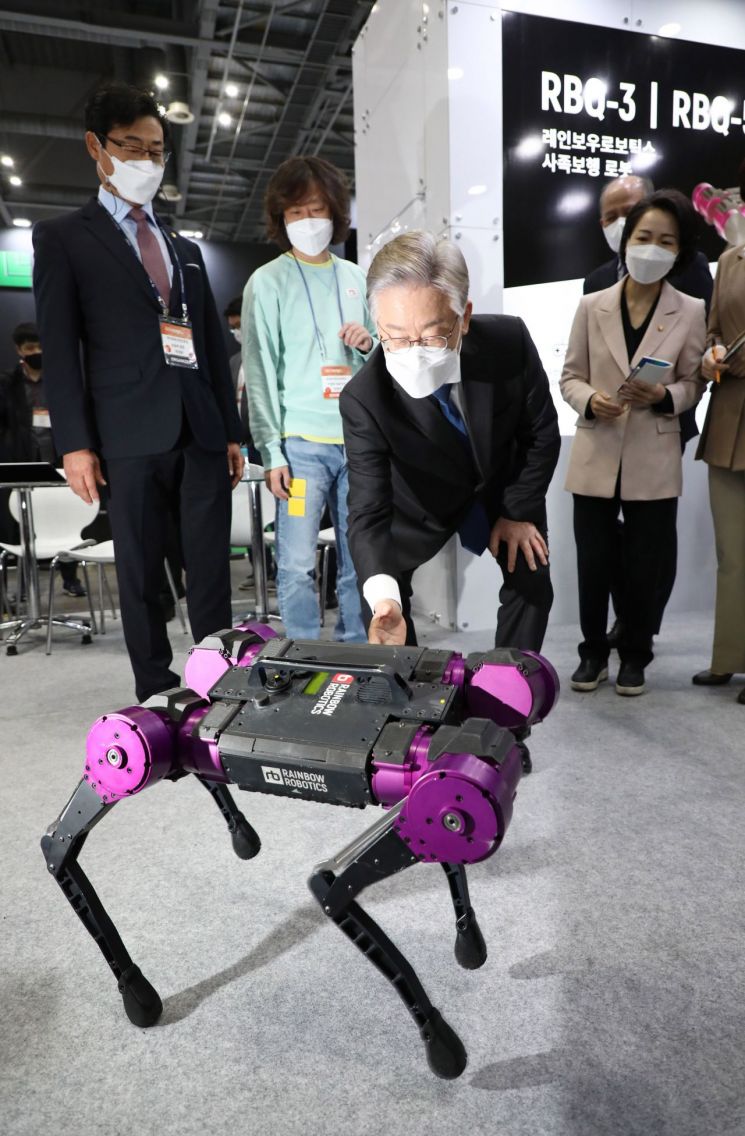 Lee Jae-myung, the Democratic Party presidential candidate, is examining Rainbow Robotics' quadruped robot at '2021 RoboWorld' held at KINTEX in Goyang, Gyeonggi Province on the 28th of last month.
 [Image source=Yonhap News]
[Daejeon=Asia Economy Reporter Lee Junhyung] In 2004, a research team at KAIST (Korea Advanced Institute of Science and Technology) succeeded in developing ‘Hubo,’ the first bipedal humanoid robot in Korea. This achievement was the second in the world, following Honda’s development of the bipedal robot ‘ASIMO’ in 2000. Humanoid robots are considered the “flower of robotics” as they integrate cutting-edge technologies related to robotics. Even now, more than 20 years after the emergence of bipedal robots, only three companies worldwide, including Boston Dynamics?which Hyundai Motor Group acquired for 1 trillion won at the end of last year?are capable of properly manufacturing humanoid robots. This underscores the significant meaning of Hubo in the domestic robot development industry.
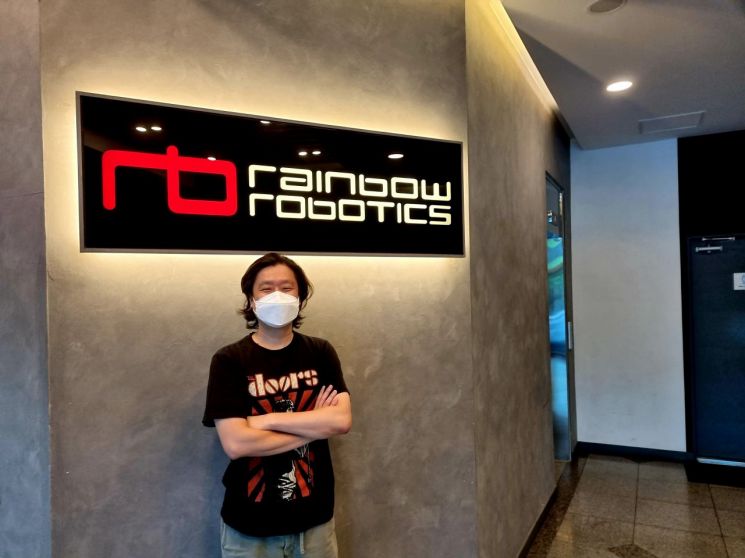
At the center of the ‘K-Robot’ legend written by Hubo is the robotics specialist company Rainbow Robotics. Rainbow Robotics was spun off in 2011 from the Hubo Lab at KAIST. The core research team, including Professor Junho Oh, who led the development of Hubo, formed the backbone of the company. CEO Jeongho Lee of Rainbow Robotics is also an original member who joined Hubo Lab in 2002. Lee compared Hubo to an ‘F-1 machine of the robot industry.’ He explained, “An F-1 machine is built with cutting-edge technology at the testing stage rather than commercial-level technology,” adding, “Being able to develop a bipedal robot like this means possessing technologies that have reached the pinnacle in the field of robotics.”
Internalization of Core Collaborative Robot Technologies
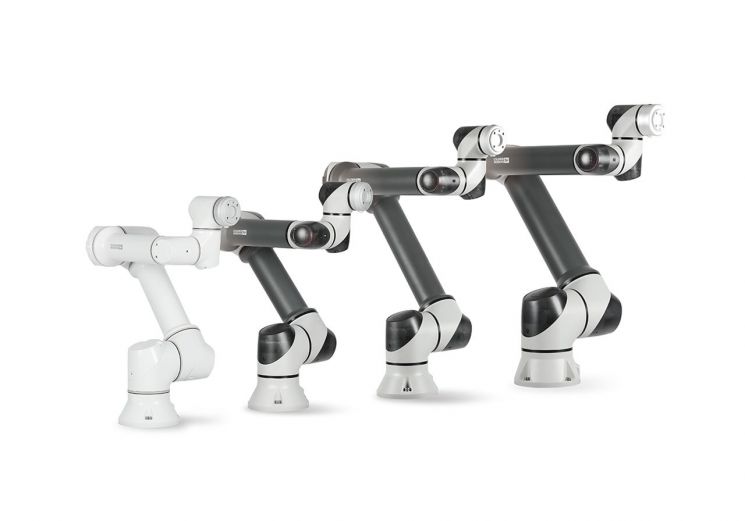
The company is writing a new legend with collaborative robots. Collaborative robots are robotic arms composed of six or more joints, designed to operate in the same space as humans. Equipped with high-performance sensors to ensure worker safety, they are not subject to legal regulations such as installing safety fences over 1.8 meters, unlike industrial robots. Due to relatively low introduction costs and flexible deployment, they are gaining attention not only as next-generation industrial robots but also as service robots. The company began developing collaborative robots in 2019 and launched a product in just one year and six months. The technological capabilities secured through developing humanoid robots formed the foundation for this ‘ultra-fast commercialization.’
Rainbow Robotics’ competitive edge in collaborative robots lies in ‘price’ and ‘after-sales service (A/S).’ Their products are about 30% cheaper compared to competitors like Universal Robots. This is largely because they have internalized almost all core components such as controllers, actuators, and brakes, which account for about 65% of the robot’s cost. Thanks to these core technologies, unlike competitors who rely on external suppliers for key parts, they can respond immediately to consumer demands. CEO Lee stated, “The only component we have not internalized yet is the reducer,” adding, “We have already completed technology development but are continuing additional development to produce the manufacturing equipment ourselves.” He further noted, “We expect to have mass production capability for reducers within 3 to 5 years.”
Entering the Quadruped Robot Market
The company has also entered the quadruped robot market, a field dominated by Boston Dynamics. Last month, at the ‘Seoul International Aerospace and Defense Exhibition (ADEX),’ the company showcased the quadruped robot ‘RBQ-5.’ This is the robot that caused controversy when Lee Jae-myung, the Democratic Party presidential candidate, pushed it over at the exhibition. CEO Lee said, “Quadruped robots have not yet found their main applications and the field has not fully blossomed,” but added, “Unlike wheeled robots, they can freely traverse rough terrain, so there are many possibilities in military and rescue applications.”
Rainbow Robotics is also the only company in Korea that manufactures astronomical mounts in-house. The ultra-precise astronomical mounts developed by integrating robotic technology once accounted for half of the company’s sales, making it an unexpectedly successful product. It eliminated the inconvenience of traditional astronomical mounts, which required attaching counterweights on one side to balance the weight when mounting telescopes. While competing astronomical mounts from countries like Germany weigh between 100kg and 200kg, Rainbow Robotics’ product weighs only 30kg.
The company already holds about 70% of the public procurement market and exports to advanced astronomical observation countries such as the United States, Germany, and the United Kingdom. CEO Lee stated, “The astronomical observation markets in the U.S. and Japan are quite large,” adding, “Since we are the only domestic manufacturer of astronomical mounts, we also supply a considerable volume for defense purposes.”
© The Asia Business Daily(www.asiae.co.kr). All rights reserved.



















