Kyungrano Conference... "Workplace-Specific Mid- to Long-Term Measures Needed to Promote Job Transition"
[Sejong=Asia Economy Reporter Moon Chaeseok] An analysis has emerged that nearly half of the jobs at coal-fired power plants will disappear within the next 10 years due to the government's eco-friendly energy transition policy. This is based on the 9th Basic Plan for Electricity Supply and Demand announced at the end of last year. Since the government has decided to pursue a rapid eco-friendly energy policy to reduce greenhouse gases by 40% compared to 2018 by 2030, the scale of job losses is expected to increase further. There is also concern about the potential loss of specialized personnel in the energy sector.
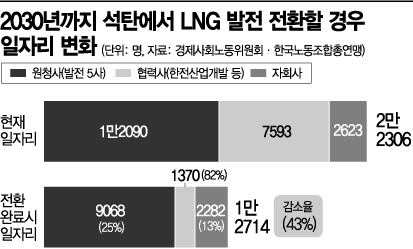
Nam Taeseop, Policy Planning Director of the Public Industry Labor Union Federation at the Federation of Korean Trade Unions (FKTU), warned on the 10th at an international conference titled "Seeking a New Employment and Labor Paradigm in the Era of Great Transition," hosted by the Presidential Committee on Economic, Social and Labor Affairs, that after the implementation of carbon neutrality policies, jobs at five coal-fired power public enterprises (prime contractors) including Korea South-East Power, as well as their partner companies and subsidiaries, will decrease from 22,306 to 12,714 by 2030, a 43% (9,592 jobs) reduction.
This is in accordance with the 9th Basic Plan for Electricity Supply and Demand, which involves closing coal-fired power plants and restructuring energy policy toward liquefied natural gas (LNG) and new and renewable energy power plants. According to Nam's analysis, the job impact is greater on partner companies than on prime contractors. While power companies will see a reduction of 3,023 employees over the next nine years, partner companies will lose 6,223 jobs.
The reduction in power plant jobs shows that workers in the power generation industry find it difficult to keep pace with the government's eco-friendly policies. It means that engineers who operated coal-fired power plants find it challenging to transition their roles to other power sources such as solar, wind, or LNG. Although the government announced the "Fair Labor Transition Support Plan" in July to support the job transition of 100,000 workers in high carbon-emission sectors such as coal-fired power and automobiles by 2025, concerns remain that its effectiveness may be limited.
A bigger issue is that the scale of workforce loss in power generation could increase further due to the government's acceleration of eco-friendly policies. The government has already approved the "2030 National Greenhouse Gas Reduction Target (NDC)" to reduce greenhouse gas emissions by 40% compared to 2018 by 2030. In particular, reflecting the NDC policy, the government is likely to announce the 10th Basic Plan for Electricity Supply and Demand next year, which will significantly increase LNG and new and renewable energy power generation compared to the 9th plan. Nam expects that out of the current 60 coal-fired power plants nationwide, 45 to 51 units will be closed by 2030 following the 10th plan. He said, "If the 10th plan is newly established in line with the NDC upgrade, the number of job losses is expected to increase further."
Experts express concern about the potential loss of personnel. Jeong Dongwook, President of the Korean Nuclear Society and Professor of Energy Systems Engineering at Chung-Ang University, said, "The departure of power plant personnel is a major blow not only to prime contractors but also to stakeholders such as partner companies supplying parts. If they leave, it will be difficult to deliver equipment or parts on time when replacements are needed, which could adversely affect the power generation industry's supply chain." He added, "If technical workers at power plants transition to management roles, they may end up performing simple management tasks such as checking output status or managing solar panels, which could lead to a waste of human resources."
Labor experts advise that the government, including the Ministry of Trade, Industry and Energy?the main energy authority?and labor sectors should elevate the level of dialogue by sharing workforce deployment status by workplace. There is also a call to prepare medium- to long-term measures by workplace to encourage job transitions for coal-fired power plant workers. Choi Younggi, Visiting Professor at Hallym University’s Business Administration Department and former President of the Korea Labor Institute, said, "We need to accelerate social dialogue to develop policies encompassing not only job transition support presented in the government's Fair Labor Transition Support Plan but also occupational transitions for coal-fired power plant workers." He emphasized, "It is urgent to share information such as workers' age, job difficulty, and length of service by workplace to minimize workforce mismatches as much as possible."
© The Asia Business Daily(www.asiae.co.kr). All rights reserved.


















