KCCI SGI Presents 'Causes and Measures to Enhance Growth Potential'
Fundamental Solution is Increasing Birth Rate... Policy Effects Must Be Strengthened Long-Term
'Corporate Business Restructuring' Has Greatest Impact on Raising Potential Growth Rate
Utilizing Retired Workforce Has Minimal Effect on Potential Growth Rate... Effect Diminishes Without Competition
Female Economic Activity Raises Potential Growth Rate by 0.25%p
[Asia Economy Reporter Hwang Yoon-joo] Due to the population cliff phenomenon, it is forecasted that South Korea's potential growth rate will fall to the mid-1% range in 10 years. A fundamental solution to mitigate the decline in potential growth rate is to increase the birth rate, but in the short term, efforts should focus on business restructuring centered on new industries such as system semiconductors and batteries that can enhance labor productivity, according to research findings.
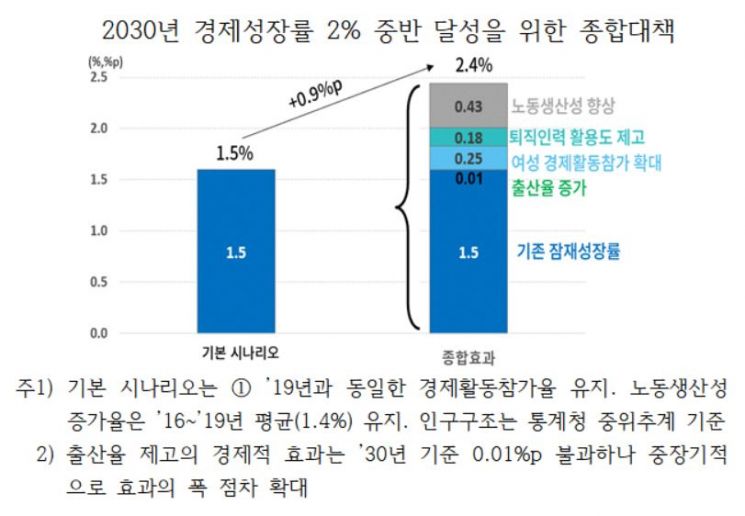
The Korea Chamber of Commerce and Industry's Sustainable Growth Initiative (SGI) predicted in its report titled "Causes of Decline in Growth Potential and Improvement Measures" on the 10th that the potential growth rate will drop to 1.5% by 2030.
The potential growth rate, which was around 4.7% in the 2000s (2000?2009), has decreased to 2% this year after experiencing the financial crisis and the COVID-19 crisis. Examining the causes of the decline in potential growth rate (-2.7 percentage points), labor input factors contributed -0.6 percentage points, and labor productivity factors contributed -2.1 percentage points, respectively.
The report suggested the following measures to slow down the decline in potential growth rate: ① increasing the birth rate, ② expanding women's economic participation, ③ enhancing utilization of retired workforce, and ④ improving labor productivity.
Increasing the birth rate is a fundamental solution, but it takes at least 15 years for newborns to enter the working-age population. Raising the female labor force participation rate (52.8%) to the level of European OECD countries (55.3%) or delaying retirement by 5 years would only increase the potential growth rate by 0.25 percentage points and 0.18 percentage points, respectively. In particular, SGI pointed out that if elderly labor competes with the younger workforce or if economic activity increases without maintaining labor productivity, the effect of growth rate improvement could be diminished.
On the other hand, if the labor productivity growth rate, which recently dropped to 1.4%, is raised to the past level (2011?2015 average of 1.9%), the potential growth rate is expected to increase by 0.43 percentage points compared to previous forecasts. In other words, improving labor productivity is a key factor in raising the potential growth rate.
Labor Productivity Can Be Improved Through Corporate Business Restructuring: "Increase Investment in New Industries Such as System Semiconductors and Batteries"
The report mentioned the necessity of corporate business restructuring as one way to improve labor productivity in domestic industries. The report stated, "Recently, domestic key industries are facing structural changes such as digital transformation and global supply chain restructuring, in addition to the impact of COVID-19," and added, "To adapt to these changes, companies should engage in business restructuring such as focusing on core businesses and acquiring new businesses to proactively improve their organizational structure and promote innovation activities."
It also called for increasing investment incentives in new growth engine sectors. The report argued, "For new growth engine sectors, it is necessary to strengthen tax support, such as restoring the investment tax credit rate to previous levels (5% for large enterprises, 7% for medium-sized enterprises)," and "National strategic technologies (currently semiconductors, batteries, vaccines) that receive up to 50% tax credit benefits for R&D investment should also include net-zero (carbon neutrality) technologies."
Kim Cheon-gu, SGI research fellow, said, "Companies should proactively carry out business restructuring targeting healthy companies to focus on core businesses and expand new growth businesses," and added, "Currently, domestic companies' main businesses have reached investment limits, making it difficult to increase productivity even with additional investments."
He continued, "We need to revise outdated regulations that do not exist in competing countries in the era of the 4th Industrial Revolution and increase productivity through convergence between digital technologies such as AI, IoT, big data, and existing industries."
© The Asia Business Daily(www.asiae.co.kr). All rights reserved.
![Clutching a Stolen Dior Bag, Saying "I Hate Being Poor but Real"... The Grotesque Con of a "Human Knockoff" [Slate]](https://cwcontent.asiae.co.kr/asiaresize/183/2026021902243444107_1771435474.jpg)
















