Dr. Kim Byung-gon’s Team at Korea Electrotechnology Research Institute
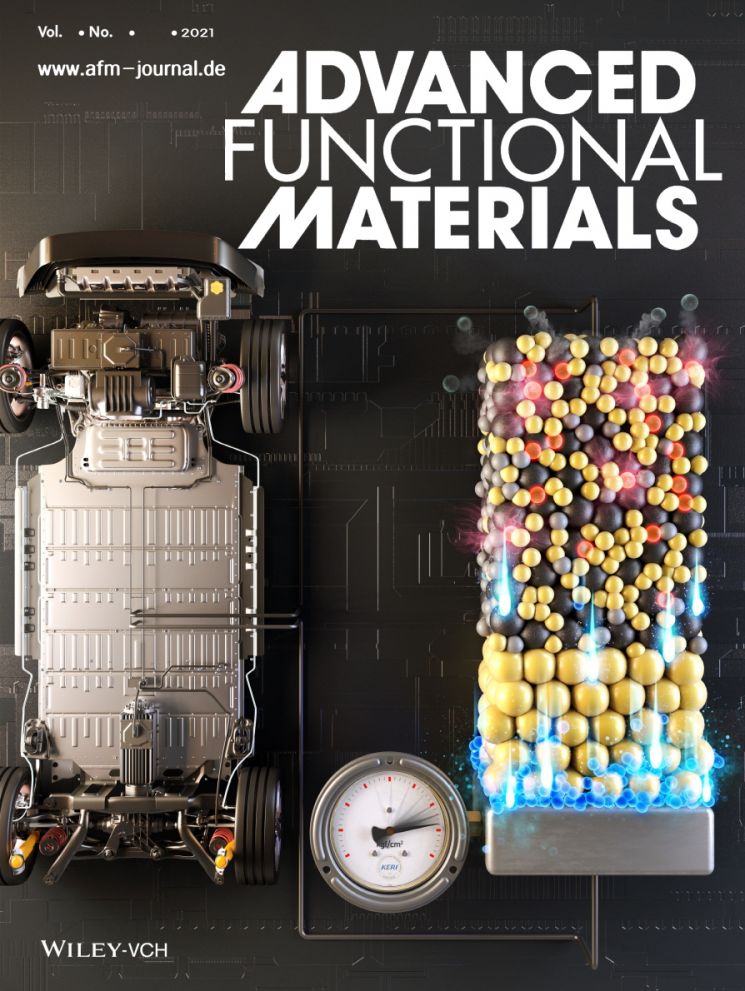 Research results on all-solid-state batteries from the Korea Electrotechnology Research Institute have been selected as the cover paper of the world-renowned academic journal Advanced Functional Materials.
[Asia Economy Reporter Kim Bong-su] A next-generation all-solid-state battery with a lifespan comparable to conventional lithium-ion batteries has been developed. By replacing the ionic electrolyte with a solid, the team succeeded in overcoming the drawback of shortened lifespan, marking significant progress toward commercialization.
The Korea Electrotechnology Research Institute (KERI) announced on the 8th that Dr. Kim Byung-gon’s team at the Next-Generation Battery Research Center successfully developed a sulfide-based next-generation all-solid-state battery with greatly improved stability and lifespan characteristics by introducing a "sacrificial cathode" and an "indium anode."
All-solid-state batteries replace the electrolyte, which transfers ions between the cathode and anode, from the conventional flammable liquid to a solid with lower risk of fire or explosion. Thanks to the enhanced safety, no separate safety devices are needed to protect against external shocks, and the solid electrolyte also serves as a separator, enabling diverse applications depending on usage, such as high capacity, miniaturization, and varied form factors.
The challenges to commercialization include low ionic conductivity, difficulties in manufacturing processes and mass production, and high costs. Particularly significant issues are the interfacial instability (high resistance at particle boundaries) between the solid electrolyte and the cathode/anode and conductive additives, resulting in active lithium loss and internal short circuits.
The research team addressed these problems by introducing the "sacrificial cathode" and "indium anode." The sacrificial cathode, introduced to compensate for lithium loss caused by interfacial instability, decomposes lithium nitride (Li3N) during charging, providing additional lithium to the battery. Furthermore, the added lithium reacts with the indium anode, causing further volume expansion that increases internal cell pressure and improves particle contact, thereby upgrading battery performance.
The indium anode suppresses the so-called "dendrite growth," where lithium grows in branch-like structures during repeated charging and discharging. By forming a stable chemical interface with the solid electrolyte, it significantly enhances the battery’s long-term lifespan characteristics.
To verify the effects of their development, the team analyzed real-time gas generation and cell pressure changes, as well as X-ray tomography, revealing that internal cell pressure and anode interface stability positively influence battery performance. Based on this principle, when KERI’s sacrificial cathode and indium anode technologies are applied to all-solid-state batteries, stable charge-discharge lifespan characteristics exceeding 260 cycles can be secured. Considering that currently commercialized lithium-ion batteries typically have 300 to 500 cycles, KERI’s technology represents a major achievement that could accelerate the commercialization of all-solid-state batteries.
Dr. Kim explained, “The sacrificial cathode eliminates the need to use metallic lithium anodes additionally, minimizing processes and costs during cell manufacturing while improving performance. Although the cell voltage of the indium anode is low and requires further research, its significance is very large in establishing the foundation for long-term stability in the anode sector, which determines the lifespan of all-solid-state batteries.”
The research team aims to develop all-solid-state batteries with top-level performance by continuously improving battery efficiency and developing anodes with stability beyond indium and voltage levels comparable to lithium.
This research was published as a front cover paper in the international materials science journal Advanced Functional Materials (IF=18.808).
© The Asia Business Daily(www.asiae.co.kr). All rights reserved.
![Clutching a Stolen Dior Bag, Saying "I Hate Being Poor but Real"... The Grotesque Con of a "Human Knockoff" [Slate]](https://cwcontent.asiae.co.kr/asiaresize/183/2026021902243444107_1771435474.jpg)
















