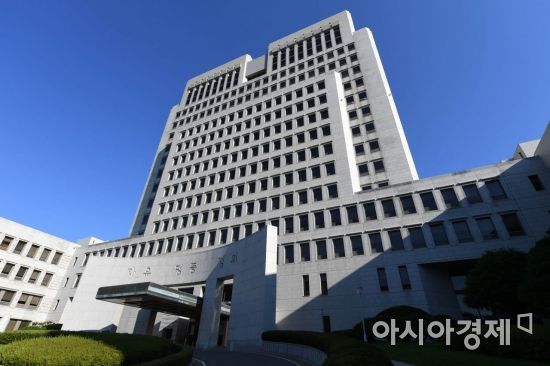
[Asia Economy Reporter Kim Hyung-min] The Supreme Court has ruled that even if a company created slush funds by receiving rebates from subcontractors, if the purpose was not personal gain but related to the company's interests, it cannot be punished for breach of trust.
The Supreme Court's 3rd Division (Presiding Justice Kim Jae-hyung) announced on the 4th that it upheld the lower court's acquittal in the final appeal of Mr. A, former head of the Civil Engineering Business Planning Team at Daewoo Construction, who was indicted for breach of trust under the Act on the Aggravated Punishment of Specific Economic Crimes.
The court recognized the lower court's judgment, stating, "The creation of slush funds was intended to facilitate smooth company operations, manage company executives and employees, and maintain relationships with business partners, and cannot be seen as unrelated to the company or aimed at personal gain."
Mr. A was indicted on charges of requesting a rebate of 2 billion KRW in exchange for raising the construction payment when the representative of a civil engineering subcontractor requested a golf course construction subcontract, and subsequently receiving a total of 800 million KRW while working as the head of the Civil Engineering Business Planning Team from 2007 to 2009.
The first trial court sentenced him to 10 months in prison, stating that although Mr. A was involved in creating, receiving, and executing off-the-books funds (slush funds) under the direction of his superior, the head of the Civil Engineering Business Headquarters, it did not appear that the funds were used for personal purposes.
In the second trial, new facts emerged showing that executives and each team found it insufficient to cover business expenses for securing construction orders, event expenses, and employee incentives with corporate cards, and thus created slush funds at the department level using the rebate money received.
Accordingly, the second trial court acquitted Mr. A, stating, "Although creating off-the-books funds without proper accounting harms the soundness and transparency of corporate activities, it is difficult to conclude solely based on the evidence that the defendant had the intention to realize illegal gains at the stage of creating off-the-books funds." The Supreme Court also found no error in this judgment.
© The Asia Business Daily(www.asiae.co.kr). All rights reserved.
![User Who Sold Erroneously Deposited Bitcoins to Repay Debt and Fund Entertainment... What Did the Supreme Court Decide in 2021? [Legal Issue Check]](https://cwcontent.asiae.co.kr/asiaresize/183/2026020910431234020_1770601391.png)















