Existing Neurons Replaced with New Ones After Same Experience
Common Belief That Existing Neurons Are Strengthened Disproved
KAIST Researchers Confirm This for the First Time Worldwide
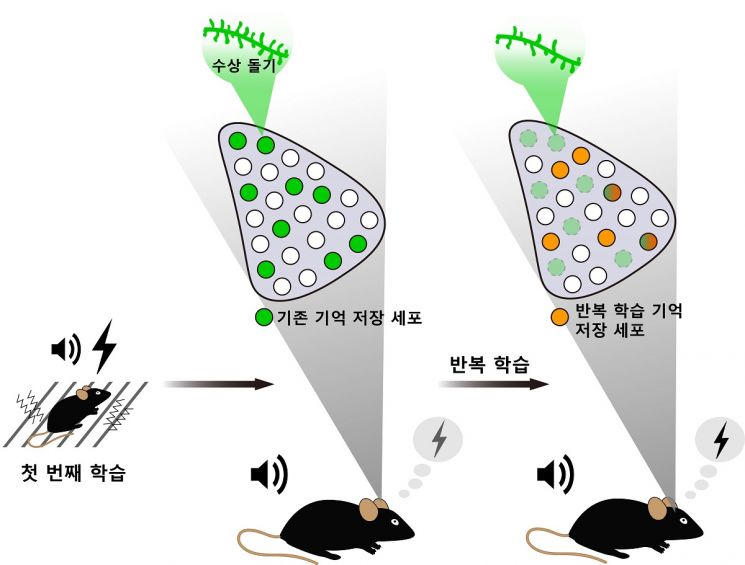
[Asia Economy Reporter Kim Bong-su] A domestic research team has become the first in the world to confirm that when an animal's brain repeats the same experience, the neurons (nerve cells) that hold that memory are replaced with new ones. This research overturns the paradigm that the same memory is continuously stored in the same neurons to reinforce the experience.
The Korea Advanced Institute of Science and Technology (KAIST) announced on the 3rd that Professor Han Jin-hee's research team in the Department of Biological Sciences used a technique to label, track, and observe memory-storing neurons in the living mouse brain, revealing that when the same experience is repeated, the originally existing old memory neurons are replaced by new neurons.
As a mechanism enabling this 'neuron switching,' a joint study with Professor Kim Eun-jun's team at the Institute for Basic Science (IBS) demonstrated that when previously experienced learning is repeated, synaptic connections decrease in existing memory neurons, while synaptic connections increase in newly participating neurons.
This study is academically significant as it is the first to prove that contrary to the conventional belief that the same memory is continuously stored in the same neurons allowing experience accumulation, neurons are dynamically replaced in the brain when the same experience is repeated, fundamentally shifting the existing paradigm.
Neuron replacement is considered an important mechanism for memory updating and suggests new ideas for developing technologies to address memory loss in aging and degenerative brain diseases. Experiences are stored in the brain as memories and later recalled. Most memories are maintained and updated in the brain through repetitive experiences. Numerous studies have revealed that there is a physical unit representing memory in the brain and that specific groups of nerve cells (memory engrams) encode memories.
So, what changes occur in neurons storing memories when exposed to repeated experiences? Previous research speculated that memories formed by repeated learning are continuously stored and reinforced through the same group of nerve cells. However, it was not clearly understood what changes occur at the nerve cell level.
In this study, the research team used a technique to label memory-storing cells in the amygdala region of the mouse brain and control them optogenetically. Contrary to previous beliefs, they discovered that when the same learning is repeated one day after the initial learning, the 'same' memory is stored and recalled through completely different cells. They confirmed that the repeated learned memory is normally expressed even while suppressing the memory engram formed by the first learning.
After repeated learning, synaptic plasticity decreased in the existing engram, indicating that repeated experiences weaken the connections of the existing memory engram in the memory circuit, so it does not participate in memory expression. Synaptic plasticity refers to the ability of synapses, the structural sites where information is transmitted between nerve cells, to continuously change their structure and function depending on their level of activity.
Although the existing memory engram was not necessary for the repeated learned fear memory, interestingly, when the existing memory engram was stimulated optogenetically, a fear response was observed. This confirmed that despite weakened connections, the existing memory engram still retains memory information and exists as a 'silent engram.'
Furthermore, the research team demonstrated that the repeated learned fear memory is newly stored in amygdala neurons activated during the second learning, providing additional evidence that memories of the same experience are encoded in different cell groups from the first time.
Professor Han Jin-hee said, "Although memories appear fixed, the cells storing those memories in the brain dynamically switch, presenting a new paradigm. This discovery will help develop future memory control technologies targeting memory neurons to enable deletion of unwanted memories and suppression or restoration of memory loss in degenerative brain diseases."
© The Asia Business Daily(www.asiae.co.kr). All rights reserved.

















