Despite Concerns Over Transaction Cliff and House Price Decline, Resale-Allowed Investment Sites Show Excessive Overheating
Overflowing Liquidity and Easy Subscription Fuel Short-Term Speculator Surge
[Asia Economy Reporter Kim Hyemin] #A, a dual-income office worker in her 30s, makes it a routine with her husband to keep track of major real estate pre-sale schedules. As a single-homeowner for whom winning an apartment subscription is virtually impossible, A is interested in non-regulated products without subscription eligibility restrictions, such as officetels and residential hotel facilities. On the 2nd, A and her husband each applied for subscription under their own names for the ‘Hillstate Gwacheon Cheongsayeok’ officetel, which was pre-sold in Byeolyang-dong, Gwacheon-si. A said, "I applied just in case, thinking that if I win, I would sell it with the initial premium attached to the pre-sale right."
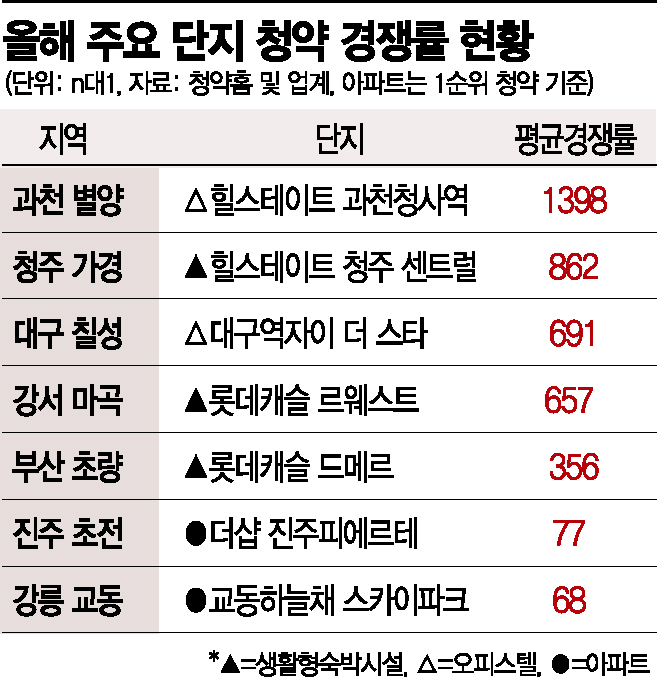
Despite growing concerns over falling house prices due to a sharp decline in buying demand, the investment fever in niche real estate markets is actually heating up. As apartment regulations such as loans and resale restrictions tighten, subscriptions for small-scale officetels, residential hotel facilities, and apartments in non-regulated areas where resale is allowed are overheating. The subscription results for the Hillstate Gwacheon Cheongsayeok officetel, which attracted over 1.2 trillion won in subscription deposits and recorded a competition rate of ‘1398 to 1’ the previous day, clearly demonstrate this enthusiasm.
While some real demand buyers have turned to officetels due to the ‘insurmountable’ apartment prices, experts analyze that investment demand is even greater. This is especially because a large number of subscription applications are concentrated on complexes where pre-sale rights can be bought and sold. The Hillstate Cheongju Central, a residential hotel facility pre-sold in Cheongju, Chungbuk, recorded an average competition rate of 862 to 1. The Daegu Jaieok The Star officetel, which offers 81 units and allows free resale, also showed an average competition rate of 691 to 1.
The fact that subscriptions are less stringent than for apartments is also a factor attracting investment demand. Even for officetels alone, a subscription savings account is not required, and winners are selected by lottery rather than by points. Adults aged 19 or older, including multi-homeowners, can apply. For the Hillstate Gwacheon Cheongsayeok officetel, only 10% of the total supply was allocated to local residents, so subscriptions poured in from across the country.
Since winners can resell immediately and do not lose their subscription savings accounts, the mentality of ‘just apply first’ follows. The Lotte Castle Le West, pre-sold in Magok-dong, Gangseo-gu last August, recorded an average competition rate of 657 to 1 despite controversy over its high pre-sale price, which is not unrelated to this. The pre-sale price for a 49㎡ unit with one bedroom was set at up to 900 million won, and a ‘short-term trading market’ formed where buyers and sellers traded with premiums immediately after winning, causing controversy. Apartments in non-regulated areas have also effectively turned into speculative markets, with Seoul residents engaging in pre-sale right buying sprees after subscription winner announcements.
Professor Seo Jin-hyung of Gyeongin Women’s University (President of the Korean Real Estate Society) said, "Due to the rapid rise in apartment prices and strengthened regulations, existing liquidity that was released has nowhere suitable to invest, so it is flowing into niche real estate markets. Interest rate hikes are also not attractive enough to curb investment demand, so this phenomenon is expected to continue."
However, experts point out that ‘blind investments’ made without considering future value can be risky. Although some standards have been relaxed to allow residential hotel facilities to be converted into residential officetels, strict regulations are in place to prevent illegal conversion of residential hotel facilities for residential use. For officetels, the investment yield has been on a continuous decline from 4.77% in January this year. Song Seung-hyun, CEO of City and Economy, said, "Due to the frenzy, even officetels in poor locations with low real demand are gaining popularity, but if the decline intensifies, they could be the first to be hit. Since they have lower liquidity than apartments, future value must be carefully considered."
© The Asia Business Daily(www.asiae.co.kr). All rights reserved.
![Clutching a Stolen Dior Bag, Saying "I Hate Being Poor but Real"... The Grotesque Con of a "Human Knockoff" [Slate]](https://cwcontent.asiae.co.kr/asiaresize/183/2026021902243444107_1771435474.jpg)











