As Delivery Fee Increases Burden
Menu Prices Adjusted to Offset Losses
In-Store Customers Effectively Pay Part of Delivery Fee
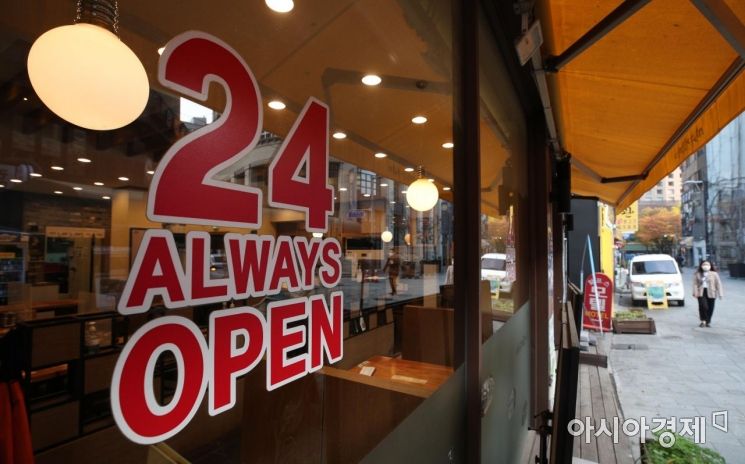 On the 1st, when the phased daily recovery (With Corona) was fully implemented, a 24-hour operation sign was posted at a restaurant in Seoul city. From this day, up to 10 people can gather in the metropolitan area, and up to 12 people in non-metropolitan areas, and most facilities such as restaurants and cafes can operate 24 hours./Photo by Kim Hyun-min kimhyun81@
[Asia Economy Reporter Seungjin Lee] #A pasta specialty restaurant located in Dongdaemun-gu, Seoul raised its menu prices by 1,000 won each after starting delivery service last year. Since it was impossible to pass the entire delivery fee of 4,500 won onto delivery customers, the store decided to cover 2,000 won of the cost. However, as the COVID-19 pandemic prolonged and delivery demand surged rapidly, the burden of delivery fees increased, leading the store to incorporate the delivery fee into the menu prices to offset losses. As a result, dine-in customers ended up paying food prices that included the delivery fee.
As delivery became the trend due to COVID-19, more customers visiting stores are having to pay food prices that include delivery fees. This is because the increased delivery fees were incorporated into the food prices, and the same prices are charged to dine-in customers as well. A hamburger shop located in Dongdaemun-gu, Seoul raised its menu prices by 500 won each.
Initially, for the ‘Cheeseburger,’ the price was 6,900 won in-store and 7,900 won for delivery, with an additional delivery fee charged separately. However, as delivery orders increased, a review appeared on the delivery platform stating, “They charge a delivery fee of 2,500 won and still raise the menu price by 1,000 won for delivery orders of the same item,” which led to a price adjustment. Subsequently, the in-store cheeseburger price was changed to 7,400 won, while the delivery price was maintained, reducing the price gap between in-store and delivery.
Mr. Kang Chanyoung (37, pseudonym), who operates the hamburger shop, explained, “If we lowered the delivery order price, we would incur losses, so we had no choice but to raise the in-store menu prices to narrow the price difference with delivery orders.”
Recently, ‘dual pricing’?where in-store and delivery prices differ?has become controversial in some hamburger franchises. Delivery menu prices being over 1,000 won higher than in-store prices was problematic, prompting many dining businesses to set the same prices for both in-store and delivery. However, in most cases, this meant reflecting the delivery fee in the in-store prices, and with the gradual transition to daily recovery (With COVID), further criticism of dual pricing is expected.
An industry insider said, “Due to the prolonged COVID-19 pandemic, there have been unusual cases of pricing shaped by unprecedented delivery demand,” adding, “As store operations return to normal with the transition to With COVID, it seems necessary to adjust prices again to correct these issues.”
© The Asia Business Daily(www.asiae.co.kr). All rights reserved.
![Clutching a Stolen Dior Bag, Saying "I Hate Being Poor but Real"... The Grotesque Con of a "Human Knockoff" [Slate]](https://cwcontent.asiae.co.kr/asiaresize/183/2026021902243444107_1771435474.jpg)
















