'Virtual Factory' Enables Experimentation and Data Collection
Usable Anywhere Worldwide, Also for Technology Export
KAIST Opens 'Manufacturing AI Metaverse Factory' Experience Center Offering Pilot Service from the 1st
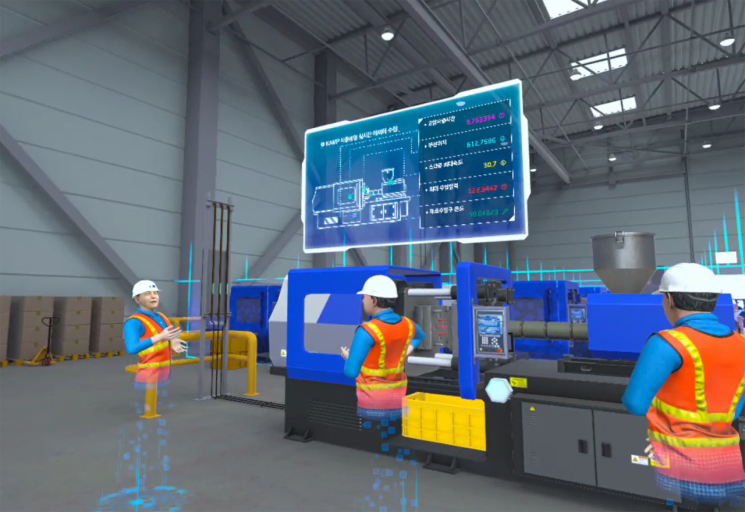
[Asia Economy Reporter Kim Bong-su] A 'virtual factory' has been created where small and medium-sized manufacturing companies can collect data from the manufacturing process, analyze it with artificial intelligence (AI), and use it to improve on-site processes. This is a place that implements metaverse (extended virtual world) technology, allowing production to continue without interruption for experiments and data collection, and can be utilized from anywhere in the world, which is expected to greatly assist companies in technology development and overseas exports.
The Korea Advanced Institute of Science and Technology (KAIST) opened the 'Manufacturing AI Metaverse Factory Experience Center' on the 1st at the Manufacturing AI Big Data Center Pairing Room in the Munji Campus of the Daejeon Daedeok Research and Development Special Zone, with President Kwang-Hyung Lee and Kim Heung-nam, head of the 'K-Industry 4.0' Promotion Headquarters, among others participating. This virtual factory implements manufacturing-specialized AI in the metaverse world, providing an experiential service that combines AI technology with manufacturing data collected from actual sites for analysis and utilization. KAIST's 'K-Industry 4.0 Promotion Headquarters' and 'Manufacturing AI Big Data Center' are in charge of operation. DigiFore, a developer and supplier of application software, donated all the hardware and software necessary for building the experience center and supported the technology for its operation.
The experience center was planned based on the awareness of the lack of content that allows small and medium-sized manufacturing companies to intuitively experience the process of collecting manufacturing data and analyzing it with AI, and then apply it to on-site factories. Users wearing augmented reality equipment can visit a metaverse factory that manufactures plastic screws and directly operate an injection molding machine, experiencing the plastic screw production process exactly as in an actual manufacturing site. Manufacturing AI analyzes manufacturing data collection variables such as temperature, pressure, speed, position, and time to immediately detect the causes of defects and improve productivity and quality, which can be experienced in the virtual factory.
If such analysis is conducted in an actual factory, there is the difficulty of temporarily halting the production process for business operations. The greatest advantage of the Manufacturing AI Factory created in the metaverse is that the process can be vividly experienced without affecting operating profit. It can also be accessed from anywhere in the world using augmented reality (AR), virtual reality (VR), extended reality (XR) equipment, and metaverse solutions. Domestic small and medium-sized manufacturing companies, which have been struggling with overseas market development and sales of manufacturing site production lines due to the COVID-19 pandemic, can use this experiential technology as a platform to introduce excellent manufacturing technology overseas and export it.
Starting with the injection molding machine metaverse factory, KAIST plans to expand its application to industries such as plating, welding, mold, casting, forging, and heat treatment, contributing to the enhancement of manufacturing competitiveness in Korea's small and medium-sized foundational industries.
Kim Il-jung, head of the KAIST Manufacturing AI Big Data Center, said, "At this year's World Economic Forum (WEF) annual meeting, it was emphasized that the biggest change in the manufacturing sector over the next five years will be determined by AI machine learning," adding, "Choosing the optimal AI algorithm suitable for manufacturing sites in various industries will act as a critical success factor for improving the competitiveness of our country's manufacturing industry."
© The Asia Business Daily(www.asiae.co.kr). All rights reserved.
![Clutching a Stolen Dior Bag, Saying "I Hate Being Poor but Real"... The Grotesque Con of a "Human Knockoff" [Slate]](https://cwcontent.asiae.co.kr/asiaresize/183/2026021902243444107_1771435474.jpg)
















