Parents' Concerns Deepen on the First Day of 'With Corona'
Care Gaps Arise Due to Conflicting Recovery Schedules
Welcoming School Attendance but Coexisting Fears of Infection Spread
Increased Infection Rates Among Teens and in Schools
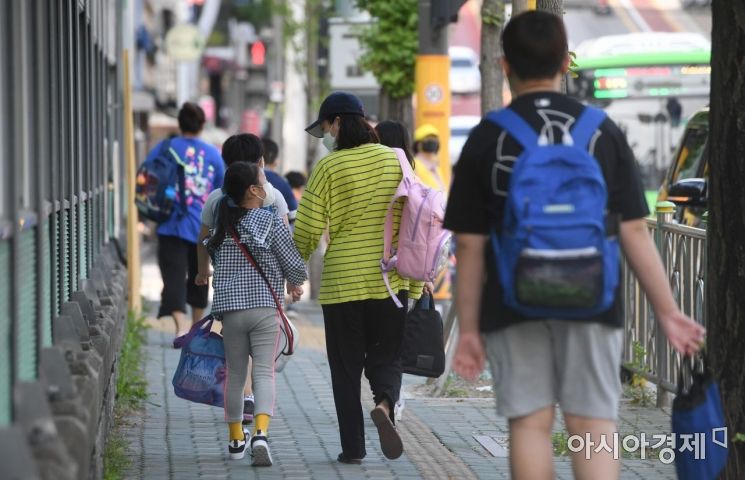 On the 6th, students are attending school at an elementary school in Gangbuk-gu, Seoul, where in-person classes have expanded in areas under Level 4 social distancing. In areas with Level 4 distancing, 1st and 2nd graders attend school every day, 3rd to 6th graders attend at no more than half capacity, and middle school students attend at no more than two-thirds capacity. For high schools, 3rd-year students, who are exempt from density restrictions, attend every day, while 1st and 2nd-year students attend at half capacity or may attend fully.
"Remote work has ended, but the kids have to attend school every day starting from the 22nd, which is quite challenging."
Although the phased return to normal life (With Corona) began this month, parents are deeply concerned because full in-person attendance starts only after the College Scholastic Ability Test (CSAT).
From the 22nd, all kindergartens and elementary, middle, and high schools nationwide will implement full in-person attendance. Until now, elementary and middle schools in the metropolitan area have allowed about two-thirds of students to attend in person under the Level 4 social distancing guidelines, but this will change to daily attendance. Starting on the 22nd, kindergartens will also resume peer and outdoor play and physical activities normally, and elementary, middle, and high schools will permit group and discussion classes as well as small-scale experiential activities. After a three-week preparation period, the attendance schedule was aligned to start after the CSAT day (the 18th), but parents are worried about care gaps as they begin returning to normal life first.
A dual-income parent in their 30s, Mr. A, said, "It would be great if the kids could all attend school together, but since remote work has ended, parents worry whether their children can attend online classes alone at home." Another parent in their 30s, Ms. B, said, "Although academies say they will operate normally, it is hard to understand why elementary schools, which do not overlap with the movement paths of high school seniors, have a three-week preparation period for attendance. The vacation is almost over, and I don’t know what they have been preparing for during the past two years."
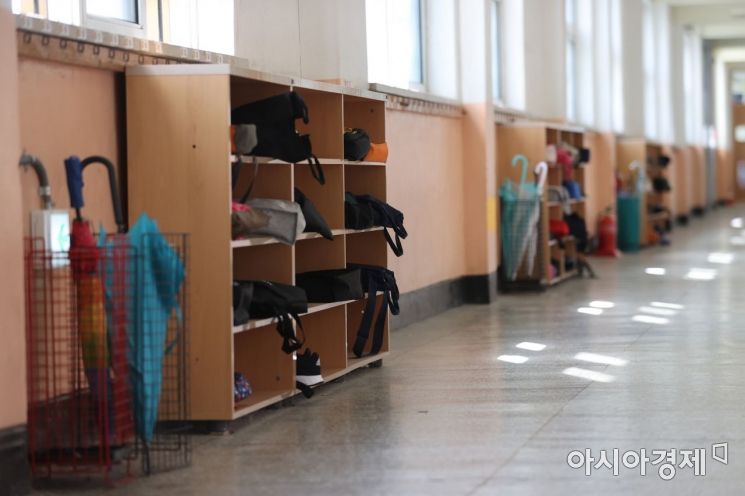 On the morning of the 6th, when in-person classes expanded in areas under Level 4 social distancing, indoor shoe bags filled with students' indoor shoes were seen at the shoe rack of Beondong Elementary School in Seongbuk-gu, Seoul.
 According to the "Second Semester Academic Operation Plan" announced by the Ministry of Education last month, from this day, attendance is allowed for about two-thirds of students by school level even in Level 4 areas.
Grades 1 and 2 in elementary school attend every day, grades 3 to 6 attend up to half the students, and middle school students attend up to two-thirds.
For high school, seniors (Grade 3), who are exempt from density restrictions, attend every day, while grades 1 and 2 attend half the students or may attend fully. 2021.9.6
Most parents welcome the expansion of in-person attendance as children, who have become accustomed to online classes for about two years, will now go to school every day. However, with daily COVID-19 cases recently reaching the 2,000s, there are concerns about the spread of infection among children.
In the past three months, the proportion of student infections traced to ‘school’ was 16.6%, higher than the first semester’s 15.9%. As of the 26th of last month, vaccination reservation rates for children and adolescents are only 62% for ages 16-17 and 23.1% for ages 12-15. Since there is currently no vaccination plan for those under 12, reliance on ‘quarantine measures’ is inevitable.
A dual-income parent, Mr. C, said, "From the perspective of dual-income families who do not heavily rely on private education, full in-person attendance is very welcome, but with more confirmed cases than during previous social distancing and children not vaccinated, it feels a bit rushed. It seems that schools have not adequately prepared for With Corona over the past two years."
A parent in their 40s, Mr. D, said, "One semester has passed, but many children do not know the faces or names of their classmates, and younger elementary students inevitably need time to adapt to school and group life, so I welcome full in-person attendance." However, he added, "Since many children are unvaccinated, rather than full attendance, we should consider measures such as adjusting the total number of students attending by day."
The Ministry of Education also acknowledges that an increase in infections among students and within schools is inevitable considering With Corona. The Ministry plans to maintain a special quarantine system by providing additional quarantine personnel, guiding the wearing of KF80 or higher-grade health masks, and expanding the operation of mobile polymerase chain reaction (PCR) testing teams.
© The Asia Business Daily(www.asiae.co.kr). All rights reserved.


















