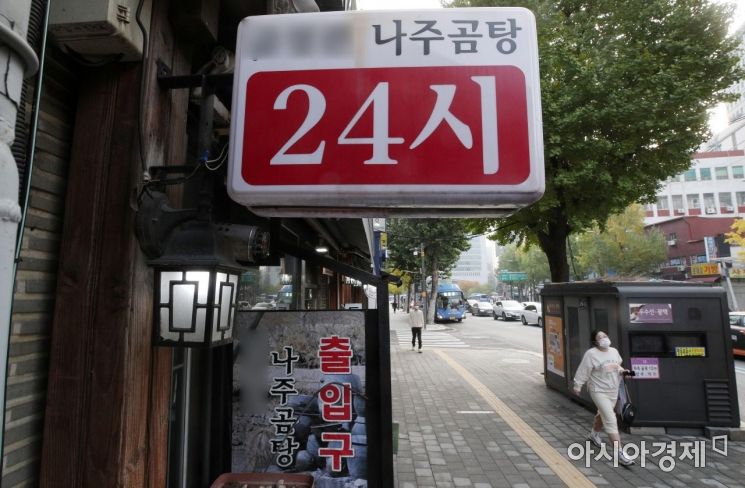
 On the 1st, when the phased daily recovery (With Corona) was fully implemented, a sign indicating 24-hour operation was posted at a restaurant in Seoul city. From this day, up to 10 people can gather in the metropolitan area, and up to 12 people in non-metropolitan areas, and most facilities such as restaurants and cafes can operate 24 hours./Photo by Kim Hyun-min kimhyun81@
[Asia Economy Reporter Seungjin Lee] The dining industry is expected to implement price increases across the board in November. Delivery fees are rising by nearly 30% simultaneously in most regions nationwide, intensifying inflationary pressures. This is likely to act as another setback for the dining industry, which had high hopes following the phased return to normal life (With Corona) implemented this month.
According to the dining industry on the 1st, delivery agency fees have increased by about 30% from today in most regions nationwide. For example, a delivery agency in Gangdong-gu, Seoul, raised its basic delivery fee from 3,850 won to 4,950 won starting today. Another delivery agency in Gangbuk-gu increased the delivery fee within the 1.2 km area from 3,800 won to 4,200 won for the 600m to 1.2 km section by segmenting the zones.
The delivery agencies explained that the fee hikes are measures taken in response to the continuous outflow of personnel to major delivery platforms such as Baedal Minjok and Coupang Eats. Their strategy is to preemptively reflect next year’s minimum wage increase to minimize staff losses.
However, this delivery fee increase is expected to pressure dining businesses to raise their prices. Due to fierce delivery competition among dining establishments during COVID-19, owners have been bearing a significant portion of delivery fees.
Lee Byung-geon (41, pseudonym), who runs a pho restaurant in Seoul, explained, "If the 'delivery tip' exceeds a certain level, consumers simply stop ordering, so the only option is to incorporate the delivery fee into the menu prices. Since prices of other ingredients have also risen sharply, this delivery fee increase is a big blow."
In November, price hikes will continue beyond delivery fees. Following Seoul Milk last month, dairy product prices from Maeil Dairy and Namyang Dairy will increase by 4-10% starting this month. Additionally, coffee bean prices have risen 70% over the past year due to the impact of COVID-19. On top of that, liquefied petroleum gas (LPG) supply prices will also rise. From this month, the price will increase by 165 won per kilogram, burdening small business owners who mainly use LPG gas.
A dining industry official stated, "Over the past year, due to logistics disruptions caused by COVID-19, prices of major ingredients have risen sharply, increasing pressure on dining businesses to raise prices. The November increases in delivery fees and other prices, along with the upcoming rise in labor costs, have significantly dampened the expectations associated with the transition to With Corona."
© The Asia Business Daily(www.asiae.co.kr). All rights reserved.

















