'Hoarding Disorder' Collecting Even Garbage
Neighbors Complain of Odor and Insects
No Accurate Statistics on Hoarding Disorder Patients
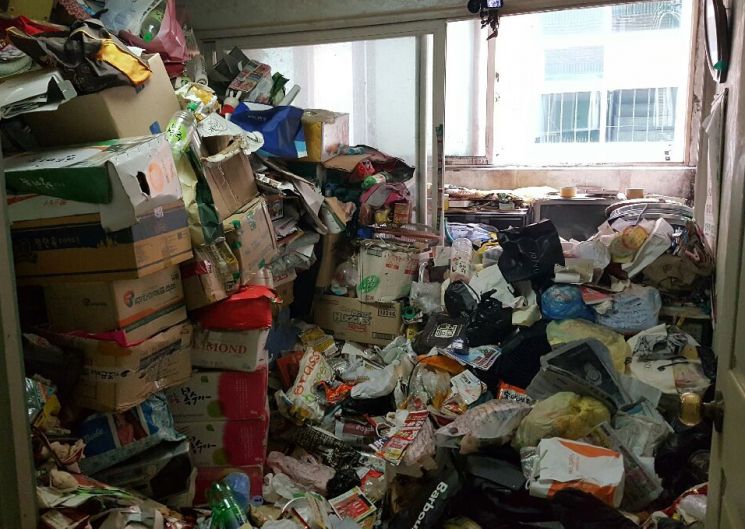 Trash filling the entire house. The foul odor spreads to neighbors and surrounding people, and it can also pose a fatal health risk to the residents themselves due to bacteria originating from the garbage.
 [Image source=Yonhap News]
[Asia Economy Reporter Yoon Seul-gi] # A in their 20s, a college student, recently won a lottery for a rental apartment and moved out independently. Although the independence started with excitement, the happiness did not last long. A began to feel stressed by cockroaches crawling on the walls and ceiling and flying fruit flies. It turned out that the bugs were attracted and the smell spread because the next-door neighbor had piled up garbage inside their house. Besides A, other nearby neighbors also felt discomfort from the foul odor and filed complaints, revealing the reality of the neighbor who lived surrounded by trash.
# B, the landlord who rented out their apartment, is currently troubled by the tenant C. B learned from the apartment management, after receiving complaints from neighbors, that the rented house had become a 'garbage house.' Shocked by the news, B visited C and was horrified. C was keeping dozens of cats inside the house, and the cat excrement mixed with a large amount of garbage had turned the house into a complete mess. After consulting a cleaning specialist, B was informed that cleaning would cost over one million won and that the contamination was so severe that cleaning alone could not restore the house to its previous condition.
◆ 'Hoarding Disorder,' a Type of Obsessive-Compulsive Disorder... Causes Stress and Depression
Recently, the number of hoarding disorder patients has increased, emerging as a new social issue. Hoarding disorder is a type of obsessive-compulsive disorder where a person continuously accumulates any items inside their home and feels uncomfortable and anxious if they do not do so. They even bring garbage into the house.
Hoarding disorder began to be classified by the American Psychiatric Association in 2013 and has since become socially recognized. In Korea, there are no exact statistics on people suffering from hoarding disorder, but in the U.S., it is known that 2-5% of the total population are hoarding disorder patients.
The exact cause of hoarding disorder is not clearly known yet, but it usually appears as a compensatory psychology to escape from pain caused by stress or depression, or is often observed in people living alone who lack emotional interaction with others.
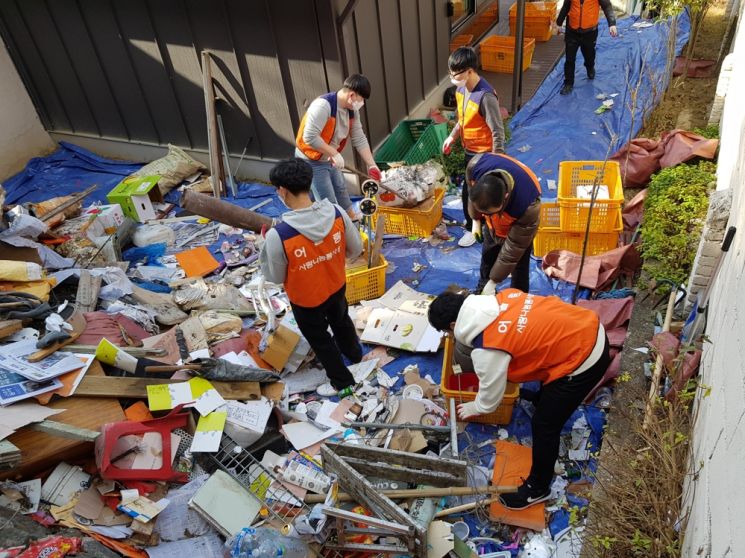 In December last year, public officials from the district office and volunteers collected garbage from the home of a resident suffering from hoarding disorder in Jiwon 1-dong, Dong-gu, Gwangju.
 [Image source=Yonhap News]
◆ Houses Filled with Garbage, Bugs, and Foul Odors... Neighbors Suffer
The problem is that by collecting garbage that should be discarded, an unsanitary environment is created, leading to the occurrence of maggots, fruit flies, and cockroaches, which can adversely affect health.
As seen in the cases above, if a person living in an apartment complex has hoarding disorder, they can cause harm not only to themselves but also to their neighbors. Although complaints from neighbors are increasing, local governments across the country are currently responding mainly by improving the residential environment.
Namdong-gu in Incheon announced in September that it had cleaned up about 400 kg of garbage piled up inside and outside the house of a man in his 60s. From January to July this year, Namdong-gu conducted a total of 48 residential environment improvement projects through visiting health and welfare services over seven months.
In Seongnam, Gyeonggi Province, the 'Seongnam City Ordinance on Support for Suspected Hoarding Households' was proposed and has been in effect since November 2 last year. The ordinance aims to provide a legal basis to support residents living in unsanitary and hazardous housing environments due to hoarding, contributing to residents' health and welfare improvement.
In Cheonan, Chungnam Province, a related ordinance was enacted in September last year, with a budget of 30 million won allocated in this year's budget. As of September, support for waste disposal and disinfection costs has been provided to 11 households, and counseling and hospitalization treatment are being conducted for those with severe mental disorders.
However, there is also an opinion that large-scale measures should be taken at the central government level rather than just local government responses. When garbage accumulates and foul odors spread, it should not be limited to just cleaning up the items but also include national-level responses to the patients causing the problems. Currently, there are no accurate statistics even on the number of hoarding disorder patients.
Experts emphasize that hoarding disorder patients need treatment rather than punishment such as fines. Professor Kwon Jun-su of Seoul National University Department of Mental Health Medicine said in an interview with KBS, "Patients should naturally be diagnosed at hospitals and receive treatment since it is caused by illness," adding, "Even if fines are imposed, if they do not have the strength to overcome their anxiety, the same behavior will continue."
© The Asia Business Daily(www.asiae.co.kr). All rights reserved.


















