SK Innovation Q3 Earnings Conference Call
SK On "1.6 TWh Electric Vehicle Battery Orders"
Competitor LG Also 200 Trillion+ α...Likely Similar
"Targeting Breakeven Next Year
Battery Material Recycling, US·China·EU Factories in Preparation"
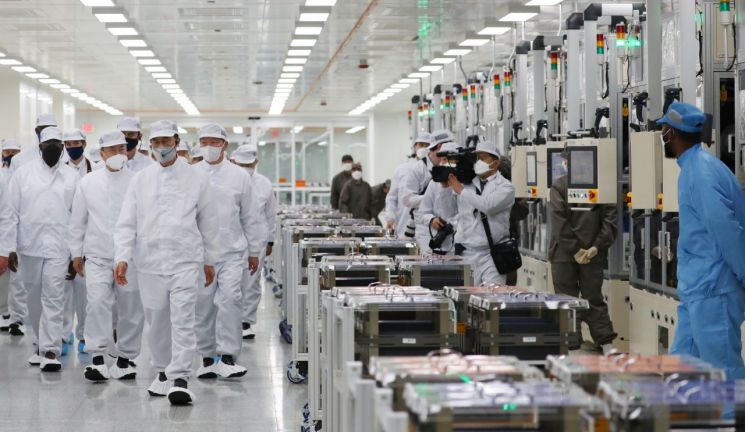
[Asia Economy Reporter Choi Dae-yeol] SK On announced on the 29th that the battery volume ordered from electric vehicle manufacturers currently stands at 1.6 TWh, equivalent to approximately 220 trillion KRW. This volume ranks among the top globally in the battery industry.
Yoon Hyung-jo, Head of Battery Planning at SK On, said during the Q3 earnings conference call, "The order volume is 1.6 TWh, worth 220 trillion KRW, considering the joint venture (JV) effect with Ford. In addition to existing customers such as Hyundai Motor, Kia, Daimler, and Volkswagen, we are pursuing new orders from other global OEMs (electric vehicle manufacturers)."
Previously, at the mid-to-long-term management strategy briefing in early July, the figure was 130 trillion KRW, which has increased by about 90 trillion KRW in just over four months. Considering that Chinese CATL and LG Energy Solution, which compete for first and second place globally in electric vehicle usage, have order volumes exceeding 200 trillion KRW, SK On's volume is estimated to be at a similar level. LG's battery order volume was about 180 trillion KRW as of the end of July, and considering supply volumes to the Stellantis joint venture, the industry expects it to be around 220 trillion KRW.
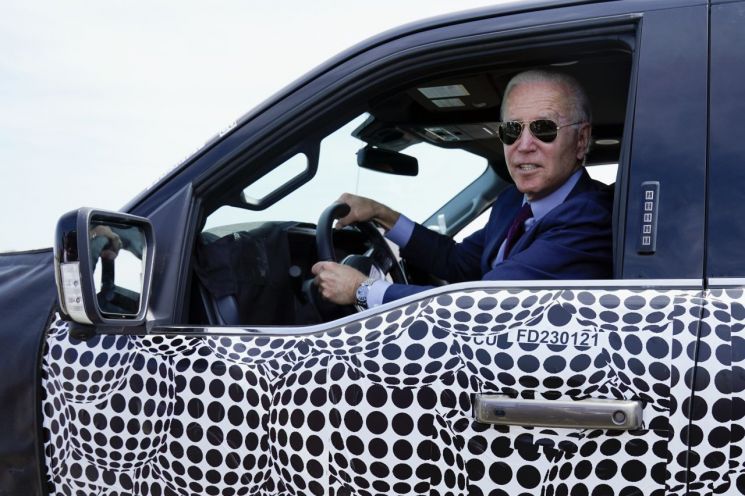 Last May, U.S. President Joe Biden personally test-drove Ford's electric pickup truck. It is a model that uses SK batteries.
 Electric vehicle batteries are often contracted in advance through mid-to-long-term agreements based on the models automakers plan to develop. Following Europe and China, the U.S. has recently been actively expanding electric vehicle adoption, leading not only major automakers but also early-stage startups to continuously launch new models. As supply of electric vehicle batteries is expected to become more challenging in the next three to four years, demand to secure supply early is increasing, and with major battery companies competing for orders, the overall market is rapidly growing.
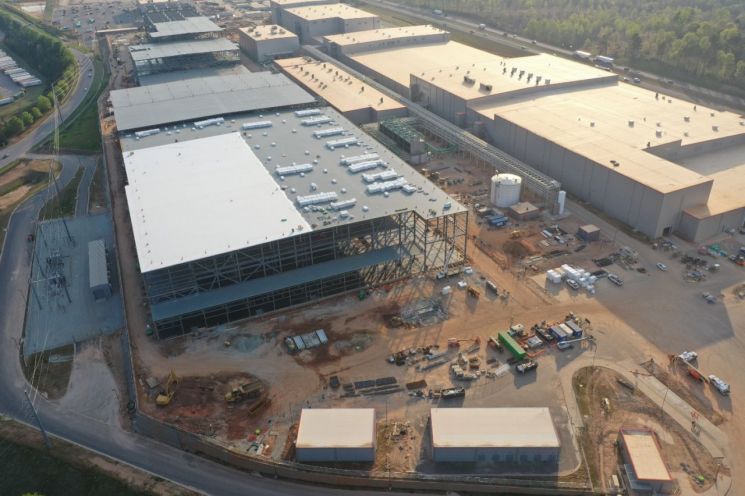
Yoon stated that SK will supply batteries not only for Volkswagen electric vehicles produced in the U.S. but also for electric vehicles launched in Europe. Mass production will also begin next year at the first plant in Georgia, U.S., and the second plant in Hungary, further increasing global supply. However, the company expects it will be difficult to achieve EBITDA profitability this year as initially targeted. The semiconductor shortage has caused production delays across automakers, pushing back electric vehicle production schedules and reducing battery supply volumes accordingly.
Nonetheless, SK On expects to post EBITDA profit on a quarterly basis in Q4 this year. The company's operating loss in Q3 was 98.7 billion KRW, slightly larger than in Q2. However, quarterly sales steadily increased to 816.8 billion KRW. Cumulative sales from Q1 to Q3 reached 1.9733 trillion KRW, and the company expects annual sales to exceed 3 trillion KRW including Q4. Yoon said, "Our goal is to achieve break-even point (BEP) based on operating profit next year."
Regarding lithium iron phosphate (LFP) batteries, which are widely used mainly by Chinese companies, the company stated it is developing solutions to compensate for their drawbacks. Yoon said, "It is true that LFP batteries have lower energy density and larger volume, raising questions about whether they meet OEM requirements. We are developing batteries with higher energy density and faster charging speeds based on our high energy density capabilities."
Regarding power shortages in China, the company said that although there were requests from local governments and others to reduce power consumption, operations are continuing smoothly through cooperation with local authorities. Currently, the company operates joint venture factories in Changzhou, Yancheng, and Huizhou, China. On battery recycling, the company believes it has a cost advantage compared to others due to recovery technology applicable to the mainly used high-nickel type batteries.
The company reported that it has completed pilot plant verification at a demonstration level and is constructing a demo plant at its Daejeon R&D center to assess suitability for large-scale mass production. Kim Hyun-seok, Head of Portfolio Development at SK Innovation, said, "We plan to complement missing capabilities through partnerships and aim to operate three plants in the U.S., China, and Europe after 2025."
© The Asia Business Daily(www.asiae.co.kr). All rights reserved.
![Clutching a Stolen Dior Bag, Saying "I Hate Being Poor but Real"... The Grotesque Con of a "Human Knockoff" [Slate]](https://cwcontent.asiae.co.kr/asiaresize/183/2026021902243444107_1771435474.jpg)


















