Insufficient Domestic Production Volume
Importing Overseas Factory Production
[Asia Economy Reporter Choi Dae-yeol] It has been revealed that South Korea's battery import volume is rapidly increasing.
The increase in imports is mainly for rechargeable lithium-ion batteries, products that have seen a surge in demand worldwide due to the recent growth in electric vehicle production and distribution. As electric vehicle sales have risen domestically, demand from automakers has also increased. However, the volume produced domestically has not been sufficient to meet this growing demand, leading domestic battery companies to import production from overseas factories.
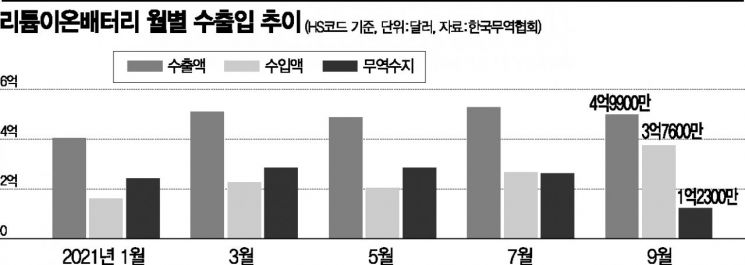
According to import-export statistics from the Korea International Trade Association on the 29th, the import value of lithium-ion batteries last month was $376 million, more than double compared to the same period last year ($159 million). This is the highest monthly import value on record, and in terms of import weight (12,455 tons), it ranks as the second highest following last month.
Battery imports were around $100 million per month until early last year, then increased to the mid-to-high $100 million range in the second half. In March this year, imports exceeded $200 million for the first time. Since then, imports have steadily increased, surpassing $350 million in August and exceeding $300 million for two consecutive months. If this trend continues, the domestic battery import volume is expected to more than double last year's annual import volume. China accounts for over 90% of the batteries imported.
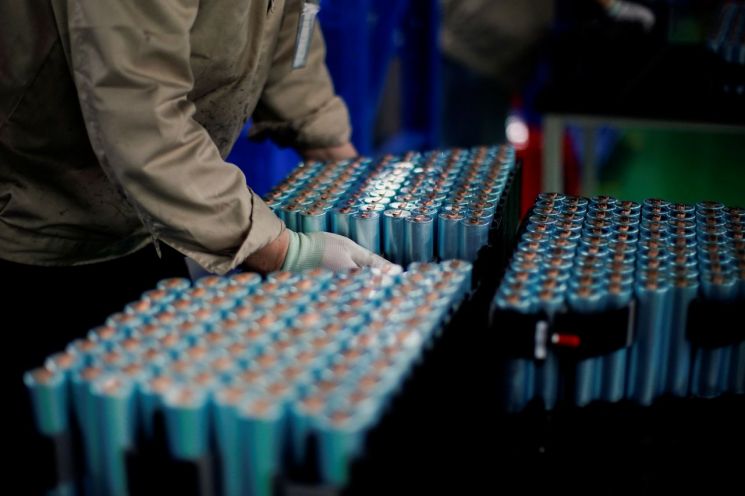
Lithium-ion batteries are widely used in home appliances, small IT devices, and electric vehicles. The recent increase in imports is attributed by the industry to the rise in sales of eco-friendly vehicles, including hybrids. As of last month, domestic sales of eco-friendly vehicles (hybrids and electric vehicles) have exceeded 200,000 units, surpassing last year's annual sales. Electric vehicle sales have roughly doubled compared to the same period last year. The new model effect of the Ioniq 5 (Hyundai) and EV6 (Kia), along with steady demand for commercial electric vehicles such as trucks and buses, contribute to this growth.
Hyundai and Kia have vehicle production bases worldwide, but except for some small and medium-sized models produced in India, China, and the Czech Republic, most vehicles are manufactured domestically and supplied globally. Hyundai and Kia use batteries from LG Energy Solution and SK On, while Korea GM uses LG batteries. SK On, a battery subsidiary of SK Innovation, manufactures batteries at its Seosan plant in Korea with an annual production capacity of 4.7 GWh, enough to supply approximately 65,000 units of the Ioniq 5.
Considering that battery plant operating rates are typically around 80%, the actual supply volume from domestic plants is estimated to be lower. Chinese company CATL was also selected as a battery supplier for Hyundai and Kia, but since the models are still under development and actual supply has not yet begun, it is estimated that a significant portion of the currently imported batteries are produced at SK's local joint venture factories operating in China. Recently, most of Hyundai and Kia's major electric vehicle models use SK batteries.
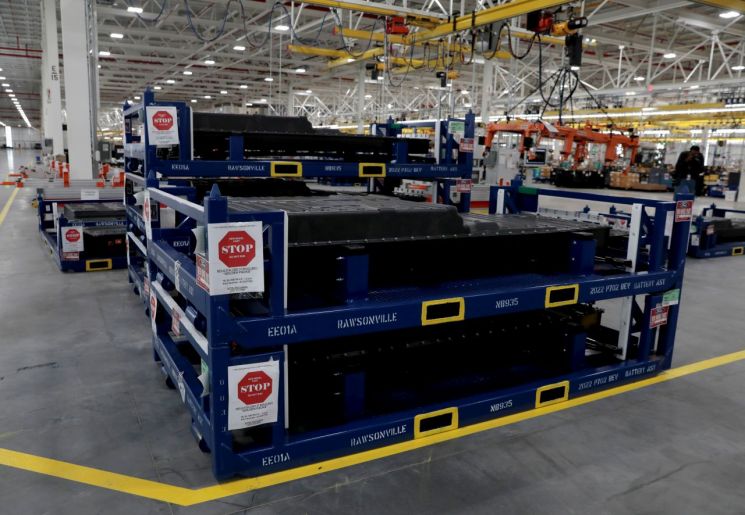 Batteries for the prototype of the electric pickup truck F-150 Lightning are stacked at the Rouge Electric Vehicle Center of Ford's Dearborn plant in Michigan, USA. Ford receives batteries from SK On.
 With domestic battery demand already tight, overseas exports, which had been progressing smoothly, have recently stagnated. Last month's battery export value was $499 million, a 0.9% decrease compared to the same period last year. This is the first time this year that monthly battery export values have recorded a year-on-year decline. Domestic battery companies had been increasing exports significantly to the U.S. market but have been on a downward trend since reaching a peak in June.
While exports have stagnated, imports have increased, shrinking the trade balance to about $123 million, roughly one-third of its peak. Although domestic battery companies such as LG, SK, and Samsung SDI are aggressively expanding production facilities in major markets like the U.S., Europe, and China, they have been relatively passive in expanding facilities domestically, raising concerns that battery supply shortages may occur in the future.
© The Asia Business Daily(www.asiae.co.kr). All rights reserved.



















