Investment According to Value Consumption Trends
Global Market Size Expected to Reach 42 Trillion by 2025
[Asia Economy Reporter Lim Chun-han] Large supermarkets are expanding their presence in the vegan (vegetarian) market. Although sales are still at a minimal level, the number of consumers seeking eco-friendly, healthy, and value-driven consumption is increasing, leading to significant expansion and investment in vegan specialty zones and products.
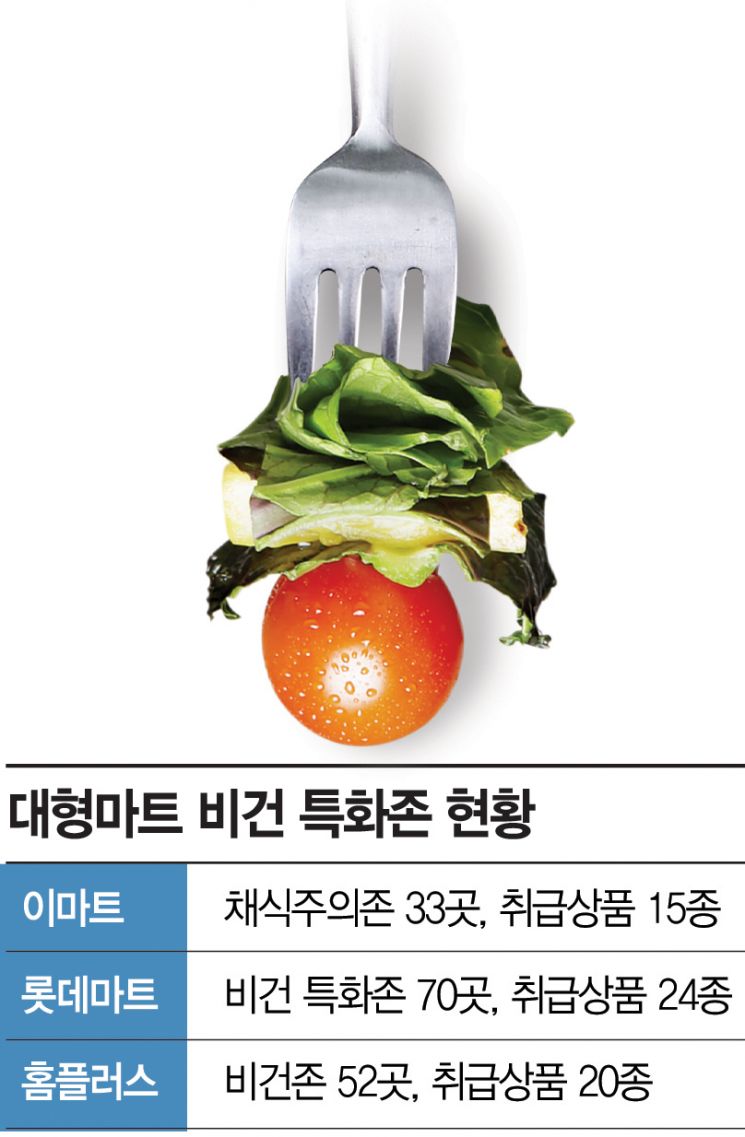
◆ Establishing Specialty Zones and Increasing Product Lines = According to Homeplus on the 29th, there are currently 52 stores operating 'Vegan Zones' where vegan products are gathered and displayed for sale. The number of vegan products handled in stores increased from 10 types last year to 20 types this year. Sales of the 10 products sold since last year increased by 53.2% compared to the same period last year from the 19th to the 25th. Homeplus has started selling 'Unlimit,' a plant-based meat brand from food tech startup Jiguin Company, at major stores nationwide, and Montblanc Bakery introduced a purely plant-based vegan bread made only with plant ingredients.
Lotte Mart operates 'Vegan Specialty Zones' in 70 frozen food sections. They sell 24 types of frozen vegan products and 6 types of snacks, with plans to increase the number of items in the future. They are also developing private brand (PB) vegan products. 'Habit Healthy Mayo,' made with functional soybeans instead of eggs using purely plant-based ingredients, received vegan certification from the Korea Vegan Certification Institute, the first in the distribution industry. Sales of this product increased by 80% in the first half of the year compared to the previous year. Following products include 'Cooking Cheongyang Soy Sauce Mayo,' and Lotte Mart plans to launch 'Habit Pure King Dumplings' in December.
Emart gathers and sells products made with 100% plant-based raw materials in its 'Vegetarian Zone.' The number of operating stores expanded from 28 last year to 33 this year. The product lineup includes 15 types such as plant-based meat, nuggets, dumplings, and fried rice.
◆ Value Consumption Trend and Investment in Future Food = The domestic vegan market is still in its early stages. According to the Korea Vegetarian Vegan Association, the domestic vegetarian population is estimated to be around 1.5 million as of last year. Although it has increased tenfold since 2008, it accounts for only about 3% of the total population. However, interest and demand for vegan products are rising, especially among the MZ generation (Millennials + Generation Z). According to a dietary trend survey by University Tomorrow 20s Research Institute, 27.4% of the MZ generation practice intermittent vegetarianism, and 9.0% maintain continuous vegetarianism.
The reason large supermarkets are actively entering the vegan market is investment in future food products. Although the current share of vegan products in total sales is small, they see high growth potential in the market. According to Univedacos Market Insight, the global plant-based food market is expected to grow from 28 trillion won in 2020 to over 42 trillion won by 2025. Coupled with the trend of valuing consumption, selling vegan products is also calculated to help improve corporate image. A large supermarket official said, "Interest in healthy food has increased after experiencing COVID-19," adding, "We plan to further expand various plant-based alternative product lines that align with value consumption considering the environment and health."
© The Asia Business Daily(www.asiae.co.kr). All rights reserved.
![Clutching a Stolen Dior Bag, Saying "I Hate Being Poor but Real"... The Grotesque Con of a "Human Knockoff" [Slate]](https://cwcontent.asiae.co.kr/asiaresize/183/2026021902243444107_1771435474.jpg)
















