Judge 5 (Dismissed) : 1 (End of Trial Procedure) : 3 (Accepted)
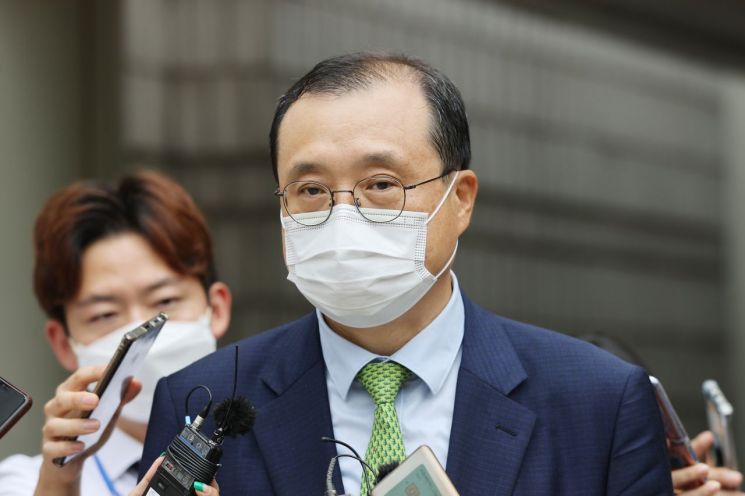
[Asia Economy Reporter Choi Seok-jin, Legal Affairs Specialist] The impeachment petition against former Busan High Court Chief Judge Lim Seong-geun, who is accused of involvement in three trials including the defamation case of former Sankei Shimbun Seoul Bureau Chief Kato Tatsuya, has been dismissed.
On the 28th at 2 p.m., the Constitutional Court held a ruling session on the impeachment petition against former Chief Judge Lim at the Grand Bench in Jaedong, Jongno-gu, Seoul, and decided to dismiss the petition with a vote of 5 (dismissal) to 3 (acceptance) to 1 (termination of proceedings).
The Constitutional Court judged that since former Chief Judge Lim had already retired from his judicial position due to the expiration of his term during the impeachment proceedings, it was impossible to issue a dismissal order, and thus the petition did not meet the legal requirements for impeachment proceedings.
The impeachment system is a procedure to remove from public office presidents, prime ministers, state council members, judges, etc., whose constitutional status is guaranteed, if they violate the Constitution or laws during their duties. Since former Chief Judge Lim had already retired due to term expiration, it was impossible to issue a dismissal order, and the respondent (Lim Seong-geun)'s argument that there was no benefit to the trial was accepted.
◆ Majority Opinion of Four Justices: "Benefit of Impeachment Proceedings Disappeared"… No Recognition of Benefit for Confirming Presence of Impeachment Grounds
Justices Lee Seon-ae, Lee Eun-ae, Lee Jong-seok, and Lee Young-jin, who voted for dismissal, stated, "While the Constitutional Court is granted the authority to issue dismissal orders in impeachment proceedings, this authority is exercised by pursuing legal responsibility according to the requirements and procedures prescribed by the Constitution and laws, and legal responsibility cannot be pursued beyond these predetermined requirements and procedures."
They also pointed out, "'No lawsuit without benefit' is a legal maxim indicating that if there is no benefit to the lawsuit, it should be dismissed. Article 40, Paragraph 1 of the Constitutional Court Act applies civil procedure laws mutatis mutandis to impeachment proceedings, so if there is no 'benefit of trial' in impeachment proceedings, the petition must be dismissed."
The justices emphasized, "Impeachment proceedings aim to secure the normative force of the Constitution by issuing a 'dismissal order' when the impeachment petition is justified. The impeachment procedure is a means to achieve this purpose. If dismissal is impossible and the purpose cannot be achieved, the benefit of impeachment proceedings disappears."
Referring to precedents involving former Presidents Roh Moo-hyun and Park Geun-hye, the justices noted, "In both cases, although it was judged that the presidents violated the Constitution or laws in their official duties, separate orders confirming the unconstitutionality or illegality of their official acts were not issued; only orders dismissing the petition or dismissal from office were pronounced."
They explained, "This is based on Article 65, Paragraph 4 of the Constitution, which states that 'impeachment decisions result only in dismissal from public office,' Article 53, Paragraph 1 of the Constitutional Court Act, which stipulates a single decision to dismiss the respondent from the relevant public office if the petition is justified, and Article 23, Paragraph 2, Item 1 of the Constitutional Court Act, which requires the consent of six or more justices for impeachment decisions."
They added, "This is no different from criminal proceedings, where judgments recognizing criminal facts are issued through sentencing orders without separately pronouncing orders confirming the illegality of the criminal facts. Thus, defining the subject and orders of impeachment proceedings as above aligns with Article 40 of the Constitutional Court Act, which prioritizes the application of civil procedure laws."
The four justices also stated, "The full text of Article 65, Paragraph 4 of the Constitution, which states 'impeachment decisions result only in dismissal from public office,' has been maintained since Article 47 of the 1948 Constitution. According to records from the first reading of the 1948 Constituent Assembly's draft Constitution, the constitutional authority recognized the essence of the impeachment system as deciding whether to remove certain high-ranking officials, including the president, from office, because it is difficult for them to undergo civil or criminal trials or disciplinary actions while holding office."
Finally, they concluded, "Considering the general theory of the benefit of impeachment proceedings as a legal requirement, the wording and intent of related provisions such as the Constitution and the Constitutional Court Act, and the constitutional authority's intention regarding judicial term systems and impeachment, it is confirmed that to recognize the benefit of impeachment proceedings, it is essential that the respondent holds the relevant public office at the time the dismissal order is issued."
They pointed out, "According to the records, the National Assembly passed the impeachment motion against the respondent on February 4 this year and filed the petition with the Constitutional Court the same day. The respondent retired from his judicial position on March 1 following the expiration of his term on February 28, so he no longer holds the relevant public office."
They concluded, "Since the respondent lost his judicial position due to term expiration, even if the substantive trial is completed in this case, it is clear that a dismissal order depriving him of public office is impossible. From the perspective of 'deprivation of public office,' which is a means to restore the damaged constitutional order as a constitutional safeguard function of impeachment proceedings, the benefit of impeachment proceedings cannot be recognized."
They also rejected the petitioners' claim that "even if the subjective benefit of the trial disappeared due to the former chief judge's retirement, the objective benefit of the trial for protecting constitutional order such as judicial independence is recognized," stating, "No benefit for confirming the presence or absence of impeachment grounds regardless of dismissal is recognized, so this part of the petitioner's claim is also groundless."
◆ Justice Lee Mi-seon: "Impeachment Proceedings Terminate Upon Loss of Public Official Status for Any Reason"… Order is 'Dismissal'
Justice Lee Mi-seon also voted for dismissal but gave different reasons.
She stated, "The Constitutional Court Act does not provide regulations on the continuation of impeachment proceedings if the respondent retires due to term expiration or other reasons during the proceedings, and the impeachment decision order only stipulates dismissal, without provisions allowing orders confirming unconstitutionality or illegality."
She added, "Considering the overall content of the Constitutional Court Act, if a public official subject to impeachment loses their official status for any reason during the impeachment proceedings, the proceedings should be terminated. In this case, it is appropriate to issue a 'dismissal' order as a formal judgment."
◆ Justices Yoo Nam-seok, Lee Seok-tae, Kim Ki-young: 'Acceptance' Opinion… "Confirmed Serious Violation of Article 103 of the Constitution"
On the other hand, Chief Justice Yoo Nam-seok and Justices Lee Seok-tae and Kim Ki-young dissented, stating that former Chief Judge Lim's actions constituted a serious violation of Article 103 of the Constitution, which guarantees judicial independence.
These justices first addressed the benefit of the trial, stating, "Impeachment proceedings have the character of a subjective lawsuit for forced removal from office and also strongly possess the character of an objective lawsuit aimed at restoring and protecting constitutional order. There is a significant need to ensure the effectiveness of the impeachment system by constitutionally controlling unconstitutional or illegal acts committed near the end of a high-ranking official's term. It is necessary to consider that clarifying how serious the respondent's acts are in violating the Constitution or laws is as crucial as deciding whether to dismiss from office from the perspective of protecting and maintaining constitutional order."
They continued, "This case is the first impeachment case of a judge arising from internal judicial issues concerning judicial independence. If the Constitutional Court clarifies the significance of judicial independence and the constitutional responsibility of judges within our constitutional order, it can preemptively warn and prevent future judicial independence violations by judges. Therefore, the necessity of constitutional clarification is recognized, and the benefit of the trial can be acknowledged."
They regarded former Chief Judge Lim's acts related to the impeachment grounds as "acts performed in the execution of duties," based on the fact that he served as the Senior Criminal Division Chief Judge at the Seoul Central District Court and was responsible not only for adjudicating cases assigned to him but also for managing the allocation of criminal cases, acting as a de facto middle approver for important case reports, overseeing the status management of case reception and disposition, and directing public relations work related to criminal division cases.
Although former Chief Judge Lim did not have personnel or evaluation authority over criminal division judges, they judged that he was in a position to influence the allocation of duties, evaluations, and personnel of judges because he drafted proposals on work distribution and judge evaluations under the court president's instructions.
They concluded, "The respondent's acts sufficiently undermine trust in judicial independence and fairness, thus violating Article 103 of the Constitution."
Regarding whether former Chief Judge Lim's acts constitute serious constitutional violations, they pointed out, "The respondent's interference in trials was carried out using the judicial administrative system in his capacity as Senior Criminal Division Chief Judge, posing a serious threat to judicial independence and fairness. Moreover, the repeated nature of these acts across multiple trials exceeds acceptable limits."
They emphasized that the fact that the demands made by former Chief Judge Lim to presiding or responsible judges matched the actual trial outcomes strengthens suspicions that he significantly influenced other judges' trials, undermining judicial independence and fairness.
They judged, "The respondent's use of the judicial administrative system to intervene in specific trial proceedings and verdict content severely damages public trust in judicial independence and fairness, causing serious dysfunction in judicial functions, thus constituting a grave violation."
However, they stated, "This impeachment petition is justified and the respondent should be dismissed from office. However, since the respondent retired on February 28 due to term expiration and cannot be dismissed from office, the court only confirms that the respondent's acts constitute serious constitutional violations."
Finally, they clarified, "This means that although the respondent's acts are serious constitutional violations, he no longer holds the position to be dismissed from, so dismissal is impossible. This is distinct from dismissing a petition when violations are minor constitutional or legal breaches."
◆ Justice Moon Hyung-bae: "Termination of Proceedings" Opinion… Proceedings Ended on March 1 Upon Loss of Judicial Status
Meanwhile, Justice Moon Hyung-bae expressed an opinion to terminate the proceedings.
Justice Moon stated, "Our Constitution stipulates term and reappointment systems for judges, but neither the Constitution nor laws regulate the relationship between these systems and the impeachment system for pursuing judges' legal responsibility. Therefore, once the respondent's retirement under the term and reappointment system takes effect, impeachment proceedings cannot continue by denying that effect."
He added, "Since the National Assembly's impeachment motion and the Constitutional Court's impeachment proceedings are independent procedures, even if the respondent was lawfully impeached while holding office, if he retires during the proceedings, this constitutes grounds to terminate the proceedings. Therefore, this impeachment proceeding ended on March 1 this year when the respondent lost his judicial status due to term expiration."
◆ First Judge Impeachment Case… Conclusion After About Eight Months Since Impeachment Motion
This decision came about eight months after the National Assembly decided on February 4 this year to impeach former Chief Judge Lim, marking the first impeachment of a judge in constitutional history.
According to the summary of the National Assembly's impeachment charges, former Chief Judge Lim, who served as Senior Criminal Division Chief Judge at the Seoul Central District Court during former Chief Justice Yang Sung-tae's tenure from 2015 to 2016, is accused of improperly intervening in three trials: ▲ the defamation case of former Sankei Shimbun Seoul Bureau Chief Kato Tatsuya related to reports on former President Park Geun-hye's whereabouts on the day of the Sewol ferry disaster, ▲ the arrest and injury charges against lawyers from the Lawyers for a Democratic Society (Minbyun) during the Ssangyong Motor protests, and ▲ the gambling charges involving professional baseball players Oh Seung-hwan and Lim Chang-yong.
In the Kato Tatsuya case, he requested the presiding judge of the trial panel to revise intermediate judgments or oral statements of verdicts. In the baseball players' case, he summoned the judge who referred a summary order case to a formal trial and advised consulting other judges, leading to a reversal of the decision. In the Minbyun lawyers' arrest and injury case, he caused modifications to already issued verdicts, infringing on constitutional judicial independence and violating the Court Organization Act and Criminal Procedure Act.
During the preparatory hearing on March 24 and three trial hearings between June and September, the petitioners and respondents engaged in intense disputes.
Procedurally, the impeachment petition case raised issues such as ▲ whether the National Assembly's impeachment motion procedure was proper, ▲ whether criminal trials or disciplinary actions for the same reasons violate the constitutional principle of ne bis in idem, and ▲ whether dismissal orders are possible for officials who have already retired.
Substantively, the disputes centered on ▲ whether former Chief Judge Lim's acts included in the charges were illegal or unconstitutional, and ▲ whether these acts constituted 'serious legal violations' warranting impeachment.
In earlier hearings, the petitioners (prosecutors) argued that former Chief Judge Lim, as Senior Criminal Division Chief Judge, exercised influence over judges at the Seoul Central District Court through 'orders' or 'coercion,' constituting unconstitutional acts infringing judicial independence. They also emphasized that retroactive dismissal orders before his term expiration were possible.
Conversely, the defense cited testimonies from junior judges submitted during criminal trials and court testimonies, arguing that the interactions were merely 'advice' or 'recommendations' from a senior judge with whom he had a friendly relationship, not violations of judicial independence, and that dismissal of a retired official is impossible.
Former Chief Judge Lim was acquitted of abuse of authority charges in both the first and second trials and is currently undergoing appeal proceedings.
With the dismissal of the impeachment petition, controversy is expected to resurface over Chief Justice Kim Myung-soo's conduct, who last year refused to accept former Chief Judge Lim's resignation amid impeachment efforts by the ruling party and issued false explanations earlier this year, causing embarrassment.
© The Asia Business Daily(www.asiae.co.kr). All rights reserved.

















