[Asia Economy Reporter Jeong Hyunjin] As the COVID-19 vaccination rate increases, the 'With Corona' phase is set to begin in earnest, but opinions on the economic outlook for next month diverged between the manufacturing and non-manufacturing sectors. While manufacturing showed a negative outlook due to increased production cost burdens, the non-manufacturing sector expected economic improvement with the transition to With Corona.
On the 29th, the Korea Economic Research Institute under the Federation of Korean Industries conducted a Business Survey Index (BSI) of the top 600 companies by sales from November 13 to 20. The comprehensive economic outlook for November recorded 100.6. With rising COVID-19 vaccination rates, expectations for economic normalization increased, surpassing the baseline of 100 for three consecutive months, but it fell by 2.8 points compared to last month (103.4). The comprehensive economic performance index for October was 98.3, showing a sluggish trend as it remained below the baseline for four consecutive months since July.
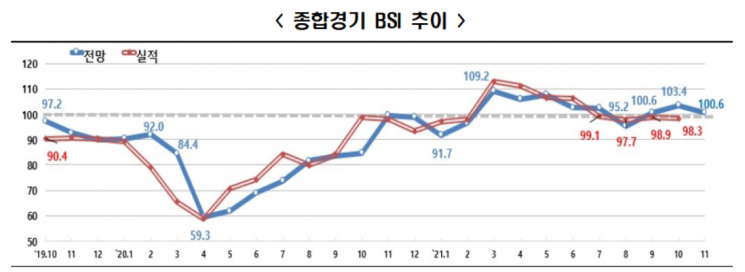
The comprehensive economic outlook for November showed mixed results by industry. The manufacturing outlook was 96.5, indicating a predominantly negative forecast, while the non-manufacturing outlook was 105.9, reflecting a positive industry economic outlook. Compared to October, both manufacturing and non-manufacturing economic outlooks decreased by 1 point and 4.5 points respectively, but the non-manufacturing outlook still exceeded the baseline of 100.
The Korea Economic Research Institute explained, "In the case of manufacturing, the outlook appears weak due to increased manufacturing cost burdens and concerns over reduced export volumes caused by the economic downturn in China, a major export market." Recently, the rise in the won-dollar exchange rate and the sharp increase in raw material and energy prices have significantly raised import prices for raw materials, and even electricity rates have increased, intensifying manufacturing cost burdens. In particular, China's industrial production activities have sharply contracted, and combined with energy supply difficulties, uncertainty in the Chinese economy is increasing.
The Korea Economic Research Institute attributed the optimistic outlook for the non-manufacturing sector in November to factors such as increased COVID-19 vaccination rates, the phased transition to With Corona starting from the 1st of next month, expectations for domestic demand revitalization due to the resumption of consumer coupon use, and anticipated expansion of household consumption due to the reduction of fuel tax. According to government announcements, fuel tax will be reduced by 20% for six months starting next month.
Looking at detailed industries, among manufacturing sectors, the most negative economic outlook for November was in wood, furniture, and paper (69.2), and petroleum refining and chemicals (83.9), industries highly dependent on overseas raw materials and energy. Conversely, among non-manufacturing sectors, the most positive economic outlook for November was in information and communication (123.5), and electricity, gas, and water supply (121.4).
By sector, economic outlooks were positive in domestic demand (105.9), which has high expectations for With Corona, as well as investment (102.8), employment (102.8), and financial conditions (102.3). However, negative outlooks prevailed in profitability (95.2), exports (99.7), and inventory (100.8) due to increased cost burdens and the economic downturn in China.
Choo Kwang-ho, Director of Economic Policy at the Korea Economic Research Institute, stated, "Manufacturing costs have sharply increased in a short period due to the surge in international raw material prices such as crude oil and the rise in electricity rates, worsening profitability and potentially disrupting production plans." He urged, "The government should minimize the impact of international raw material prices by preparing measures to stabilize raw material supply and production costs."
© The Asia Business Daily(www.asiae.co.kr). All rights reserved.

















